
 Worksheets
Torque AP Physics
Total questions: 16
Worksheet time: 52mins


The rotational equivalent to d (distance), v (velocity) and a (acceleration) are?
m, m/s, m/s2
θ, ω, α
x, x/t, α
μ, Σ, τ

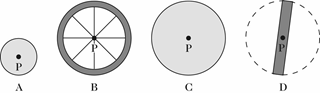
If the angular velocity of an object changes from 3 rad/s to 1 rad/s in 2 seconds, what is the object's angular acceleration?
–1.5 rad/s2
–1 rad/s2
1 rad/s2
1.5 rad/s2
If the translational velocity of an object is 3 m/s, and is located a distance of 2 m from the axis of rotation, what is the object's angular velocity?
0.67 rad/s
5 rad/s
1.5 rad/s
6 rad/s
An object completes 1.5 circular orbits in half a minute. What is its approximate angular velocity?
0.05 rad/s
0.5 rad/s
0.31 rad/s
3.1 rad/s
You exert a force on a friend who is holding a 4.0-m-long rope. Now suppose you exert the same force on your friend, but the friend is holding an 8.0-m-long rope. How will this affect the rotational acceleration?
It will be quartered
It will be halfed
It will double
It will quadruple
A group of students must conduct an experiment to determine how the location of an applied force on a classroom door affects the rotational motion of the door. The rotational inertia of the door about its hinges is known. The initial angular velocity of the door is zero.
Which of the following lists what measuring devices the students need and the measurements they should take to collect the necessary data to test the relationship between a torque exerted on the door and the change in angular velocity of that object about the hinges of the door? Justify your selection.
A protractor to measure the angular displacement of the door and a meterstick to measure the radial distance from the door's hinges to the location where the force is applied.
A stopwatch to measure the time interval during which the force is applied and a meterstick to measure the radial distance from the door's hinges to the location where the force is applied.
A force probe to measure the applied force on the door, and a stopwatch to measure the time interval during which the force is applied, and a meterstick to measure the radial distance from the door's hinges to the location where the force is applied.
A stopwatch to measure the time interval during which the force is applied, a force probe to measure the applied force on the door, a protractor to measure the angular displacement of the door, and a meterstick to measure the radial distance from the door's hinges to the location where the force is applied.

A point on a disk rotates around the center axle of the disk. The table shows the angular speed of the point as a function of time. Which of the following graphs could represent the angular position of the point as a function of time?


During an experiment, students collect data about the angular momentum of a rigid, uniform spinning wheel about an axle as a function of time, which was used to create the graph that is shown. A frictional torque is exerted on the wheel. A student makes the following statement about the data.
“The frictional torque exerted on the wheel is independent of the wheel’s angular speed.”
Does the data from the graph support the student’s statement? Justify your selection.
Yes, because the slope of the line is constant.
Yes, because the angular momentum of the wheel decreases as time increases.
No, because the area bound by the curve and the horizontal axis from 0 s to 10 s is a positive value.
No, because the data does not provide information about the relationship between net torque and angular speed.

A rod is at rest on a horizontal surface. One end of the rod is connected to a pivot that allows the rod to rotate around the pivot after a net external force is exerted on the rod. A lump of clay is launched horizontally toward the free end of the rod, as shown in Figure 1. The lump of clay collides with and sticks to the rod, and the clay-rod system rotates, as shown in Figure 2. Which of the following linear collisions is analogous to the rotational collision that is described?
A block traveling in the positive direction collides with a second block that travels in the negative direction. After the collision, the two blocks move together with a common final speed.
A block traveling in the positive direction collides with a second block that is at rest. After the collision, the two blocks move together with a common final speed.
A block traveling in the positive direction collides with a second block that travels in the negative direction. After the collision, the blocks reverse their directions and travel with their original speeds.
A block traveling in the positive direction collides with a second block that is at rest. After the collision, the two blocks move at different speeds in the same direction.

