
 Worksheets
Light Optics
Total questions: 27
Worksheet time: 19mins
Name
Class
Date
1.
Light is considered to be
a)
electromagnetic waves
b)
particles
c)
transverse waves
d)
all of the above
2.
Speed of light in a vacuum is
a)
represented by the symbol "c"
b)
3.00 X10⁸ m/s
c)
both answers are correct
3.
correct order of colors on a prisim
(top to bottom)
(top to bottom)
a)
ROYGBIV
b)
VIBGYOR
c)
YGBIVOR
d)
ajhfkjwa
4.
When a wave bends as it passes through at an angle from one medium to another.(example: pencil in a glass of water-)
a)
medium
b)
refraction
c)
reflection
d)
interference
5.
A wave carries...?
a)
energy only
b)
matter only
c)
the matter carries the energy
d)
neither
6.

According to the Law of reflection, a light ray striking a mirror
a)
continues moving through the mirror in the same direction
b)
moves into the mirror at a slightly different angle
c)
bounces off the mirror toward the direction it came from
d)
bounces off the mirror at the same angle it hits.
7.

The point where the rays meet is known as....
a)
Fire
b)
the focal point
c)
refraction
d)
Plane of the lens
8.
Which lens represents the path light takes through a diverging lens?
a)
b)
c)
d)
9.
Which figure represents the path light takes through a converging lens?
a)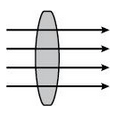
b)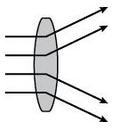
c)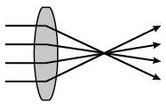
d)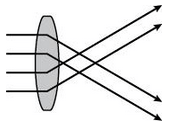
10.

The pencil in the glass of water appears bent due to ....
a)
reflection
b)
refraction
c)
mirrors
d)
focal point
11.

_____ is a lens that is thicker in the middle and converges light rays creating a real image.
a)
A prism
b)
A convex lens
c)
A concave lens
d)
A mirror
12.

______ is a lens that is thicker on its edges, diverges light and makes ______________ images
a)
A plane lens / virtual
b)
A convex lens / real
c)
A concave lens / virtual
d)
A prism / real
13.
Diamonds, as well as Fiber Optic cables, are able to redirect light through themselves and out at a specific point. This is possible due to...
a)
Diffusion
b)
Total Internal Reflection
c)
Total Internal Refraction
d)
Dispersion
14.
_________ can separate light into its component wavelengths.
a)
A prism
b)
A mirror
c)
A star
d)
A black hole
15.
An image that is inverted and can be projected onto a screen is called...
a)
a real image
b)
a virtual image
c)
an imaginary image
d)
a mirage
16.
What is the ray of light that strikes the surface.
a)
Incident ray
b)
reflected ray
c)
normal ray
d)
normal
17.
....................... - the imaginary line perpendicular to the surface.
a)
Normal
b)
Angle of incidence
c)
Angle of reflection
18.
What does the word "converging" mean?
a)
to separate
b)
to come together
c)
parallel
d)
perpendicular
19.
A converging lens is also known as a ____ lens.
a)
convex
b)
concave
c)
double
d)
refracted
20.
Two light rays from a common point are refracted by a lens. A real image is formed when these two refracted rays do which of the following?
a)
Diverge and appear to come from a single point
b)
Converge to a single point
c)
Travel in parallel paths
d)
Totally reflect inside the lens
21.
What does the word "diverging" mean?
a)
to spread apart
b)
to come together
c)
parallel
d)
perpendicular
22.
Images produced by a diverging lens are always _____.
a)
real, reduced, and inverted
b)
virtual, reduced, and upright
c)
real, enlarged, and inverted
d)
virtual, enlarged, and upright
23.
What is the angle of refraction?
a)
The angle which light bounces of an object?
b)
The angle which light changes direction
c)
The angle of which light enters an object
24.

This image is...
a)
Inverted and smaller
b)
inverted and bigger
c)
not inverted and smaller
d)
not inverted and bigger
25.
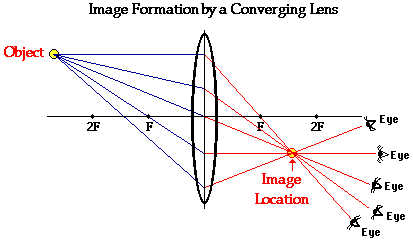
This image is.....
a)
inverted and smaller
b)
inverted and larger
c)
not inverted and smaller
d)
not inverted and larger
26.
What type of image is formed when rays of light actually intersect?
a)
real
b)
virtual
c)
projected
d)
curved
27.

This image is...
a)
Inverted and smaller
b)
Inverted and larger
c)
not inverted and smaller
d)
not inverted and larger
100 %

