wayground logo

Free Printable Worksheets

NEW

Font size

S
M
L
XL
Worksheets

Law of Reflection and Spherical Mirror

Total questions: 26

Worksheet time: 16mins

Name
Class
Date
1.
Section B1a
Given that the angle of incidence = 30 degrees
a. Draw a ray diagram, labelling clearly the normal, incident ray, angle of incidence, reflected ray and angle of reflection accurately.
Which is the correct diagam? 
a)
A
b)
B
c)
C
d)
D
2.

According to the laws of reflection, if i = angle of incidence and r = angle of reflection,

a)

A. i = r

b)

B. i > r

c)

C. r > i

d)

D. i is not equal to r

3.

In the diagram, which letter represents the angle of incidence?

a)

A

b)

B

c)

C

d)

D

4.
........... – the angle between the normal and the incident ray.
a)
Angle of incidence
b)
Angle of reflection
c)
Angle of coincidence
d)
Angle of direction
5.
The imaginary line perpendicular to a reflecting surface is called _____.
a)
crooked line
b)
parallel line
c)
angular line
d)
normal line
6.
straight lines that represent light waves 
a)
Rays
b)
image
c)
lines
d)
visible light
7.
What is the line MN called in the given diagram
                               
a)
incident ray
b)
reflected ray
c)
reflecting surface
d)
normal
8.
If the angle of incidence is 45 degree, what is the angle between the incident ray and reflecting surface
a)
45
b)
90
c)
180
d)
none of the above
9.
a copy of an object formed by reflected or refracted rays of light
a)
image
b)
reflection
c)
regular reflection
d)
diffuse reflection
10.
What is A?
a)
Angle of incidence
b)
Angle of reflection
c)
Incident ray
d)
Reflected ray
11.
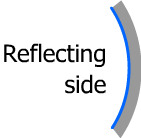
The following is a picture of what type of mirror? 
a)
Convex Mirror
b)
Concave Mirror
c)
Plane Mirror
d)
Flat Mirror
12.
The following is a picture of what type of mirror? 
a)
Convex Mirror
b)
Concave Mirror
c)
Plane Mirror
d)
Flat Mirror
13.
An image that you can see , but does not really exist is called which of the following?
a)
Real Image
b)
Fake Image
c)
Virtual Image
d)
Digital Image
14.
The fact the two angles are the same is an example of....
a)
Refraction
b)
Angle of Incidence
c)
Law of reflection
d)
Magnification
15.
This is an example of a __________ mirror.
a)
Concave
b)
Convex
c)
Plane
d)
Magnifying
16.
This is an example of a _____________ mirror
a)
Concave
b)
Convex
c)
Plane
d)
Magnifying
17.

The image of an object, which is placed one foot in front of a plane mirror, will be ___.

a)

behind the mirror and reversed, left to right.

b)

behind the mirror.

c)

in front of the mirror and reversed, left to right.

d)

in front of the mirror.

18.

What word means to bend light rays toward each other?

a)

Converging light

b)

Diverging light

c)

Virtual Light

d)

Real Light

19.

What word means to bend light rays away from each other?

a)

Converging light

b)

Diverging light

c)

Virtual Light

d)

Real Light

20.

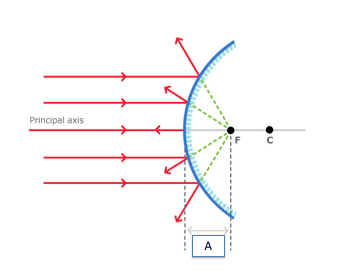
In the image, all the rays meet at F, What is F

a)

focal length

b)

focal point

c)

center of curvature

d)

reflection

21.
What is B?
a)
Angle of incidence
b)
Angle of reflection
c)
Incident ray
d)
Reflected ray
22.
What is C?
a)
Angle of incidence
b)
Angle of reflection
c)
Incident ray
d)
Reflected ray
23.
What is E?
a)
Angle of incidence
b)
Angle of reflection
c)
Normal
d)
Reflect ray
24.
What does the word "converging" mean?
a)
to separate
b)
to come together
c)
parallel 
d)
perpendicular
25.
According to the Law of reflection, a light ray striking a mirror
a)
continues moving through the mirror in the same direction
b)
moves into the mirror at a slightly different angle
c)
bounces off the mirror toward the direction it came from
d)
bounces off the mirror at the same angle it hits.
26.

What is the line MN called in the given diagram

a)

incident ray

b)

reflected ray

c)

reflecting surface

d)

normal