wayground logo

Free Printable Worksheets

NEW

Font size

S
M
L
XL
Worksheets

Heat Temperature and Heat Transfer

Total questions: 40

Worksheet time: 59mins

Name
Class
Date
1.
True or false: Heat moves from the cooler object to a warmer object
a)
True
b)
False
2.
If two objects have different temperatures, heat will flow from the warmer object to the cooler one UNTIL ____________
a)
one reaches a temperature of zero
b)
they both have an equal temperature
c)
one runs out of energy
3.

Heat is transferred by conduction, ____________, and radiation.

a)

convection

b)

waves

c)

thermal energy

d)

radiant energy

4.

The transfer of energy by electromagnetic waves is called

a)

conduction

b)

convection

c)

radiation

5.
A material that conducts heat well is called a(n)
a)
conductor 
b)
insulator 
6.

A material that does not conduct heat well is called a(n)

a)

conductor

b)

insulator

7.
Which of the following is the sun's rays reaching the earth?
a)
radiation
b)
convection
c)
conduction
d)
insulator
8.
Conduction transfers heat by atoms colliding and transferring energy.
a)
True
b)
False
9.

Convection currents can happen in solids, liquids and gases.

a)

True

b)

False

10.
Heat transfer continues until both objects are at equal temperatures. 
a)
True
b)
False
11.

Most metals are good conductors.

a)

True

b)

False

12.
How is the teapot being heated? 
a)
condensation
b)
conduction
c)
convection
d)
radiation
13.
How is the cat being heated?
a)
condensation
b)
conduction
c)
convection
d)
radiation
14.

When you pick up an ice cube, thermal energy flows from your hand to the ice cube.

a)

True

b)

False

15.
What is the definition of CONDUCTION?
a)
When heat is transferred from objects like rays of light or electromagnetically.
b)
a  hot liquid or air that  expands, becomes less dense, and rises or becomes more dense, and sinks.
c)
When heat transfers from objects that are touching.
d)
When heat transfers through the heater or AC in your house.
16.
The way the heat is moving from the hot coffee is called...
a)
convection
b)
radiation
c)
insulation
d)
conduction
17.
Heat is _________________.
a)
how hot or cold something is.
b)
the sum of all the kinetic and potential energy of the particles in an object.  
c)
the flow of energy from a warmer object to a cooler object.
d)
A measure of the average kinetic energy of all the particles in an object.
18.
The SI unit for temperature is _____.
a)
Farenheight
b)
Celsius
c)
Kelvin
d)
Degree
19.

A material that flows is a _______.

a)

Solid

b)

Liquid

c)

Gas

d)

Fluid

20.
What is thermal equilibrium?
a)
When two objects are at rest at the same time.
b)
When two or more objects reach a common temperature.
c)
When two objects have the same specific heat.
21.
This is a lava lamp. When the light bulb heats the wax, the wax rises. When the wax cools, it falls. This cycle of rising/falling is an example of:
a)
Conduction.
b)
Convection.
c)
Radiation.
22.
Firewalkers who walk barefoot on red-hot wooden coals depend on...
a)
mind over matter
b)
wood's poor conductivity
c)
pure chance
d)
magic
23.
Temperature is the same thing as heat.
a)
TRUE
b)
FALSE
24.
A piece of metal will feel colder than a piece of wood at the same temperature. Why?
a)
Metal atoms are moving more slowly, on the average, than wood atoms.
b)
Metals, in general, are good heat conductors.
c)
Metals are colder than wood.
d)
Wood, in general, is a poor insulator.
25.
You are feeling sick, so you place a thermometer under your tongue to check your temperature. The directions on the box tell you to leave the thermometer there for three minutes before you read your temperature. Why should you wait?
a)
It takes some time for the thermometer to reach its activation energy.
b)
It takes some time for the thermometer and your body to reach thermal equilibrium.
c)
It takes some time for the thermometer to raise your body’s internal energy.
d)
It takes some time for the thermometer and your body to attain a state of contact.
26.

Winds and weather patterns are good examples of convection currents.

a)

True

b)

False

27.
_________________________ is a measure of the average kinetic energy of the particles in a material.
a)
thermal
b)
friction
c)
temperature
d)
expansion
28.
The most common temperature scale used in the United States - where water freezes at 32 degrees and boils at 212 degrees is called the __________________________ scale.
a)
Celsius
b)
Pound
c)
Kelvin
d)
Fahrenheit
29.
The most common temperature scale used in the world where water freezes at 0 degrees and boils at 100 degrees is called the __________________ scale.
a)
Celsius
b)
Fahrenheit
c)
Pound
d)
Kelvin
30.
The most common temperature scale used in the physical sciences where temperatures are 273 degrees more than temperatures on the Celsius scale is called the _______________ scale.
a)
Fahrenheit
b)
Kelvin
c)
Pound
d)
Celsius
31.
A jacket is a good example of an . . .
a)
Insulator
b)
Investigator
c)
Insider
d)
Interrogator
32.

The faster molecules move,

a)

the higher the temperature

b)

the less temperature

c)

the same temperature

33.

Heat is defined as

a)

the transfer of thermal energy from one object to another due to temperature difference

b)

the temperature of a solid, liquid, or gas

c)

The kinetic energy of a solid, liquid, or gas.
34.

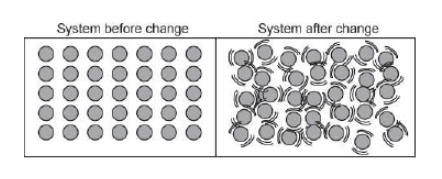
The picture below shows a closed system before and after undergoing a change.


What was changed in the system?

a)

Particles were added to the system.

b)

Water was added to the system.

c)

Heat was added to the system.

d)

Air was added to the system.

35.

Jeriah places two metal cubes in contact with each other. Energy transfers as heat flows from Cube A to Cube B. What conclusion can you draw regarding Cube B?

a)

It is larger than Cube A.

b)

It is cooler than Cube A.

c)

It is smaller than Cube A.

d)

It is warmer than Cube A.

36.
As water in a freezer turns into ice,
a)
the water absorbs energy from the air in the freezer.
b)
the water absorbs the coldness from the air in the freezer.
c)
the freezer air absorbs heat from the water.
d)
the water neither absorbs nor releases energy
37.
An aluminum plate and a plastic plate have been in the freezer all night long. When you remove them the next morning,
a)
The plates are the same temperature.
b)
The plastic plate has a higher temperature.
c)
The plastic plate has a lower temperature.
d)
The aluminum plate has a lower temperature.
38.
What is the only method of heat transfer that DOESN’T require matter?
a)
Conduction
b)
Convection
c)
Radiation
39.
What method of heat transfer uses direct contact? 
a)
Conduction
b)
Convection
c)
Radiation
40.
What method of heat transfer uses fluids?
a)
Radiation
b)
Conduction
c)
Convection