wayground logo

Free Printable Worksheets

NEW

Font size

S
M
L
XL
Worksheets

Heating Curve Mathematics

Total questions: 28

Worksheet time: 28mins

Name
Class
Date
1.
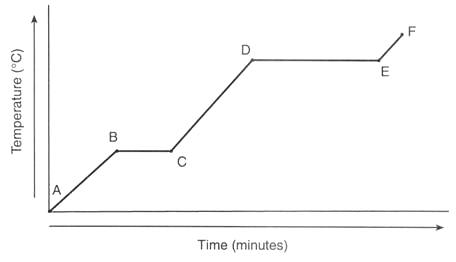
What line segment represents only the solid state?
a)
A-B
b)
B-C
c)
C-D
d)
D-E
2.
Which segment represents the heat of fusion?
a)
A-B
b)
B-C
c)
C-D
d)
D-E
3.
In which segment is the kinetic energy remaining constant?
a)
A-B
b)
B-C
c)
C-D
d)
E-F
4.
Which process takes the longest to occur?
a)
melting
b)
boiling
c)
freezing
d)
heating the solid
5.
What state(s) of matter are present at D-E?
a)
Solid-liquid
b)
Liquid
c)
Liquid-gas
d)
Gas-Solid
6.
Between which points is the temperature of the substance remaining constant?
a)
A-B only. 
b)
A-B, C-D, E-F
c)
B-C only. 
d)
B-C, D-E
7.

Between which points is the kinetic energy of the substance increasing?

a)

A-B only.

b)

A-B, C-D, E-F

c)

B-C only.

d)

B-C, D-E

8.
Between which points is the substance changing state?
a)
A-B only. 
b)
A-B, C-D, E-F
c)
B-C only. 
d)
B-C, D-E
9.

Between which two points is Heat of Vaporization?

a)

A <----> B

b)

B <----> C

c)

C <----> D

d)

D <----> E

e)

E <----> F

10.

Which equation do you use to solve for the energy of segment D-E?

a)

q= mCΔT

b)

q= Hv*m

c)

PV=nRT

d)

q= Hf*m

11.

Which equation do you use to solve for segment B-C?

a)

q=mCΔT

b)

q= Hv*m

c)

q= Hf*m

d)

PV=nRT

12.

The energy of which segments can be found using the equation q=mCΔT?

a)

A-B, D-E, E-F

b)

B-C, D-E ,E-F

c)

B-C, C-D, E-F

d)

A-B, C-D, E-F

13.

Which equation do you use to solve for the energy of segment C-D?

a)

q=mCΔT

b)

q= Hv*m

c)

q= Hf*m

d)

PV=nRT

14.

Which equation would you use to solve the following: Calculate the heat necessary to change 10 g of ice(s) at 0°C to 10 g of water(l) at 0°C.

a)

q=mCΔT

b)

q= Hv*m

c)

q= Hf*m

d)

PV=nRT

15.

Which equation would you use to solve the following: Calculate the heat necessary to change 10 g of H2O(l) at 0 °C to 10 g of H2O(l) at 100°C.

a)

q=mCΔT

b)

q=Hv*m

c)

q= Hf*m

d)

PV=nRT

16.

What equation would you use to solve the following:

How much heat is absorbed by 20g granite boulder as energy from the sun causes its temperature to change from 10°C to 29°C?

a)

q=mCΔT

b)

q=Hv*m

c)

q= Hf*m

d)

PV=nRT

17.

What equation would you use to solve the following:

Calculate the heat necessary to change 10 g of H2O(l) at 100°C to 10 g of H2O(g) at 100°C.

a)

q=mCΔT

b)

q=Hv*m

c)

q=Hf*m

d)

PV=nRT

18.

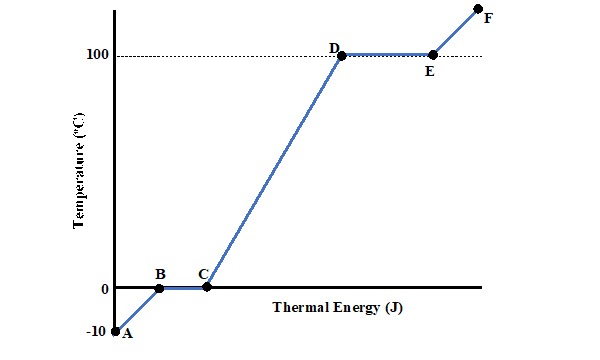
The melting point of the sample is

a)

-60 ºC

b)

-100 ºC

c)

60 ºC

d)

100 ºC

19.

The heating curve for a sample of pure ethanol is provided

above. The temperature was recorded as a 50.0 g sample of

solid ethanol was heated at a constant rate. What is the boiling point of ethanol?

a)

50K

b)

150K

c)

350K

d)

550K

20.
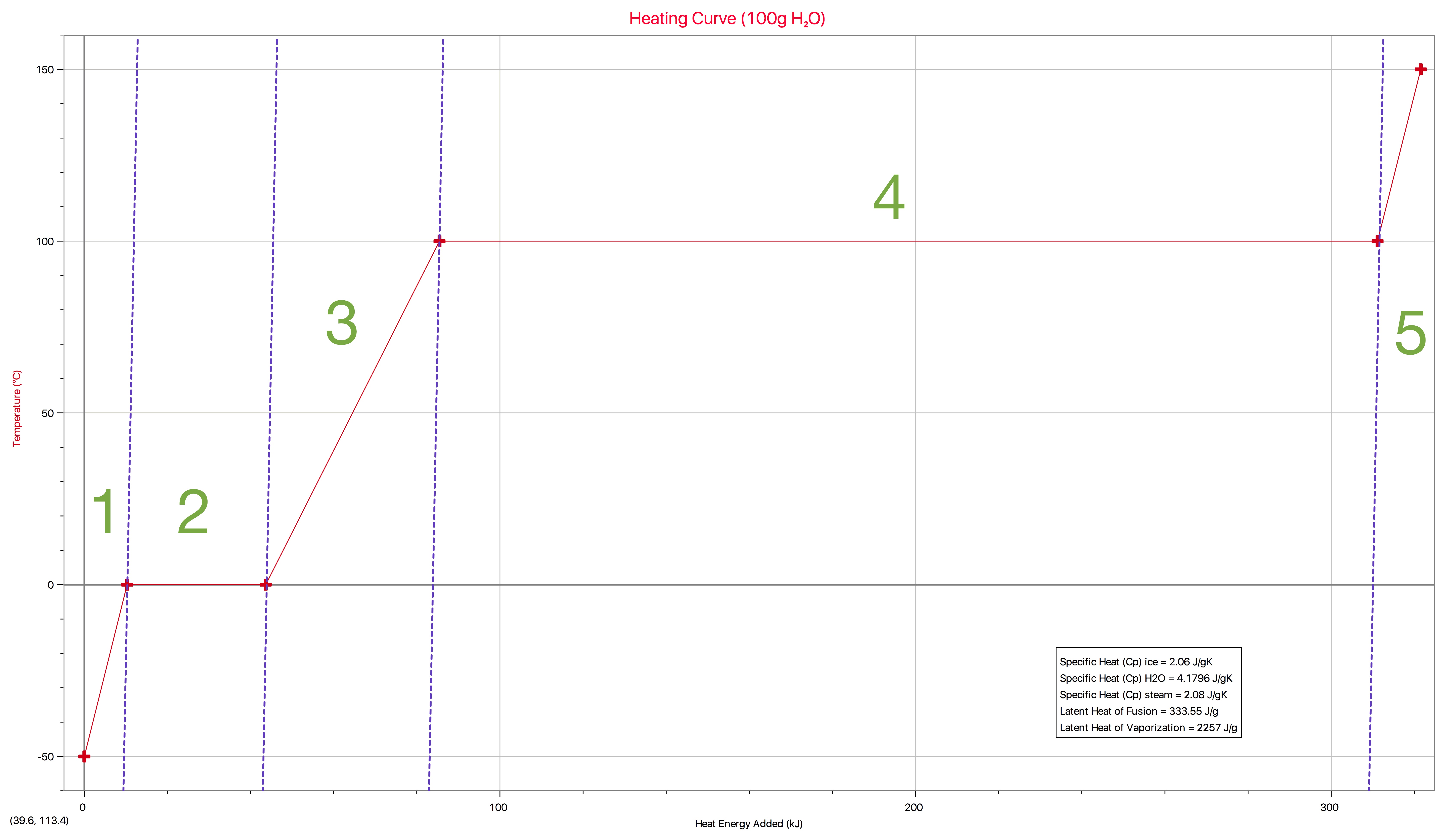
In which region of the graph would use the specific heat of the liquid (cp liquid) to calculate heat energy?
a)
Region 1
b)
Region 2
c)
Region 3
d)
Region 4
21.
In which region of the graph would use the specific heat of the gas (cp gas) to calculate heat energy?
a)
Region 2
b)
Region 3
c)
Region 4
d)
Region 5
22.
In which region of the graph would use the specific heat of the solid (cp solid) to calculate heat energy?
a)
Region 1
b)
Region 2
c)
Region 3
d)
Region 4
23.
In which region of the graph would be used to find the boiling point of the substance?
a)
Region 2
b)
Region 3
c)
Region 4
d)
Region 5
24.
In which region of the graph would be used to find the melting of the substance?
a)
Region 2
b)
Region 3
c)
Region 4
d)
Region 5
25.
True or false: melting and freezing occur at the same temperature!
a)
True
b)
False
c)
I don't know
26.
What happens to the energy of particles in a substance as it changes from gas, to liquid, to solid?
a)
KE decreases
b)
KE increases
c)
KE stays the same
d)
KE goes up and then goes down
27.

In which region of the graph would only potential energy change?

a)

Regions 1, 3, 5

b)

Regions 3 and 5

c)

Regions 2 and 4

d)

Region 5 only

28.

Why are the slopes of the diagonal lines all different?

a)

they have different densities

b)

they have different specific heats

c)

they have different heats of fusion and vaporization

d)

the reaction rates are different