
 Worksheets
Science
Total questions: 35
Worksheet time: 26mins
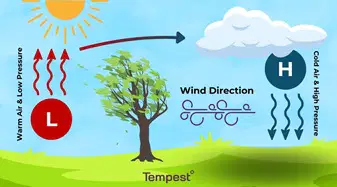
Winds generally move from areas of _____________ to areas of _______________.
low to high altitude
the north to the south
cold to hot tempartures
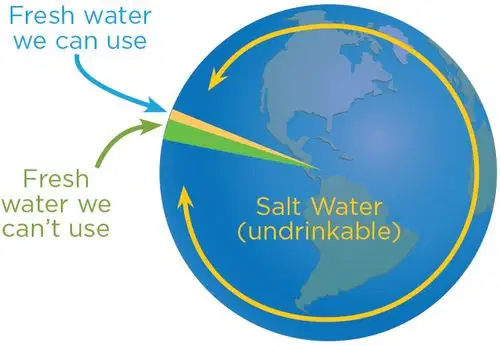
Water on Earth is either freshwater or saltwater. What is the percent ratio of freshwater to percent saltwater on Earth?
1% freshwater : 99% saltwater
3% freshwater : 97% saltwater
30% freshwater : 70% saltwater
50% freshwater : 50% saltwater
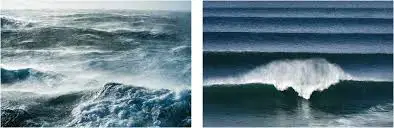
Large waves, called __________, are different from surface waves and are usually caused by underwater earthquakes, volcanic eruptions, or landslides.
swells
breakers
capillary waves
A warm front is progressing northward ahead of the storm center while a cold front is sweeping southeastward. The cool air mass north of the warm front is already in place. As the storm intensifies, the cold front rotates around the storm and catches the warm front. Identify the weather map that shows these conditions.


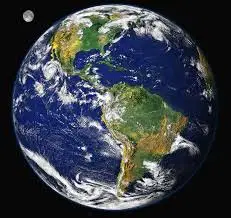
Earth seems to be the only planet in our solar system that can support life. Which of these is NOT a reason why life is found only on Earth?
a moderate climate.
the presence of water on Earth.
it is the perfect distance from the sun.
it only has slight surface elevation differences.
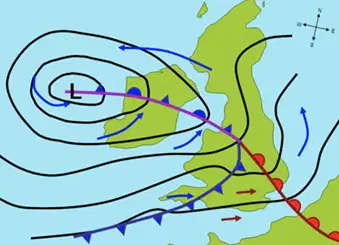
The weather map for a certain region. It shows a cold air mass rapidly overtaking a warm air mass. The result is an occluded front. These conditions could cause a severe weather event called a
flood
earthquake
tornado
Energy from the sun is transferred to the earth by
conduction.
conservation.
convection.
radiation.
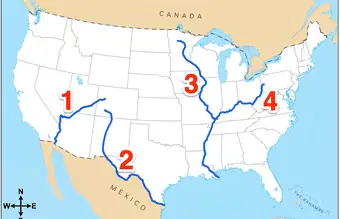
The numbers 1-4 represent large bodies of water in the United States. All of these are freshwater and are flowing, which means they are moving and do not stay still. They empty into a larger body of water, such as an ocean. What are these bodies of water called?
glaciers
lakes
rivers
seas
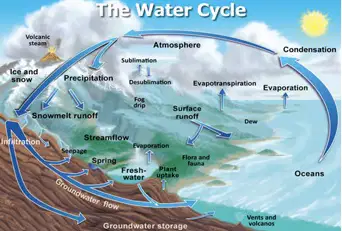
The image is a model showing the processes of the water cycle. Water uptake to the atmosphere occurs through the processes of evaporation and transpiration from plants where it condenses to form clouds. Clouds release the water through precipitation. During an extreme rainy season, what can we expect to happen to the surface ground water stored in ponds and lakes?
animals drink more water, so water levels decrease
water levels will increase because there is more precipitation
water levels will increase because there is more evaporation and transpiration
water levels will decrease because there is more evaporation and transpiration
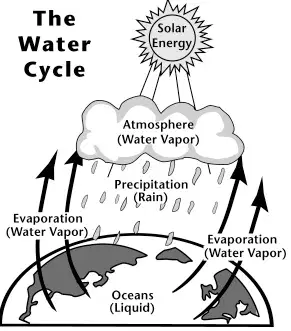
Describe the role of temperature change in cloud formation.
As water on Earth cools down, it condenses in the air and forms clouds.
As water on Earth cools down, it evaporates into the atmosphere and forms clouds.
Water on Earth heats up and evaporates into the atmosphere, then cools and condenses to form clouds.
Water on Earth heats up and evaporates into the atmosphere. Water vapor continues to heat up to form clouds.
Lori's class is completing an investigation about heat from the Sun. They placed a cup of water in a sunny spot in the grass outside of their classroom for one hour. They measured the temperature every 15 minutes and noticed that each time the water became hotter.
Where could the students place the cup to cool the water?
on the sidewalk
on a sandy beach
in the parking lot
under a large tree
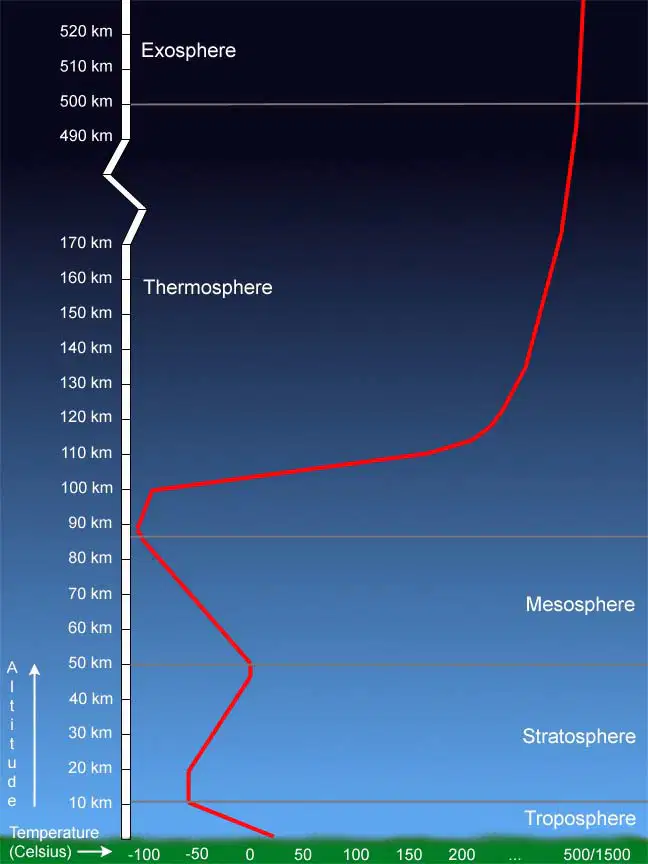
This is the coldest layer of Earth's atmosphere, with the temperatures at the top of this layer as low as -90° C (-130° F). This is the _______________.
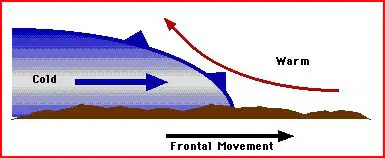
Fronts are transition zones between cool and warm air masses. The leading edge of a wedge of cold air represents the frontal zone. The front is called a cold front if the wedge is moving into an area of warmer air. If the wedge is retreating, the front is called a warm front with warmer air moving into an area previously occupied by cool air. Which weather condition is NOT associated with cold fronts?
sudden drop of temperature as front passes
strong thunderstorms along and ahead of the front
winds south-southwest before passing and west-northwest after passing
pressure rising steadily before passing and falling steadily after passing
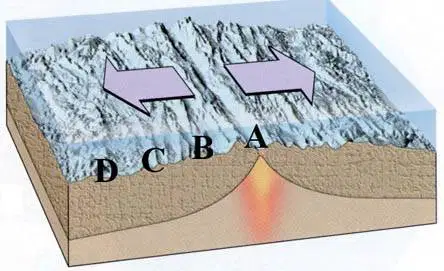
Technological advances had helped reveal that the ocean floor was not flat, as once believed, but instead was marked by 50,000-kilometer-long, 3,000-meter-high ridges and 11-kilometer-deep trenches. How do scientists explain why, if new crust is constantly being formed from volcanic materials at the ridges, Earth's crust stays the same size?
Seafloor spreading is the cause of new crust being added. Old crust crumbles and forms mountains throughout the Earth's surface. Mountains keep growing.
Scientists hypothesize that new crust is the result of volcanic activity throughout the Earth's surface and older magma is destroyed as it subducts during earthquakes into Earth's mantle.
Scientists found that the youngest oceanic crust is located nearest the mid-ocean ridge and divergent boundary and the oldest crust is at subduction zones where it sinks back into the Earth.
Scientists found that the oldest oceanic crust is located nearest the mid-ocean ridge and forms from volcanic activity; the youngest crust is nearest the trenches and it comes from magma flowing up to Earth's surface.
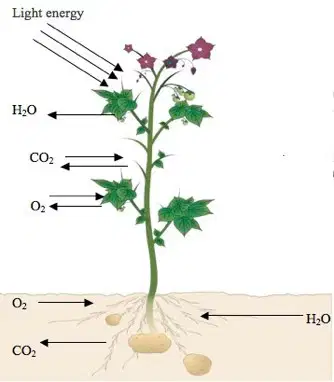
Like animals, plants undergo cellular respiration to produce energy. Plants use carbon dioxide and release oxygen and water. Water returns to the atmosphere and becomes part of the water cycle through the process of
condensation.
perspiration.
precipitation.
transpiration.
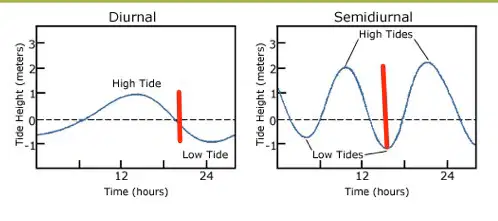
Consider the two tide cycles seen here. We have drawn a red line from the crest of high tide to the trough of low tide. What does this red line represent?
a lunar day
flood and ebb
the tidal range
the tidal current
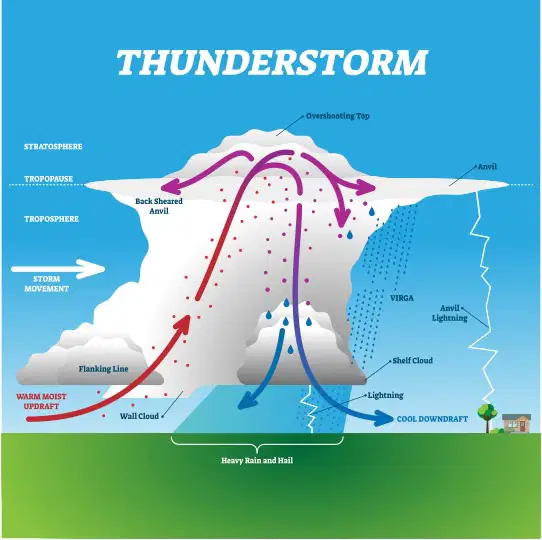
The action of warm air rising and cold air sinking plays a key role in the formation of severe thunderstorms. If thewarm surface air is forced to rise, it will continue to rise, because it is less dense than the surrounding air. Inaddition, it will transfer heat from the land surface to upper levels of the atmosphere through the process of
conduction
thermal expansion
radiation
convection
upwelling
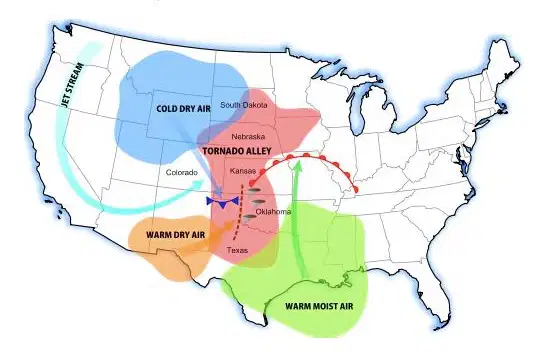
Check out the map showing tornado alley in the U.S. During the winter of 2017, massive tornadoes occurred in the states of Alabama and Georgia, two states that ARE NOT in tornado alley. If the conditions for a tornado are predictable, how could these tornadoes have formed in these two states?
Warm, moist Pacific coast air meets cold, Atlantic coast air
Arctic, Canadian air meets west moving air from the cold Atlantic coast
Warm, moist Gulf coast air meets cold, dry continental air moving down from Canada
A northeastern air mass drops down into the southern states bringing precipitation
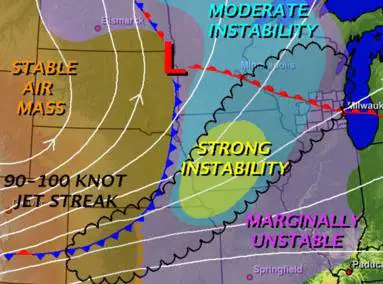
Meteorologists are able to predict weather within probable ranges because air masses responsible for weather interact in predictable ways. The boundary at which two air masses meet is called a front, which is the main cause of stormy weather. This weather map shows conditions for severe weather. Which statement best elaborates on how air masses would interact to cause severe weather?
Warm air masses and cold air masses have different densities, and when they mix, their densities stabilize, and excess moisture is released.
As the fronts move away from one another, the cold air mass is heated by the warm air mass. When cool air becomes warm, precipitation falls.
Cold air is denser than warm air, so the cold air mass travels beneath the warm air, pushing it up. Storms are often the result of rising warm air.
Since warm air is more dense than cold air, the cold air mass is forced higher. When the cold air becomes too heavy, it releases heavy precipitation.
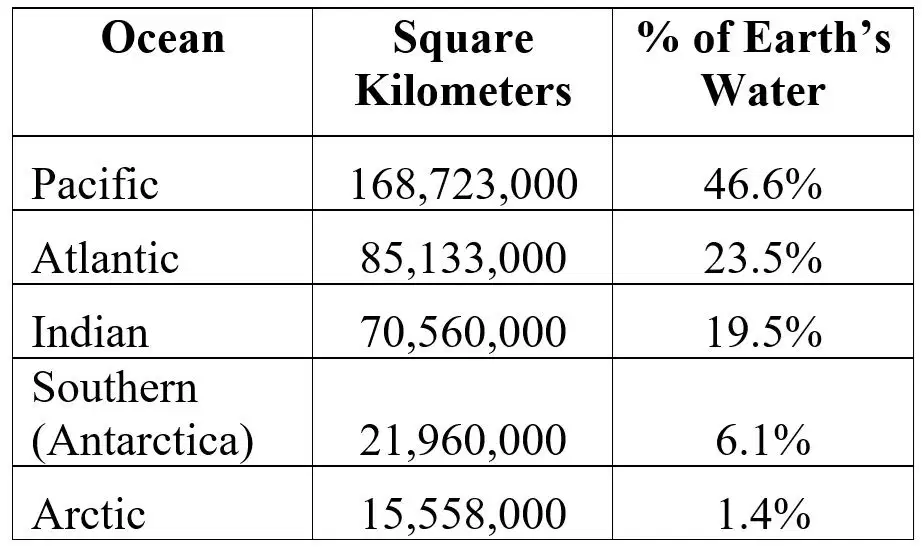
This table shows sizes of Earth's oceans. Based on this table and the makeup of Earth's total water, which reasonable conclusion can be made?
Earth's seas contain more salt water than the oceans.
Earth's land has more surface area than Earth's oceans.
Earth's largest source of salt water is the Pacific Ocean.
The Pacific Ocean is larger than all other oceans combined.

A simplified model of atmospheric convection is shown here. Which of the statements explains how convection occurs to move energy around the Earth? Select ALL that apply.
The warmer air rises within the atmosphere.
Colder air moves northward while warmer air moves southward.
Warmer air moves to the west while colder air moves to the east.
Colder air in the atmosphere is denser and sinks down to the Earth.
The solar energy makes the surface of the Earth warmer than the atmosphere.
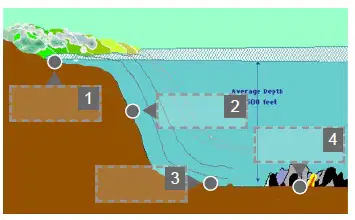
The ocean floor is not flat. There are many interesting features and landforms found in the ocean. See if you can label these landforms of the ocean floor.
abyssal plain -
rift zone -
continental slope -
continental shelf -
(a)
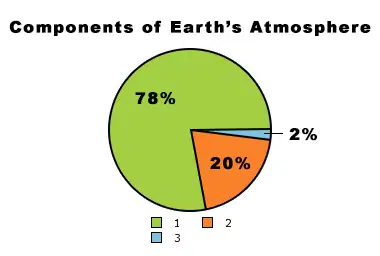
Air is a mixture of elements and compounds. Label this pie chart.
Word bank: Oxygen, Trace Compounds (water, carbon dioxide,) Nitrogen
(a)
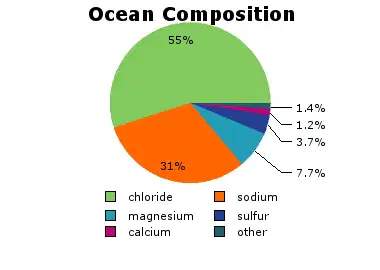
The majority of Earth is covered with water, mostly oceans and the most important substance dissolved in the ocean is salt. Ocean salt comes from mineral deposits that find their way to the ocean through the water cycle. Salts comprise about 3.5% of the mass of ocean water. The salt concentration of ocean water depends on a specific location. When ocean water mixes with fresh water, like at the mouth of a river, the salinity will be lower. But where there is lots of evaporation and little circulation of water, salinity can be much higher. The Dead Sea, has 30% salinity and very few organisms can live in its very salty water. Based on the pie chart, we would expect most of the salt in oceans to be
sodium chloride.
sulfur chloride.
calcium chloride
magnesium chloride
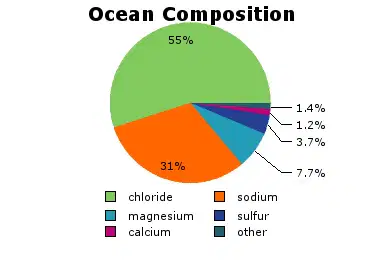
The pie chart shows the elements dissolved in the ocean to produce salt. But one element is missing. It is not a component of salt but it is a critical element for life to live in the oceans. What is that element?
carbon
glucose
hydrogen
oxygen

As a student is heating up a flask of water on a hot plate, their teacher tells them that they can observe all three types of heat transfer.
1 _______ can be seen as the hot water warms and rises and cools, 2 _______ can be seen as heat moves from the hot plate and through the glass flask, and 3 _______ can be seen by holding a hand over the hot plate and feeling warmth without touching it.
conduction
radiation
convection
radiation
convection
conduction
convection
conduction
radiation
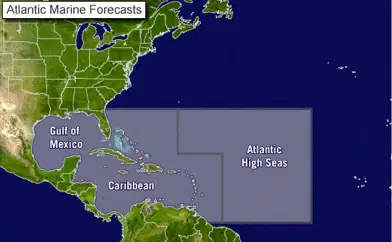
A hurricane is MOST LIKELY to occur in an area
near warm water.
near cool water.
with strong wind.
with little moisture.
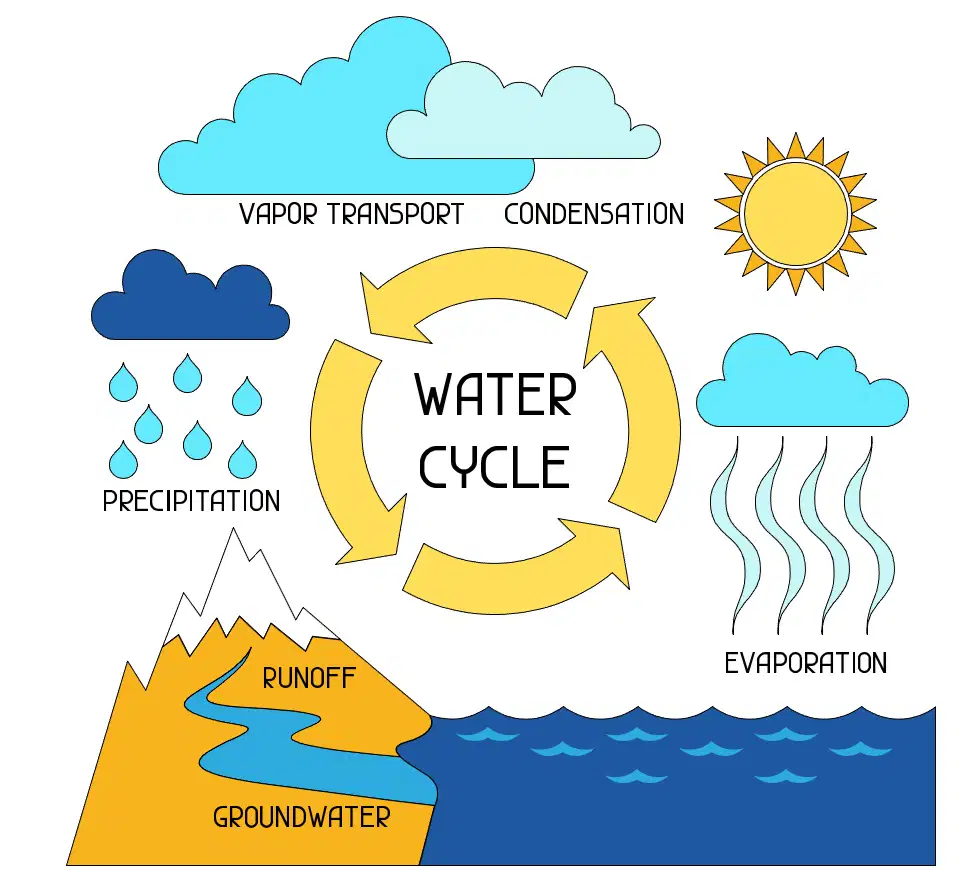
How would climate change impact the water cycle and the climate around bodies of water, like oceans and lakes?
Warmer temperatures would cause in a drier, hotter climate.
Warmer temperatures would cause more precipitation and less run-off.
Warmer temperatures would cause more evaporation and more precipitation.
Warmer temperatures would cause more evaporation and much less ground water.
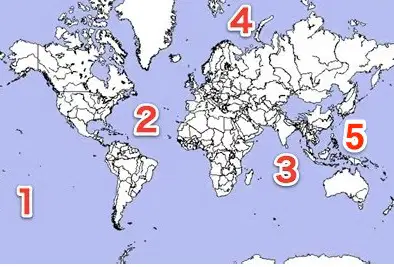
The rate of evaporation depends on four main factors: water body size, heat energy, atmospheric pressure and air movement. Warm waters and high winds often result in the development of hurricanes over the world's oceans because of increased evaporation. Where, on this map, is the LEAST likely location for a hurricane to form?
1.
2.
3.
4.
5.
Conduction on Convection?
A space heater warming a room
Conduction
Convection
Conduction on Convection?
Walking on hot sand
Conduction
Convection
Conduction on Convection?
Steam coming from a cup of hot chocolate
Conduction
Convection
Conduction on Convection?
Noodles rising and falling in a pot of boiling water
Conduction
Convection
Conduction on Convection?
A frying pan on a hot burner
Conduction
Convection
Conduction on Convection?
Butter melting on a hot biscuit
Conduction
Convection

