
 Worksheets
Unit 7
Total questions: 15
Worksheet time: 15mins
Which statement below best describes how biodiversity contributes to the sustainability of an ecosystem?
A variety of plant and animal species allows for more survivors of a natural disaster.
Having more species in an ecosystem allows the human population to increase in size.
Low biodiversity reduces the competition for resources, which helps native species survive.
Fewer species in the ecosystem reduces the likelihood that disease spreads through the ecosystem.
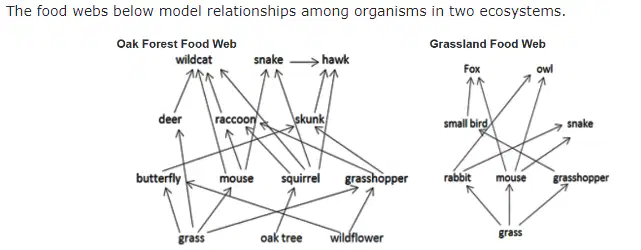
Students were asked to make a claim supported with evidence to answer the question, “Which ecosystem would be most sustainable if all the grasses died from severe drought?” What claim is valid and supported by the evidence?
The forest ecosystem is most sustainable because there are more top predators.
The grassland ecosystem is most sustainable because there are fewer organisms that eat grass.
The forest ecosystem is most sustainable because most of the animals can eat other organisms.
The grassland ecosystem is most sustainable because there is less competition for food.
Which event would most likely cause an ecosystem to have the lowest biodiversity and population sizes 3 years later?
Clearing land for a highway
A river floods a cornfield
A forest fire destroys the plant growth
A lava flow creates a new section of land
When forest fires destroyed many of the pine trees in Bastrop State Park, the burned areas began secondary succession. What is the role of succession in this example?
Creating new soil by chemical and physical weathering of rocks
Restoring the ecosystem through grass, shrub, and tree stages
Changing the landscape to be more fire resistant in the future
Opening the land for new uses like farming and raising livestock
Students observe ecological succession of a field that has been left bare. Which of the following are the students likely to observe first?
Growth of shrubs and trees
Formation of topsoil
A mature grassland community
Growth of grasses and weeds
Which of the following sequences most likely represents ecological succession on a recently abandoned wheat field?
grasses-flowering plants-shrubs-native trees
native trees-shrubs-flowering plants-grasses
shrubs-grasses-native trees- flowering plants
flowering plants - native trees-shrubs-grasses
The more diverse an ecosystem is —
the more threatened its populations are
the more similar the species will be
the more sustainable it is
the fewer varieties of species are present
Which of the following situations contributes to the sustainability of an ecosystem?
Increase in biodiversity
decrease in biodiversity
Extinction of a population from the ecosystem
Removal of many populations of organisms
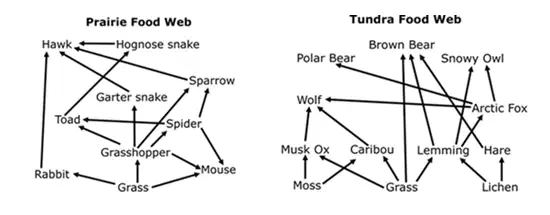
Refer to the food webs above. If the grasses in each ecosystem are attacked or killed by a disease, which ecosystem will most likely survive?
The prairie ecosystem, because fewer organisms eat grass
The tundra ecosystem, because there is a variety of producers
The prairie ecosystem, because there are fewer top predators
The tundra ecosystem, because it has more herbivores
What is the primary function of the mitochondria in a cell?
A) Photosynthesis
B) Cellular respiration
C) Protein synthesis
D) DNA replication
Which of the following best describes the process of osmosis?
A) Movement of solutes from high to low concentration
B) Movement of water from low to high solute concentration
C) Movement of water from high to low solute concentration
D) Movement of solutes from low to high concentration
In an experiment, a student measures the pH of a solution and finds it to be 3. What does this indicate about the solution?
A) It is neutral
B) It is acidic
C) It is basic
D) It is alkaline
Which of the following is a chemical change?
A) Melting of ice
B) Boiling of water
C) Rusting of iron
D) Breaking of glass
What is the role of chlorophyll in photosynthesis?
A) Absorbs water
B) Absorbs sunlight
C) Releases oxygen
D) Produces glucose
Which of the following best explains why enzymes are specific to substrates?
A) Enzymes are proteins
B) Enzymes have active sites that fit specific substrates
C) Enzymes are catalysts
D) Enzymes are reusable

