
NEW
Font size
 Worksheets
Genetics and Epigenetics
Total questions: 25
Worksheet time: 25mins
Epigenetics is
a change in the DNA sequence
a change in the histone protein shape
addition of methyl groups to DNA only
addition of methyl groups to DNA and histone proteins
DNA methylation is
adding CH4 groups to DNA
adding CH3 groups to DNA phosphate groups
adding CH3 groups to pentose sugar in DNA
adding CH3 groups to DNA nucleotide bases
Epigenetic changes are said to be
somatically heritable
autosomally heritable
x linked heritable
y linked heritable
Proportionate heritability is
Phenotype= genetics + environment
Genetics = phenotype + environment
environment + phenotype = genetics
Genetics + phenotype = environment
A segment of DNA that codes for a trait
gene
centromere
chromosome
chromatid
What is the shape of the DNA molecule?
Single helix
Double helix
Triple helix
Quadruple helix
Gene expression is
transcription then translation and building a protein
translation then transcription and making carbohydrate
transpiration then transcription and building proteins
proteins making changes to DNA
Histone modification is
histone methyltransferases join methyl groups to histone protein heads
histone methyltransferases join methyl groups to histone protein tails
DNA methyltransferases join methyl groups to DNA phosphate groups
DNA methyltransferases join methyl groups to DNA hydrogen bonds

In a pedigree chart this symbol indicates
identical male twins
non-identical male twins
identical female twins
non-identical female twins

In a pedigree chart the symbol indicates
identical male twins
identical female twins
non-identical male twins
non-identical female twins
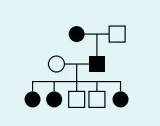
This pedigree shows
Autosomal dominant
Autosomal recessive
X linked dominant
X linked recessive
Y linked
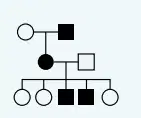
This pedigree shows
Autosomal dominant
Autosomal recessive
X linked dominant
X linked recessive
Y linked

This pedigree shows
Autosomal dominant
Autosomal recessive
X linked dominant
X linked recessive
Y linked
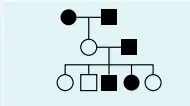
This pedigree shows
Autosomal dominant
Autosomal recessive
X linked dominant
X linked recessive
Y linked
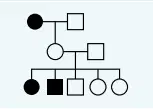
This pedigree shows
Autosomal dominant
Autosomal recessive
X linked dominant
X linked recessive
Y linked
If Purple Flowers (P) are dominant over white flowers (p), what would the phenotype be for a Pp genotype?
Purple flowers
White flowers
Not enough information
The physical appearance of a trait is known as the-
genotype
phenotype
characteristics
intelligence

The alleles of a gene pair in a heterozygote are both expressed with no blending.
codominance
incomplete dominance
polygenic
multiple alleles
Which of these Punnett squares represents a cross between a homozygous dominant parent and a heterozygous parent?


Protein molecules around which DNA is tightly coiled in chromatin
histones
casein
nucleosome
chromosome
A chemical modification of DNA that does not affect the nucleotide sequence of a gene but makes that gene less likely to be expressed.
activators
methylation
acetylation
proteins
What is the role of histone acetylation in gene expression?
Increases gene expression by loosening DNA-histone interaction
Decreases gene expression by tightening DNA-histone interaction
Has no effect on gene expression
Completely silences gene expression
Which of the following best describes a gene?
A segment of DNA that codes for a protein
A protein that regulates DNA replication
A lipid molecule involved in cell signaling
A carbohydrate that stores genetic information
In a classic Mendelian experiment, if a homozygous dominant plant is crossed with a homozygous recessive plant, what will be the phenotype of the offspring?
All dominant phenotype
All recessive phenotype
50% dominant and 50% recessive phenotype
75% dominant and 25% recessive phenotype
What is the primary difference between genetics and epigenetics?
Genetics involves changes in DNA sequence, while epigenetics involves changes in gene expression without altering the DNA sequence
Genetics involves protein synthesis, while epigenetics involves lipid synthesis
Genetics is only concerned with inherited traits, while epigenetics is only concerned with acquired traits
Genetics is a branch of chemistry, while epigenetics is a branch of physics

