
 Worksheets
Earth's Structure and Plate Tectonics
Total questions: 25
Worksheet time: 25mins
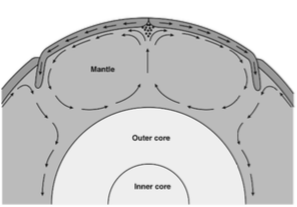
The figure shows part of what scientists think is happening in Earth’s mantle.
What process does the figure show occurring in the mantle?
Hot rock expands, becomes less dense, and rises toward the surface of Earth.
Hot rock expands, becomes more dense, and rises toward the surface of Earth.
Hot rock becomes less dense and moves towards the outer core.
Hot rock becomes more dense and moves towards the lithosphere.
Earth’s physical layers correspond to Earth’s compositional layers. Which part of the mantle is also part
of the lithosphere?
the fluid, hot part
the rigid upper part
the soft moving part
the lower stationary part
Mount Everest formed when two tectonic plates collided. Which of the following processes lead to the
formation of Mount Everest?
eriosion
substidence
pushed up or uplift
weathering
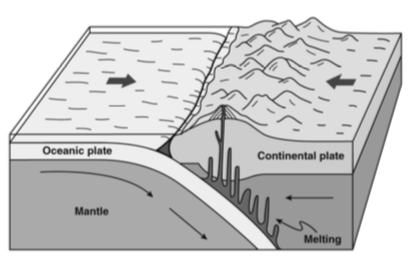
Subduction occurs when one plate slides beneath another plate. The figure below shows the process of subduction. Notice that the oceanic plate slides beneath the continental plate.
What happens when the crustal plates move as shown in the figure?
An ocean forms.
Volcanic mountain ranges form.
Sea-floor spreading occurs as the oceanic plate moves.
A transform boundary forms where the subduction occurs.
Match the following
How large plates move across Earth's surface
Convection currents
The type of plate boundary where seafloor spreading can create a mid-ocean ridge
Divergent
Where the upper solid mantle meets the crust
Lithosphere
______ is a rock with a fine, dark texture that makes up the oceanic crust.
Granite
Gypsum
Basalt
Limestone
What is the main difference between the lithosphere and asthenosphere?
The lithosphere is rigid and solid, while the asthenosphere is plastic and can flow.
The lithosphere and asthenosphere are made of the same materials
The lithosphere is plastic and can flow, while the asthenosphere is rigid and solid
The lithosphere is located in the outer core of the Earth, while the asthenosphere is located in the inner core
Which layer of the Earth is responsible for convection currents?
Outer core
Crust
Inner core
Mantle
Label the parts of this plate boundary.
Oceanic crust
Continental crust
Subduction zone
Continental volcanic arc

Most geologists think that the movement of Earth's tectonic plates is caused by (a)
the rotation of the Earth.
the Earth's magnetic field.
subduction.
convection currents.
What do scientist believe to cause the tiny wobble in Earth's spin?
areas of solid iron floating over the molten core
the blending of materials between the upper core and the inner core
the amount of pressure put on the core from the weight above
the amount of magnesium in the core
Which is thicker, the oceanic crust or the continental crust?
oceanic crust
continental crust
Earth's oceanic crust is ______ than continental crust.
thinner but denser
thicker and denser
thicker but less dense
thinner and less dense
Earth's (a) is always changing because of the (b) of magma in the (c)
crust
movement
mantle
core
stillness
lava
Match the following parts of the Earth with their role in mantle convection.
the Crust
The outermost layer of the Earth.
the Mantle
The layer involved in convection currents.
the Core
The primary heat source for mantle convection.
The motion of tectonic plates can cause both slow and rapid changes in Earth’s surface. Which is an example of a rapid change?
earthquake
seafloor spreading
mountain range formation
formation of an ocean trench
Earth’s temperature increases with depth. Which of the following is a result of the motion of materials caused by high temperatures in Earth’s mantle?
earthquakes and volcanoes
radioactive atoms in minerals
ocean tides
erosion and deposition
Evelyn is making a model of Earth to show how the physical layers correspond to the compositional layers. Which of the following should Evelyn show in her model?
The physical layers exactly match the compositional layers.
The crust is the only compositional layer not included in the physical layers.
The physical layers of the inner core and outer core form a single compositional layer.
The physical layer of the asthenosphere includes the compositional layer of the crust.
Basalt forms when lava cools on Earth’s surface. Granite forms when magma cools within the Earth. Which of these statements correctly classifies both basalt and granite?
Basalt and granite are both igneous rocks.
Basalt and granite are both metamorphic rocks.
Basalt is igneous rock, and granite is metamorphic rock.
Basalt is metamorphic rock, and granite is igneous rock.
A geologist is studying three layers of sedimentary rock in an area. The layers have not shifted from their original positions. The geologist records the relative ages of the rocks. The bottom layer is listed as the oldest. The top layer is listed as the youngest. What did the geologist use to determine the relative ages of the rocks?
mineral content
radioactive decay
the law of superposition
the principle of unconformity
Fossils of the same plants and animal species have been found on continents that are separated by the Atlantic Ocean. Which of the following statements does this observation support?
These animals and plants crossed the Atlantic Ocean.
The Atlantic Ocean was once a large body of freshwater.
The continents that are now separated by the Atlantic Ocean once formed a single landmass.
The continents that are now separated by the Atlantic Ocean have the same kinds of organisms today as they did millions of years ago.
Which layer of the Earth is primarily responsible for the movement of tectonic plates?
A) Crust
B) Mantle
C) Outer Core
D) Inner Core
What is the primary cause of earthquakes along tectonic plate boundaries?
A) Volcanic eruptions
B) Tidal forces
C) Plate movements
D) Solar flares
Which type of plate boundary is most likely to create a mountain range?
A) Divergent boundary
B) Convergent boundary
C) Transform boundary
D) Passive boundary
What evidence supports the theory of continental drift?
A) Similar rock formations on different continents
B) The presence of oceanic trenches
C) The distribution of earthquakes
D) The alignment of Earth's magnetic field

