
 Worksheets
Heat Engines
Total questions: 25
Worksheet time: 25mins
Why does heat engine cannot be 100% efficient?
Some of the steam cannot make the turbines to move.
The energy converted to mechanical energy is not enough.
It is because all heat is converted into work to perform its function.
It is because part of the heat input is utilized for the mechanical work and
some heat input cools down due to friction and for the cycle to happen.
Heat engine like in a geothermal power plant follows series of pattern in its operations. How will you arrange the following in correct sequence? I. Part of the heat is used to do mechanical work on an object. II. Condensed water is brought back to the Earth to repeat the cycle. III. Heat is supplied to the engine by an external source called hot reservoir. IV. Some of the heat decreases its temperature and condenses back to water.
I, II, III, IV
I, III, II, IV
III, I, IV, II
III, IV, I, II
If you will have a company business in the future using heat engines, why will you intentionally run the engine at a high operating temperature?
A heat engine reduces the heat energy from a heat source.
Heat engine depends primarily on the temperature difference.
The lower is the temperature of the input heat, the greater is the energy
for power production.
The higher is the steam temperature driving the turbine, the higher is the
efficiency of the power production
What is the primary function of a heat engine?
A) To convert thermal energy into mechanical work.
B) To transfer heat from a cooler reservoir to a warmer one without doing work.
C) To decrease the entropy of a system to zero.
D) To convert all absorbed heat into work without any losses.
Which of the following is a false statement about heat engine?
Heat Engine converts thermal energy into mechanical energy.
Heat engine utilizes all thermal energy into useful work due to its 100%
efficiency.
Heat engine may be classified into two major types: internal
combustion engine and external combustion engine.
Heat engine uses a working substance that cools and/or heats,
compresses and/or expands like water in a steam engine.
What happens when heat is added to a system?
The thermal energy will be wasted.
The thermal energy will increase and can do work.
The thermal energy will decrease and can do work.
The thermal energy will increase the temperature of the environment.
Geothermal power plant is a way to harness the thermal energy coming
from the Earth’s interior and uses heat engine to generate electricity. Which
is not included in the processes that all heat engines follow?
Some of the thermal energy from the input heat increases the
temperature in the geothermal power plant.
The rest of the thermal energy decreases temperature, condenses into
water and goes back beneath the ground through injection well.
Heat is added to the engine by a hot reservoir. The hot water produces
steam that turns turbine which is connected to generator that generates
electricity.
Some of the thermal energy from the input heat is used to do useful
work like turning the turbine connected to generator generating
electricity
Teacher Cristel is showing flash cards showing examples of heat engines in
your Science class. She asked you to choose which does not belong to the
group. What are you going to pick?
car
refrigerator
motorcycle
thermal power generator
Which of the following branch of natural science deals with heat and its transformation to various forms of energy?
Heat
Heat Engine
Temperature
Thermodynamics

The heat energy coming out of the hot reservoir, Q H , into the system (engine) is 200 J. The energy that goes out of the system into the cold reservoir, Q C , is 150 J of waste heat. In joules, how much work was done by the system?
(a)
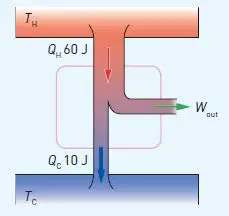
If the heat energy from the hot reservoir is 60 J and the waste energy is 10 J, calculate W_out using the formula: W = -Q_net
-70 J
70 J
-50 J
50 J

In a heat engine, 750J is drawn from the hot reservoir, and 400J is released to the cold reservoir.
How much work is done by the engine?
300 J
350 J
1150 J
0
A heat engine does a work of 220J when receiving 600J of heat. How much energy is emitted through the exhaust?
380 J
820 J
480 J
880 J
A heat engine does 100 J of work, and emits 100 J to the cold reservoir. What is the efficiency of the engine?
50%
33%
20%
100%
What is the efficiency of an engine that absorbs 200 J of heat and performs 50 J of work?
25%
50%
75%
100%
If heat added to the cycle is 40 kJ and the one rejected is 20 kJ then the efficiency of the cycle will be
40%
50%
60%
100%
What is the primary function of a heat engine?
To convert thermal energy into mechanical work.
To transfer heat from a cooler reservoir to a warmer one without doing work.
To decrease the entropy of a system to zero.
To convert all absorbed heat into work without any losses.
Why can't a heat engine be 100% efficient?
Some of the steam cannot make the turbines to move.
The energy converted to mechanical energy is not enough.
It is because all heat is converted into work to perform its function.
It is because part of the heat input is utilized for the mechanical work and some heat input cools down due to friction and for the cycle to happen.
Which of the following is a false statement about heat engines?
Heat Engine converts thermal energy into mechanical energy.
Heat engine utilizes all thermal energy into useful work due to its 100% efficiency.
Heat engine may be classified into two major types: internal combustion engine and external combustion engine.
Heat engine uses a working substance that cools and/or heats, compresses and/or expands like water in a steam engine.
What happens when heat is added to a system?
The thermal energy will be wasted.
The thermal energy will increase and can do work.
The thermal energy will decrease and can do work.
The thermal energy will increase the temperature of the environment.
Which of the following branch of natural science deals with heat and its transformation to various forms of energy?
Heat
Heat Engine
Temperature
Thermodynamics
A heat engine does a work of 220J when receiving 600J of heat. How much energy is emitted through the exhaust?
380 J
820 J
480 J
880 J
A heat engine does 100 J of work, and emits 100 J to the cold reservoir. What is the efficiency of the engine?
50%
33%
20%
100%
What is the efficiency of an engine that absorbs 200 J of heat and performs 50 J of work?
25%
50%
75%
100%
If heat added to the cycle is 40 kJ and the one rejected is 20 kJ then the efficiency of the cycle will be
40%
50%
60%
100%

