
 Worksheets
Erosion Review
Total questions: 25
Worksheet time: 25mins
What is the movement of soil from one place to another?
weathering
deposition
discharge
erosion

A satellite image of an area in Ohio shows a river with slight bends along its length. A second satellite image taken of the same area 10 years later shows the same river with a different course. What is the best explanation for the difference in the shape of the river's course between the two satellite images?
Wind blew waves across the water surface, eroding away the bank on one side of the river until the river's course changed its shape
Regular freezing and thawing of the river split the soil along the river banks, changing the shape of the river
Water eroded the banks of the river and deposited the eroded soil on opposite banks, causing the river to form tighter bends
Acid rain chemically weathered the banks along the river, forcing the river to wind back and forth
Which of these is an example of erosion
Trees roots breaking a rock
Rain breaking down rock
Wind blowing away sediment
A river slows down and drops sediment

Erosion is most likely greatest at locations
A and B
B and C
C and D
D and A

The process by which water, ice, wind, or gravity moves weathered rock and soil from one place to another.
Weathering
Erosion
Deposition
Crop Rotation
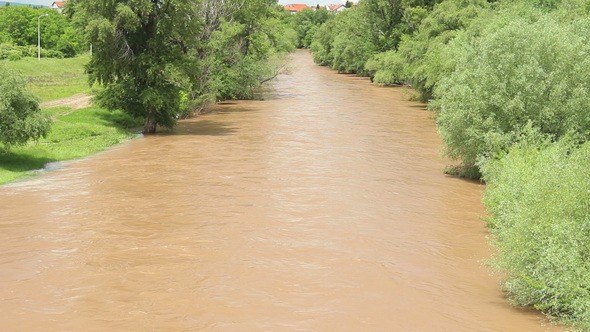
Muddy water being carried away by a fast-moving river is an example of
Weathering
Erosion
Deposition
A nice place to swim

Based on the information presented in the video, what can you infer about the type of erosion that formed the Grand Canyon?
WInd erosion
Water erosion
Sandblasting
Glacial erosion
Mud and sediment sliding down a hillside is an example of
Weathering
Erosion
Deposition

Which particles will be transported by a stream moving at a velocity (speed) of 5 cm/s?
pebbles, sand, silt, and clay, only
sand, silt, and clay, only
silt and clay, only
clay, only
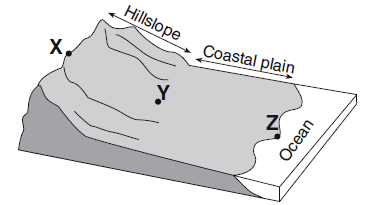
Compared to the stream speed between point X and point Y, the stream speed between point Y and point Z is most likely
greater, since the slope of the land decreases
greater, since the slope of the land increases
less, since the slope of the land decreases
less, since the slope of the land increases

At which point does the greatest stream erosion occur?
A
B
C
D

The accompanying cross section illustrates the general sorting of sediment by a river as it flows from a mountain to a plain. Which factor most likely caused the sediment to be sorted in the pattern shown?
velocity (speed) of the river water
hardness of surface bedrock
the eroding agent (wind, water, or glacier)
temperature of the water
Which erodes/breaks down more rock:
A fast-moving stream
A slow-moving stream
What is sediment?
the process of rocks being broken down and carried away
bits of rock, sand, and silt caused by the weathering of rocks
the top layer of the soil
decaying plant or animal material
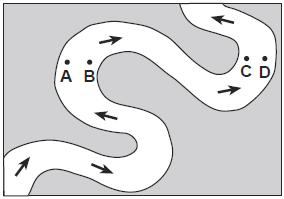
Which two locations have the fastest water flow?
A and B
B and C
C and D
D and A

What is the name of the largest sediment that can be transported by a stream moving at a velocity of 100 centimeters per second (cm/s)?
silt
sand
pebbles
cobbles

At which point would you expect to find erosion taking place?
X
Y
Z

Andrew used these two beakers in an experiment to find out how limestone would react to certain liquids. Choose the statement that BEST describes what happened to the limestone in the experiment.
The limestone dissolved in both the water and the vinegar.
Holes and pits formed in the limestone in vinegar.
The limestone in vinegar cracked.
Holes and pits formed in the limestone in water.

The 4th grade at CTM is setting up an experiment to find out how weathering and erosion are affected by rainfall. Look at the picture of their lab setup. Pouring water on the brown sugar represents _____.
erosion
deposition
weathering
The slow process where particles are removed from solids by wind or water; the movement or removal of broken pieces of rock.
weathering
erosion
deposition
What will happen to weathered rock particles on the bottom of a glacier that is melting?
The weathered rock particles will be deposited in a new place producing a new landform.
The weathered rock particles will move to the top side of the melting glacier.
The weathered rock particles will become a river.
The weathered rock particles will also melt.

TRUE or FALSE: The diagram is in the correct order to show the process of physical weathering.
TRUE
FALSE
The process in which particles removed by erosion are deposited in a new place.
weathering
erosion
deposition
What is the primary agent of erosion that shapes coastal landscapes?
Wind
Water
Ice
Gravity
Which of the following processes is NOT directly involved in erosion?
Abrasion
Hydration
Deflation
Plucking

