
Font size
 Worksheets
End of Year Biology
Total questions: 25
Worksheet time: 25mins
What was the main reason why dodos became extinct?
They lost their ability to fly
They were haunted
Humans brought other animals to their natural habitat
All of the above
What flower does the monarch butterfly needs to reproduce and avoid themselves from extinction?
Bluestem
Milkweed
Caladium
Daylily
What are the consequences of a specie extinction for humans?
Humans can't get their natural resources
Humans can't put them on display
Humans can't haunt them anymore
None of the above
what is found in the nucleus of every cell
Bacteria
viruses
cytoplasm
chromosomes
What is the primary function of the respiratory system?
To breathe in oxygen and expel carbon dioxide
To control body movements
What is a dominant trait?
A trait that appears even if only one allele is present
A trait that can never be passed on to offspring
What is the term for the genetic makeup of an organism?
Phenotype
Genotype
which pair of chromosomes female have
xx
xy
xb
non of the above
what was the name of the scientist who explained inheritance
charles mendel
Uwais panwala
gregor mendel
sherif negm
define the term variation
similarities within species
differences within species
non of the above
If a father had Bb and had brown eyes and the mother had Bb and also had brown eyes. What is possibility that their baby will have blue eyes?
0 percent
75 percent
50 percent
25 percent
20 percent
What is the advantage of using bacteria in genetic engineering
Cells are simpler
They have no nucleus
Genes are loose in the cytoplasm
All of the above

The diagram represents human digestive system. From which structure are glucose and amino acids normally absorbed into the circulatory system?
F - Large Intestine
H - Liver
C - Stomach
E - Small Intestine

Which diagram best shows the end result of diffusion?
F
G
H
J
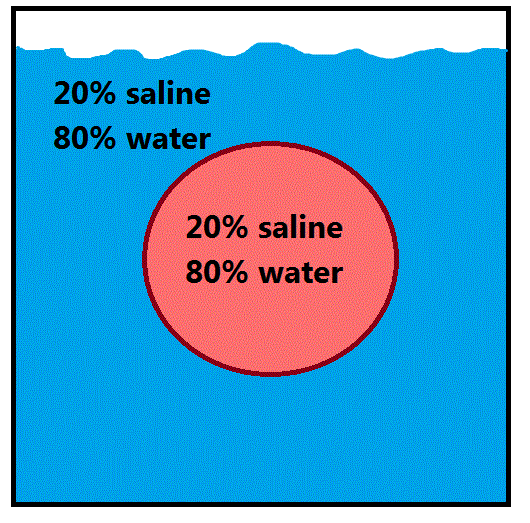
A blood cell is placed into the jar, as seen. Where will the water go?
Into the cell
Out of the cell
Equally in & out - it's isotonic
The water is a lie
The plant organelle that captures light to make energy is the:
Cell Wall
Mitochondria
Chloroplast
Ribosome

What is the term used to describe the transformation of an unspecialised cell into a specialised cell?
Differentiation
Adaptation
Transformation
Specialisation

How is a plant root hair cell adapted for absorbing water from the soil efficiently?
It has many chloroplasts
It has lots of mitochondria
It has a large surface area
It has a large vacuole
Which of these equations shows aerobic respiration?
Glucose + Oxygen -> CO2 + Water
Glucose -> Lactic Acid
Glucose -> Ethanol + CO2
What's missing from this equation for aerobic respiration? Glucose + _________ -> CO2 + Water
Oxygen
Nitrogen
Ethanol
Lactic acid
What is the process by which plants convert light energy into chemical energy?
Photosynthesis
Respiration
Transpiration
Fermentation
Which part of the cell is responsible for controlling cell activities and contains genetic material?
Nucleus
Cytoplasm
Cell membrane
Mitochondria
What is the role of chlorophyll in photosynthesis?
Absorbs light energy
Converts glucose to energy
Transports water
Protects the plant from herbivores
Which of the following is a characteristic of a prokaryotic cell?
Lacks a nucleus
Has a nucleus
Contains membrane-bound organelles
Has a complex structure
What is the primary function of the roots in a plant?
Absorb water and nutrients
Perform photosynthesis
Produce flowers
Store energy

