
 Worksheets
Ionic Bonds and Ionic Substances
Total questions: 25
Worksheet time: 25mins
Which two compounds are Ionic bonds?
water(H20) and rust(Fe2O3)
water(H2O) and carbon dioxide(CO2)
rust(Fe2O3) and salt(NaCl)
oxygen gas(O2) and nitrogen gas(N2)
Ionic bonds are between...
Metal and Non-metal
Non-metal and Non-metal
Metal and Metal
Metalloids
How are ionic bonds formed?
Transfer of electrons
Sharing of electrons
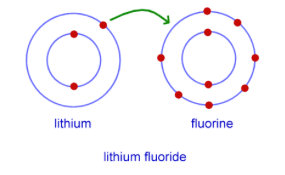
What type of bond is this?
ionic
covalent
An ionic bond forms when
Valence electrons are shared
a sea of mobile electrons surround the cations
valence electrons are transferred between atoms
none of the above
What is the type of bond formed when a metal chemically bonds with a nonmetal by GIVING its valence electrons?
ionic bond
covalent bond
atomic bond
molecular bond

Which two substances are ionic compounds?
sodium chloride (NaCl)
carbon dioxide (CO₂)
water (H₂O)
magnesium oxide (MgO)

Which three of the following are features of ionic compounds? (click 3 boxes)
They have bonds between metals and non-metals.
They have bonds between two non-metals.
They form simple molecular structures.
They form giant ionic lattices.
They involve the transfer of electrons.
Ionic compounds form giant ionic lattices. What forces hold the giant ionic lattices together?
strong frictional forces between the surfaces of the atoms
strong magnetic forces of attraction between the poles of ions
strong electrostatic forces of attraction between oppositely charged ions
Why do ionic compounds have high melting and boiling points?
Their ions are free to move.
Their ions are held in fixed positions.
They have many strong bonds.
They have many weak bonds.

True or false? Ionic compounds have high melting points.
true
false
Which of the following pairs of elements is most likely to form an ionic bond?
A) Sodium (Na) and Chlorine (Cl)
B) Hydrogen (H) and Oxygen (O)
C) Carbon (C) and Oxygen (O)
D) Nitrogen (N) and Oxygen (O)
What is the primary characteristic of an ionic compound?
A) High melting and boiling points
B) Low melting and boiling points
C) Poor electrical conductivity in solid state
D) High electrical conductivity in solid state
Which of the following is a property of ionic substances when dissolved in water?
A) They conduct electricity
B) They do not conduct electricity
C) They become gaseous
D) They form a precipitate
What happens to the electrons in an ionic bond?
A) They are shared equally between atoms
B) They are transferred from one atom to another
C) They are shared unequally between atoms
D) They are not involved in bonding
Which of the following is an example of an ionic compound?
A) Water (H2O)
B) Methane (CH4)
C) Sodium chloride (NaCl)
D) Ammonia (NH3)
Why do ionic compounds tend to have high melting points?
A) Because of strong electrostatic forces between ions
B) Because of weak van der Waals forces
C) Because of hydrogen bonding
D) Because of covalent bonding
In the formation of an ionic bond, what role does the metal play?
A) It gains electrons
B) It loses electrons
C) It shares electrons
D) It neither gains nor loses electrons
Which of the following best describes the structure of ionic compounds?
A) Molecules
B) Lattice structure
C) Linear chains
D) Discrete atoms
What is the charge on the sodium ion in sodium chloride?
A) +1
B) -1
C) +2
D) -2
Which of the following is a real-world application of ionic compounds?
A) Used as a fuel
B) Used in batteries
C) Used in making plastics
D) Used in making glass
What is the formula unit of magnesium oxide?
A) MgO
B) Mg2O
C) MgO2
D) Mg2O3
How do ionic compounds behave in water?
A) They dissolve and dissociate into ions
B) They remain intact and do not dissolve
C) They form covalent bonds with water
D) They evaporate
Which of the following statements is true about ionic bonds?
A) They are formed by the sharing of electrons
B) They are formed by the transfer of electrons
C) They are weaker than covalent bonds
D) They do not involve electrons
What is the role of non-metals in ionic bonding?
A) They lose electrons
B) They gain electrons
C) They share electrons
D) They do not participate in bonding

