
 Worksheets
Science TEKS
Total questions: 15
Worksheet time: 15mins
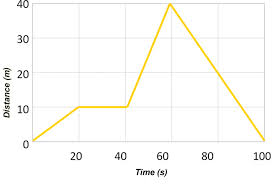
How long did it take this object to travel back to its reference/starting point?
20 s
30 s
60 s
100 s
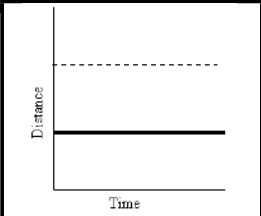
What does this graph represent?
Constant speed
Acceleration
Not moving

What is this object's SPEED at 2 seconds? (hint: you will need to do MATH!!)
5 m/s
5 s/m
20 m/s
20 s/m

What is the average speed of the person during the first 5 seconds?
0 m/s
1 m/s
3 m/s
6 m/s

Which runner won the race?
A
B
C
According to Newton's First Law of Motion, what will happen to an object at rest if no unbalanced force acts on it?
It will start moving.
It will remain at rest.
It will accelerate.
It will change direction.
According to Newton's First Law, what will happen to an object moving in a straight line at a constant speed if no external force acts on it?
It will stop.
It will change direction.
It will continue moving in a straight line at a constant speed.
It will accelerate.
A distance-time graph shows a straight line with a positive slope. What does this indicate about the object's motion?
The object is at rest.
The object is moving at a constant speed.
The object is accelerating.
The object is decelerating.
Which of the following best describes velocity?
60 km/h
60 km/h north
60 km
60 km north
What effect do balanced forces have on an object in motion according to Newton's First Law?
The object will stop.
The object will change direction.
The object will continue moving at a constant speed.
The object will accelerate.
How does velocity differ from speed in terms of motion?
Velocity is a scalar quantity, while speed is a vector quantity.
Speed is a scalar quantity, while velocity is a vector quantity.
Both speed and velocity are scalar quantities.
Both speed and velocity are vector quantities.
What happens to an object in motion if unbalanced forces act on it, according to Newton's First Law?
It will stop immediately.
It will continue moving at a constant speed.
It will change its state of motion.
It will remain in motion indefinitely.
What is the primary function of the mitochondria in a cell?
Energy production
Protein synthesis
DNA replication
Photosynthesis
Which of the following best describes the process of photosynthesis?
Conversion of glucose into energy
Conversion of light energy into chemical energy
Conversion of oxygen into carbon dioxide
Conversion of water into oxygen
In an experiment, a student measures the temperature of a substance as it is heated. The temperature remains constant for a period of time before rising again. What is the most likely explanation for this observation?
The substance is undergoing a chemical reaction
The substance is melting
The substance is boiling
The substance is cooling down

