
NEW
Font size
 Worksheets
Energy and Chemical Change
Total questions: 25
Worksheet time: 25mins
If two substances react and the temperature of the mixture increases, the reaction is
Not one that produces anything new
Exothermic
One that needs a catalyst
Endothermic
If two substances react and the temperature of the mixture decreases, the reaction is
Endothermic
Never going to happen unless it is heated
Exothermic
one that causes atoms to be destroyed
What is a sign of a chemical change?
change in state of matter
change in size
change in shape
temperature change
Metals can also react with acids. This produces a gas. What is the name of this gas?
Hydrogen
Carbon Dioxide
Nitrogen
Oxygen
The components of crude oil are separated through the process of _______
hydraulic fracturing
fractional distillation
methane separating
petroleum separation
Catalysts permit reactions to proceed along a ___________energy path.
lower
higher
According to collision theory, reactants must collide with proper orientation and sufficient _.
activation energy
temperature
pressure
surface area

Based on the following diagram, what is the function of potassium manganate (VII) crystals in this experiment?
To supply oxygen
To avoid the metals to mix with each other
To release heat
To give out water vapour

If the fork is to be electroplated with silver metal, what electrolyte should be used?
Molten silver chloride
Silver nitrate solution
Sodium chloride solution
Copper(II) sulphate solution
Name a metal that could be extracted from its metal oxide by heating with carbon.
tin
aluminium
calcium
magnesium
What is the name of the positive electrode?
cathode
anode
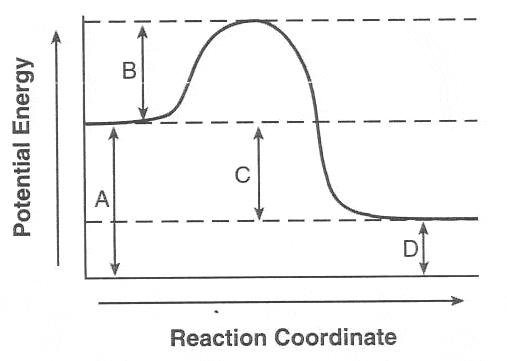
What type of reaction is this?
Endothermic
Exothermic
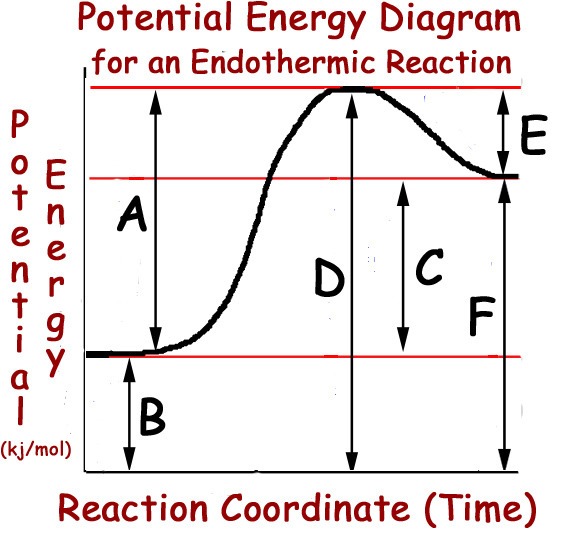
What letter represents the activation energy?
A
B
C
D

What is represented by interval C?
Potential energy of the reactants
Potential energy of the products
Activation Energy
Heat of reaction

Which interval represents the activation energy?
A
B
C
D

What does A + B represent?
Reactants
Products
Activation Energy
Heat of reaction

Is this reaction endothermic or exothermic?
Endothermic
Exothermic

What is the heat of reaction for the reaction shown in this PE diagram?
50kJ
-50 kJ
200 kJ
-200 kJ

What is the heat of reaction (∆H) for the uncatalyzed reaction?
25 kJ
10 kJ
15 kJ
50 kJ
The specific heat of aluminum is 0.21 cal/g°C. How much heat(Q) is released when a 10 g piece of aluminum foil is taken out of the oven and cools from 100° to 50°?
105 J
10.5 J
1.05 J
50 J
Which of the following is an example of an exothermic reaction?
Photosynthesis in plants
Melting of ice
Combustion of gasoline
Evaporation of water
What is the primary source of energy in an endothermic reaction?
Heat absorbed from the surroundings
Light energy from the sun
Chemical energy stored in bonds
Electrical energy from a battery
In a chemical reaction, if the products have more energy than the reactants, the reaction is:
Exothermic
Endothermic
Isothermal
Adiabatic
Which of the following processes involves a chemical change?
Boiling of water
Rusting of iron
Melting of wax
Dissolving sugar in water
What is the role of a catalyst in a chemical reaction?
Increases the temperature of the reaction
Decreases the activation energy
Changes the equilibrium position
Increases the pressure of the reaction

