
 Worksheets
Open Sci Ed
Total questions: 25
Worksheet time: 25mins

When light continues to pass through an object without changing its path
reflect
transmit
absorb
refract
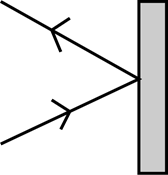
The illustration shows a light striking an object. In the illustration, the light striking the object is-
absorbed
stopped
reflected
refracted

Which of the following shows that light travels in a straight line? There are 2 correct answers. Mark them BOTH.
A
B
C
D
E

What are the reactants in this chemical equation?
villi and alveoli
water and energy
glucose and oxygen
blood and cells

Light travels
around corners
in straight lines
in zig zags
only when its warm

You are testing how the amount you water a plant affects its growth. What would be the INDEPENDENT VARIABLE in this experiment.
They type of pot you put the plants in.
The amount you water each plant.
The amount of sunlight the plants get.
The amount the plant grows.
reflect
stained glass window
light that bounces off an object
glass of water
clear window
Which item reflects light?
Mirror
Wax paper
Magnifying glass
Prism
This variable is the one thing that changed on purpose...
Dependent Variable
Control
Independent Variable

This is an example of...
independent
dependent
control
The material that transmits A LOT of light is the
one-way mirror
mirror
glass
dependent variable
the one variable that is changed/manipulated
the group that is kept the SAME
what is being measured/observed, the DATA

Things that make us wonder about the world, are observable, and can be explained by science are:
Live lab
Phenomenon
science labs

On this side of the one way mirror you can only see a reflection and not see through the glass because _______________?
It is light on both sides of the mirror
it is dark on both sides of the mirror
there is more light on one side than on the other side

We used a tool called a light meter to measure the amount of light reflected off and transmitted through each material. What is the unit of measurement we used?
amp
lux
lit
The material that reflects A LOT of light is the
one-way mirror
glass
mirror
none of the above

Sound can travel through (choose all that apply)
empty space with no matter
gases
liquids
solids

Amplitude is the
distance from the starting position to a peak or valley
the number of peaks or valleys in one second
the number of waves in one second
How high you are in the mountains

Frequency is
something very odd
the distance from starting position to a peak or valley
the number of waves in one second
the number of peaks or valleys in one second

Which structure sends the signal to the brain when you hear a sound?
eardrum
auditory canal
auditory nerve
cochlea
What is the primary purpose of the Open Sci Ed initiative?
To provide open-access scientific journals
To develop high-quality science education materials
To fund scientific research projects
To create online science courses
Which of the following is a key feature of Open Sci Ed's curriculum design?
Focus on rote memorization
Emphasis on hands-on experiments
Exclusive use of digital resources
Strict adherence to traditional teaching methods
Open Sci Ed aims to improve science education by focusing on which of the following aspects?
Increasing standardized testing
Enhancing teacher professional development
Reducing classroom sizes
Eliminating homework
In the context of Open Sci Ed, what is the role of phenomena-based learning?
To replace textbooks with online articles
To engage students through real-world scientific phenomena
To focus solely on theoretical knowledge
To limit the use of laboratory experiments
How does Open Sci Ed support diverse learning needs in science education?
By providing a one-size-fits-all curriculum
By offering differentiated instruction strategies
By focusing only on advanced learners
By excluding technology from the classroom

