
 Worksheets
STAAR
Total questions: 25
Worksheet time: 25mins

Which of these cycles is a direct result of Earth’s rotation?
Day and night
Moon phases
Rainfall and evaporation
Seasons
The Sun seems to move across the sky from sunrise to sunset. Why does the Sun seem to move?
The Sun is rotating on its axis.
Earth is rotating.
The Sun is orbiting around Earth
Earth is orbiting around the Sun.
The Moon, Sun, and Earth have different physical characteristics. Which of these best describes a physical characteristic of the Sun?
It is a solid and has many layers
It rotates on its axis every 24 hours
It is mostly made of hydrogen and helium
It is smaller and has less gravity than Earth or the Moon

The diagram shows the shadow of a tree in a field at noon on a summer day. The sun rises at 7:00 A.M. on this day. Which diagram best shows the shadow of the tree at 10:00 A.M. on the same day?


Which of these best explains why the sun appears to move across the sky each day?


A student draws a model showing the movements of Earth, the moon, and the sun. Which arrow shows the movement that causes day and night on Earth?
Arrow 1, because it shows the rotation of the sun
Arrow 2, because it shows the orbit of Earth around the sun
Arrow 3, because it shows the orbit of the moon around Earth
Arrow 4, because it shows the rotation of Earth

Some students used a globe to model the rotation of Earth. They shaded in Texas on the globe, as shown below. They rotated the globe and observed that Texas was in exactly the same place after each rotation. The students could rotate the globe quickly or slowly. If the globe could rotate only at the rate that Earth actually rotates, about how long would each complete rotation take?
30 days
60 minutes
24 hours
365 days

About how long will it take for the Moon to move from the position shown above to a position directly between Earth and the Sun?
1 week
14 days
1 month
2 seasons

A student observed the moon through the month of September. What did the student most likely observe between September 23rd and September 30th?
The amount of light will grow to the full moon phase
The amount of light will shrink to the full moon phase
The amount of light will shrink to the new moon phase
The amount of light will shrink to the first quarter phase
A student builds a model of the solar system that includes a sphere representing Earth. The sphere turns in a full circle on its axis. By using a model of Earth that spins on its axis, the student can best demonstrate —
the cycle of the four seasons
the aging of a star
the passing of a year
the cycle of day and night

Asteroids are large bodies of rock that are too small to be planets. An asteroid belt has many asteroids. The diagram shows the asteroid belt located between Mars and the first outer planet. Which outer planet is closest to this asteroid belt?
Uranus
Neptune
Saturn
Jupiter
A student is looking for evidence that Earth is always rotating on its axis. Which of the following would provide the best evidence?
The different amount of rain that falls each day
The appearance of shadows changing throughout the day
The presence of other planets in the night sky
The different phases of the moon in a month

Shadows cast by objects change throughout the day. The picture below shows the shadow cast by a tree at 3:00 P.M. Which picture shows how the tree’s shadow most likely looked at 9:00 A.M.?


A teacher asks students to explain what they see in this picture. Four student explanations are shown in the box
Student 1 only
Students 2 and 4 only
Student 2 only
Students 1 and 3 only
A student is looking for evidence that Earth is always rotating on its axis. Which of the following would provide the best evidence? (5.8C)
The different amount of rain that falls each day
The appearance of shadows changing throughout the day
The presence of other planets in the night sky
The different phases of the moon in a month

A student draws a model showing the movements of Earth, the moon, and the sun. Which arrow shows the movement that causes day and night on Earth? (5.8C)
Arrow 1, because it shows the rotation of the sun
Arrow 2, because it shows the orbit of Earth around the sun
Arrow 3, because it shows the orbit of the moon around Earth
Arrow 4, because it shows the rotation of Earth

A student observed the Sun throughout the day over the neighbor’s house. The change the student observed is caused by -
orbit of Earth around the Sun
rotation of Earth on its axis
orbit of the Sun through space
reflection of the Sun off the Moon

Shadows cast by objects change throughout the day. The picture shows the shadow cast by a tree at 3 pm. Which picture shows how the tree's shadow most likely looked at 9 am? (5.8C)


Which of these best explains why the sun appears to move across the sky each day? (5.8C)


F
G
H
J
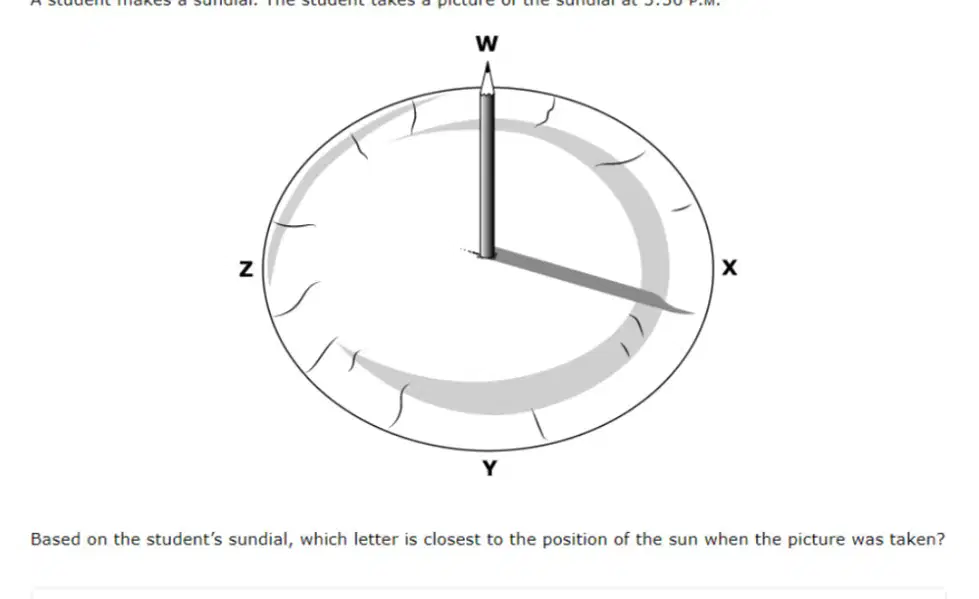
A student makes a sundial. The student takes a picture of the sundial at 3:30 P.M. Based on the student’s sundial, which letter is closest to the position of the sun when the picture was taken?
W
X
Y
Z
What is the primary reason for the change in seasons on Earth?
The distance of Earth from the Sun changes.
The tilt of Earth's axis relative to its orbit.
The speed of Earth's rotation changes.
The gravitational pull of the Moon.
Which of the following best describes the process of photosynthesis?
Conversion of light energy into chemical energy by plants.
Breaking down of food molecules to release energy.
Exchange of gases between plants and the atmosphere.
Absorption of nutrients from the soil.
A student conducts an experiment to test the effect of sunlight on plant growth. Which of the following is the independent variable in this experiment?
The amount of sunlight the plants receive.
The height of the plants.
The type of soil used.
The amount of water given to the plants.
Which of the following best explains why a metal spoon feels colder than a wooden spoon at room temperature?
Metal is a better conductor of heat than wood.
Metal has a higher density than wood.
Metal reflects more light than wood.
Metal is heavier than wood.

