
 Worksheets
Lesson the Rock Cycle
Total questions: 25
Worksheet time: 25mins

Mr. Rieser challenges his seventh grade class to explain how the process of weathering, erosion and deposition are essential to the rock cycle. Each group's response is shown above. Which group has the best response?
Group 1
Group 2
Group 3
Group 4

A list of various events within the rock cycle are shown above. Which of the following sequence of numbers is in the correct order to describe how lava could change into metamorphic rock?
1, 2, 3, 4
2, 1, 4, 3
3, 1, 2, 4
4, 3, 1, 2
Which of the following statements best describes how metamorphic rock is formed?
High temperature and intense pressure may transform an igneous rock into a metamorphic rock with banded layers.
Low temperature and intense pressure may transform a sedimentary rock into a metamorphic rock with banded layers.
High temperature and low pressure from Earth's core may transform an igneous rock into a metamorphic rock with banded layers.
Low temperature and low pressure may transform an igneous rock into a metamorphic rock with banded layers.

Which statement best describes the relationship between igneous and metamorphic rocks?
Igneous rocks must go through the sedimentary process to change into metamorphic rocks.
Igneous rocks are chemically changed into metamorphic rocks because of high temperature and pressure.
Metamorphic rocks are formed from melting igneous rocks.
Metamorphic rocks and igneous rocks do not follow a rock cycle.

Magma (the molten rock present deep inside the earth) or lava on earth's surface following a volcanic eruption, solidifies due to rapid cooling and crystallizes to form a type of rock called (a) .
igneous rocks
metamorphic rocks
sedimentary rocks
Label the three main types of rocks correctly
Deposition
Weathering
Sediment
Granite
Metamorphic
Igneous
Sedimentary
Obsidian

Jasmine created the following flow chart about sedimentary rock. Flow Chart Where did Jasmine make a mistake?
Weathering of rock material must occur after erosion takes place.
Deposition must occur before sediment is cemented.
Compaction must occur before sediment is deposited and cemented together.
Erosion of weathered sediment must occur after compaction.
Which of the following situations best describes the chemical weathering process of sedimentary rock?
Sedimentary sandstone is carried away by water along the bedrock of a stream.
Sedimentary sandstone allows water to freeze and thaw inside its cracks.
Sedimentary limestone cliffs are battered by strong ocean waves.
Sedimentary limestone is exposed to acid rain at the top of a mountain.

This rock formed when bits of other rocks became pressed into a solid. What type of rock is it?
Sedimentary Rock
Metamorphic Rock
Igneous Rock

When sediments are pressed together tightly, this is called ____________.
Compaction
Cementation
Weathering
Erosion

Click the Rock Cycle diagram to enlarge: What process is responsible for producing metamorphic rock?
Cooling
Compaction and cementation
Melting
Heat and pressure
Click the Rock Cycle diagram to enlarge: How does metamorphic rock become sediment?
Cooling
Weathering and erosion
Melting
Compaction and cementation
Click the Rock Cycle diagram to enlarge: How does metamorphic rock become igneous rock?
Cooling
Melting and cooling
Heat and pressure
Weathering and erosion
This rock was formed when molten rock cooled into a solid. What type of rock is it?
Igneous Rock
Metamorphic Rock
Sedimentary Rock

This rock was formed when magma cooled very slowly inside the Earth. What specific type of rock is it?
Intrusive Igneous Rock
Extrusive Igneous Rock
Foliated Metamorphic Rock
Clastic Sedimentary Rock

This rock formed when lava cooled very quickly on Earth's surface. What specific type of rock is it?
Extrusive Igneous Rock
Intrusive Igneous Rock
Non-Foliated Metamorphic Rock
Biochemical Sedimentary Rock
When you watch a volcano erupt molten rock, you are seeing _____
Lava
Magma
Mineral Crystals
Igneous Rocks
What are the 3 major types of rocks?
Igneous, Metamorphic, Sedimentary
Metamorphic, Igneous, Cementation
Brown, Red, Gray
Streak, Hardness, Breakage
Two ways to describe types of igneous rocks are _____
Extrusive and Intrusive
Foliated and Non-Foliated
Clastic and Biochemical
Black and Gray
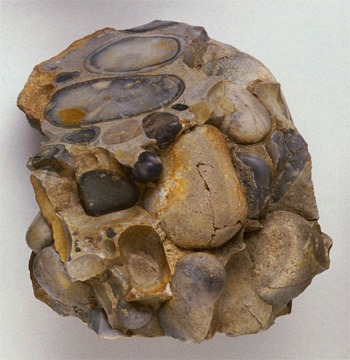
This rock was formed by smaller pieces of rock that settled at the bottom of a lake millions of years ago. What type of rock is this?
Sedimentary
Igneous
Metamorphic
Which of the words below describe mud, sand, and tiny bits of rocks that cement together to form a type of rock?
stalactites
magmas
metamorphs
sediments
Which process is responsible for the formation of sedimentary rocks?
Compaction and cementation of sediments
Melting and solidification of magma
High pressure and temperature
Cooling of lava
What type of rock is formed from the cooling and solidification of magma beneath the Earth's surface?
Extrusive igneous rock
Intrusive igneous rock
Sedimentary rock
Metamorphic rock
Which of the following best describes the process of metamorphism?
Transformation of rocks by heat and pressure
Erosion of rocks by wind and water
Deposition of sediments in layers
Melting of rocks into magma
In the rock cycle, what is the primary process that transforms sedimentary rock into metamorphic rock?
Heat and pressure
Weathering and erosion
Melting and cooling
Compaction and cementation

