
 Worksheets
GSE S8P2
Total questions: 25
Worksheet time: 25mins
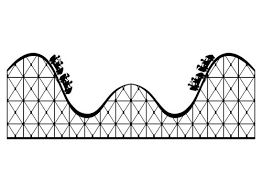
When a roller coaster is at the bottom of a hill it has
high potential energy
high kinetic energy
low kinetic energy
equal amounts of kinetic and potential energy

At which point is potential energy greatest?
W
X
Y
Z
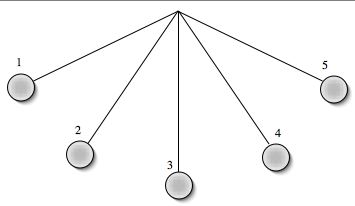
When a pendulum swings, at which point is kinetic energy highest?
1
2
3
4

In the diagram below, a 5 kg object is moving with a speed of 10 m/s, and a 10 kg object is moving with a speed of 5 m/s. Which object in the diagram has more kinetic energy?
Both of the objects have the same amount of kinetic energy.
The 5 kg object has more kinetic energy.
The 10 kg object has more kinetic energy.
Neither object has any kinetic energy.
What happens to the magnetic field around a wire when the electric current through the wire increases?
It decreases
It remains the same
It increases
It reverses direction
What is the principle of energy transfer in a battery-operated device?
Mechanical to electrical
Electrical to mechanical
Chemical to electrical
Electrical to chemical
What is the term for the rate at which energy is transferred or converted?
Power
Energy
Work
Force
What is the unit of resistance in an electrical circuit?
Volt
Ampere
Ohm
Watt
When a person holds an object, it has potential energy. How will the potential energy change if the person lifts the object above his or her head?
The object's potential energy will be the same.
The object's potential energy will be greater.
The object's potential energy will be less.
The object's potential energy will be zero.

A demonstration helps students understand the principle of roller coaster design. Which answer choice correctly describes the ball’s kinetic and potential energy?
The ball has more PE at position X than at position Z.
The ball has more KE at position Y than at position W.
The PE and KE of the ball are equal at position X
The PE and KE of the ball are greatest at position Z.

The bicycle rider is traveling up a hill. When the rider reaches the top of the hill, she stops to rest. Then she travels down the hill. The diagram shows the rider in the three different positions. Which of these correctly describes the potential energy and the kinetic energy of the bicycle rider?
When the rider is at the top of the hill, her potential energy is the greatest, and her kinetic energy is the least.
As the rider moves up the hill, her kinetic energy increases, and her potential energy decreases.
When the rider goes down the hill, her potential energy increases, and her kinetic energy decreases.
As the rider reaches the bottom of the hill, her kinetic energy and her potential energy decrease.

The table lists the mass and speed of each of four objects. Which two objects have the same kinetic energy?
A and D
B and D
A and C
B and C
Jayla drops the same 10-kg ball from heights of 1 m, 2 m, and 3 m. Which graph correctly shows the kinetic energy of the ball that Jayla dropped from each height?


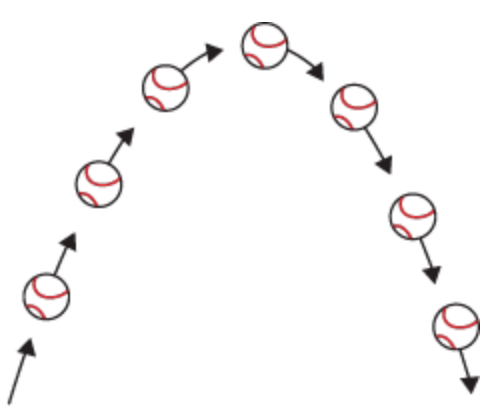
The diagram shows a baseball being thrown into the air. Which graph best represents how the kinetic energy (KE) and potential energy (PE) of the baseball change through its flight?


A student is planning an investigation in which different modes of heat transfer will be used to heat a thermometer . The diagram shows the setup used to conduct the first part of the investigation .
In this setup, the thermometer is being heated by conduction and convection . How should the student change the setup to heat the thermometer by using only radiation?
(S8P2)


(S8P2)


The diagram shows three types of electromagnetic radiation and their range of frequencies . Which explanation correctly uses the data in the diagram to show how infrared radiation and ultraviolet radiation are related in terms of energy?
Ultraviolet radiation has less energy than infrared radiation because energy is inversely proportional to
frequency and the frequency of ultraviolet radiation is higher .
Ultraviolet radiation has more energy than infrared radiation because energy is inversely proportional to frequency and the frequency of ultraviolet radiation is lower .
Ultraviolet radiation has less energy than infrared radiation because energy is proportional to frequency and the frequency of ultraviolet radiation is lower .
Ultraviolet radiation has more energy than infrared radiation because energy is proportional to frequency and the frequency of ultraviolet radiation is higher .

A student is investigating how a negatively charged rubber rod affects how charges are distributed on two stainless steel spheres that are touching each other. A diagram that shows two steps of the investigation is shown .
Which diagram for step 2 correctly predicts the distribution of charges on the stainless steel spheres?
(S8P5)


A lab group is investigating how Earth’s gravitational acceleration affects the force exerted on toy blocks of different masses . The diagram shows the results of their investigation . The group claims that the amount of force needed to accelerate a toy block is directly proportional to its inertia .
The claim is false because every time the mass of the metal cube is increased, the pointer on the spring scale moves downward .
The claim is true because every time the mass of the metal cube is doubled, the gravitational force doubles .
The claim is false because every time the volume of the metal cube is increased, the pointer on the spring scale moves downward .
The claim is true because every time the volume of the metal cube is doubled, the gravitational force doubles .
A student claims that Earth has a magnetic field. Which evidence would best support the student's claim?
The student creates a working circuit that illuminates a bulb using wire and a battery.
The student turns in all directions with a compass and the needle always points north.
The student receives a shock after walking across the carpet and touching a doorknob.
The student rolls a ball down a large hill and the ball comes to a complete stop at the bottom

Which of the diagrams shows the least gravitational force?
I
II
III
IV
What is the principle of energy conservation in a closed system?
Energy can be created or destroyed
Energy can be transformed from one form to another
Energy is always lost as heat
Energy is only conserved in mechanical systems
Which of the following best describes the process of conduction?
Transfer of heat through a fluid
Transfer of heat through electromagnetic waves
Transfer of heat through direct contact
Transfer of heat through a vacuum
What happens to the frequency of a wave if the wavelength increases while the speed remains constant?
The frequency increases
The frequency decreases
The frequency remains the same
The frequency doubles
In an experiment, a student measures the temperature of a substance as it changes state from solid to liquid. What is the expected observation during the phase change?
The temperature increases
The temperature decreases
The temperature remains constant
The temperature fluctuates

