
 Worksheets
Unit 4 Study Guide
Total questions: 20
Worksheet time: 16mins

What is the thickest layer of the Earth?
Crust
Mantle
Outer Core
Inner Core
From least to most dense, what is the correct order of Earth's four major layers?
crust, outer core, inner core, mantle
inner core, outer core, mantle, crust
crust, mantle, outer core, inner core
mantle, inner core, outer core, and crust
Which description best represents heat flow and movement in Earth's mantle?
When magma is heated, it becomes more dense and sinks. When magma is cooled, it becomes less dense and rises.
When magma is heated, it becomes less dense and sinks. When magma is cooled, it becomes more dense and rises.
When magma is heated, it becomes more dense and rises. When magma is cooled, it becomes less dense and sinks.
When magma is heated, it becomes less dense and rises. When magma is cooled, it becomes more dense and sinks.
Tommy saw footage of a landslide on the news. He saw rocks falling from the side of a mountain, with some of them smashing into each other and breaking apart. Tommy witnessed:
erosion and weathering.
erosion and compacting.
weathering and compacting.
weathering and sedimentation.

Which layer of the Earth is liquid Iron and Nickle?
Crust
Mantle
Outer Core
Inner Core
Which layer of the Earth is the thickest layer reaching 2,891 km?
Crust
Mantle
Outer core
Inner core
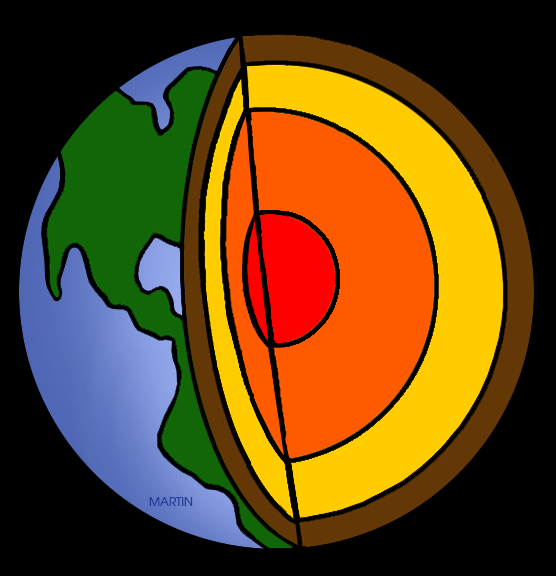
Which layer is shown in orange?
crust
mantle
outer core
inner core
What is the composition of the Earth's inner core?
Solid silicate minerals
Molten silicate minerals
Liquid iron and nickel
Solid iron and nickel
Which layer is shown in yellow?
crust
mantle
outer core
inner core
What is the composition of the Earth's outer core?
Solid silicate minerals
Molten silicate minerals
Liquid iron and nickel
Solid iron and nickel
What are Tectonic plates?
Large moving pieces on Earth's surface that are made of rock.
where two plates divide
The inner core of the earth
where magma rises up and solidifies
Why do the areas along the "Ring of Fire" experience many volcanic eruptions and earthquakes?
There is strong tidal activity along the coasts.
There are numerous tectonic plate boundaries.
There are powerful ocean currents in the Pacific.
There is warm and cool water mixing in the Pacific.
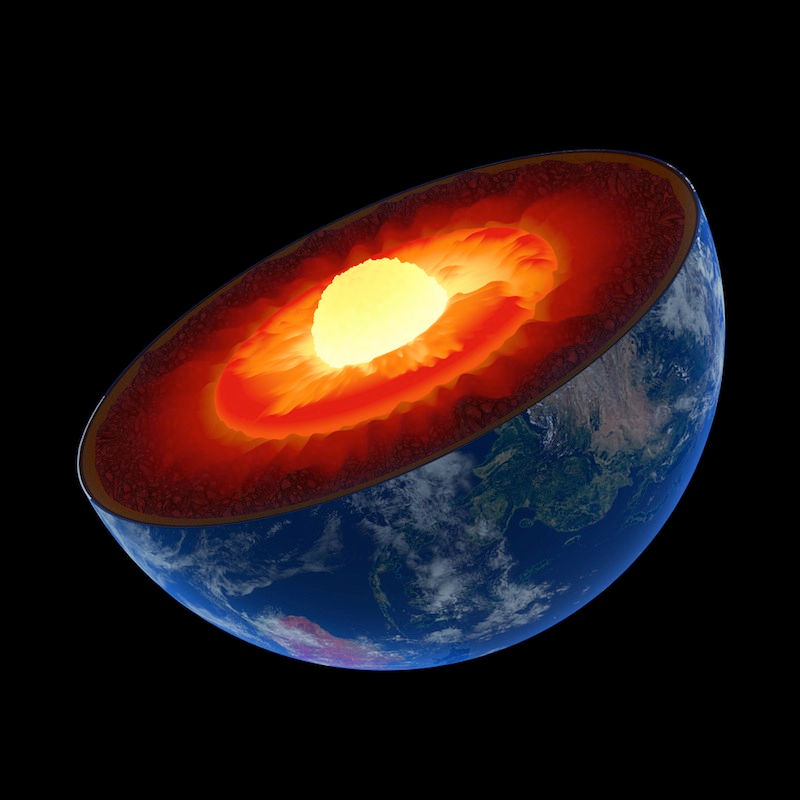
A student wants to create a model of a stream to show the process of erosion. Which type of stream should the student create in the model to cause the greatest amount of erosion?
A quickly moving stream with a small amount of water
A slowly moving stream with a small amount of water
A quickly moving stream with a large amount of water
A slowly moving stream with a large amount of water
What is the most likely reason that the bones of a Mesosaurus are found on the eastern coast of South America and on the western coast of Africa?
Flooding
Geographic isolation
Plate tectonics
Analogous structures
In which of Earth's layers are the convection currents?
Crust
Inner Core
Mantle
Outer Core
Weathering is the process of -
Moving sediment from one place to another
Dropping or leaving sediment in a location
Breaking down rocks into sediment

What is this picture an example of?
Erosion
Deposition
Weathering
The force

The process in which sediment settles out (drops to the bottom) of the water or wind that is carrying it
Weathering
Erosion
Sedimentation
Deposition

