
Font size
 Worksheets
Chapter 7 Cell Structure and Function
Total questions: 88
Worksheet time: 2hrs 5mins
Which is not a principle of cell theory?
Very few cells reproduce
cells are the basic units of life
all living things are made of cells
all cells come from existing cells
What is the basic unit of life according to cell theory?
Tissues
Cells
Molecules
Atoms
Who is credited with the discovery of cells?
Albert Einstein
Robert Hooke
Isaac Newton
Charles Darwin
Which of the following statements is true about cell theory?
All living organisms are composed of one or more cells
Cells are only found in plants
All cells have a nucleus
Cells can spontaneously generate
A student examines a cell under the microscope and determines that it is a eukaryote. Which structure did the student identify in order to come to this conclusion?
DNA
nucleus
ribosome
cell wall
Which statement distinguishes prokaryotic cells from eukaryotic cells?
Prokaryotic cells include most cells, other than bacteria, and lack a nucleus and membrane-bound organelles.
Prokaryotic cells include most cells, other than bacteria, and contain a nucleus and membrane-bound organelles.
Prokaryotic cells include mainly bacteria and lack a nucleus as well as membrane-bound organelles.
Prokaryotic cells include mainly bacteria and contain a nucleus as well as membrane-bound organelles.
Cells lacking a nucleus would also lack which other cell structure:
vacuole
ribosomes
DNA
cell wall

The Cell Theory:
1. All living organisms are composed of one or more (a) . (Unicellular or Multicellular)
2. All cells arise from (b) cells. (Not from Spontaneous Generation)
3. Cells are the structural and functional unit of (c) . (Nothing living smaller than a Cell)
The Cell Theory:
1. All living organisms are composed of one or more (a) . (Unicellular or Multicellular)
2. All cells arise from (b) cells. (Not from Spontaneous Generation)
3. Cells are the structural and functional unit of (c) . (Nothing living smaller than a Cell)
Match the following parts of the Cell Theory
Cells are the ______ of life
basic unit
All cells come from...
pre-existing (other) cells
All organisms are made of
cells
Sort the following statements based on if the statement is talking about prokaryotes or eukaryotes
Tap on all of the prokaryotic cells
Place the following terms in their corresponding categories
nucleus
no nucleus
ribosomes
Determine where the following organelles can be found (if the organelle can be found in more than one, place in the middle of the two columns).
A table comparing the characteristics of four samples is shown. Click on the sample name that is most likely a prokaryote.
Place the following terms in their corresponding categories
no membrane bound organelles
membrane bound organelles
cell membrane

See how much you remember! Match the following characteristics that belong to Eukaryotes, Prokaryotes, or BOTH!
- No nucleus
- No membrane-bound organelles
- DNA in the cytoplasm
- Single Celled
Prokaryote
- Nucleus
- Membrane bound organelles
- DNA in the nucleus
- Single & Multi celled
Eukaryote
- Ribosomes
- DNA
- Cell Division
- Plasma Membrane
Prokaryote and Eukaryote
Label the Table
Prokaryotic or Eukaryotic?
prokaryotic
eukaryotic
Which of these is INCORRECT?
Identify the type of cell each column represents.
Which cell is generally MUCH larger?
Choose the images that represent a Prokaryotic cell:

Based on the structure of the cell seen under the microscope, scientist determined the cell was a (a) cell.

Prokaryotic cells and Eukaryotic cells are BOTH surrounded by a (a) , have (b) , contain (c) , and contain (d) .

Students use a microscope to look for structures present in four different cells. The students placed an X for each structure that was viewed for each cell on the table shown.
Which cells that were viewed are most likely prokaryotes? Choose TWO correct answers. (a) (b)
Which cell is a Prokaryote?

This cell pictured is a (a) because it has (b) nucleus (c) membrane bound organelles.
Label correctly.
Prokaryote
Eukaryote

In what organelle is the genetic material found inside?
Endoplasmic Reticulum
Golgi Complex
Nucleolus
Nucleus

What cell part is NOT found in all cells?
Chloroplasts
Cell Membrane
Cytoplasm
Nucleus

What organelle contains your genes?
DNA
Genomes
Proteins
Alleles

Where is DNA found in a Eukaryotic cell?
in the nucleus
in the cell wall
in the mitochondria
Which section of the cell cycle could be labeled as interphase?
Select the area of the chart that represents CELL DIVISION (mitosis and cytokinesis)
The combination of chemical reactions through
which an organism builds up or breaks down
materials as it carries out its life processes is called ...
absorption
metabolism
digestion
consumption
Which of the following is a material that heterotrophs are unable to metabolize?
carbohydrates
nucleic acids
lipids
proteins
When is glucose synthesized?
What is metabolism?
the chemical processes that occur within a living organism in order to maintain life
the chemical processes that build molecules in the body
the chemical processes that break down molecules in the body

An organism made of only one cell is called . . .
(a)
Eukaryotic
Monocellular
Multicellular
An organism made of only one cell is called . . .
Eukaryotic
Monocellular
Multicellular
Unicellular

A _____ organism is made of many cells, each specialized to do certain jobs.
Eukaryotic
Multicellular
Prokaryotic
Unicellular
An organism made of only one cell is called . . .
Eukaryotic
Monocellular
Multicellular
Unicellular
An organism made of only one cell is called . . .
Eukaryotic
Monocellular
Multicellular
Unicellular
Which organelle synthesizes proteins for the cell?
Golgi body
ribosome
rough endoplasmic reticulum
smooth endoplasmic reticulum
Which of the following regarding the cell membrane is the most incorrect statement?
It serves as a selectively permeable barrier allowing substances to travel in one direction into the cell.
It serves as a mediator between internal and external environments.
It contains proteins, which span the membrane.
It contains phospholipids as a structural component.
The Cell Theory:
1. All living organisms are composed of one or more (a) . (Unicellular or Multicellular)
2. All cells arise from (b) cells. (Not from Spontaneous Generation)
3. Cells are the structural and functional unit of (c) . (Nothing living smaller than a Cell)
Match the following parts of the Cell Theory
Cells are the ______ of life
basic unit
All cells come from...
pre-existing (other) cells
All organisms are made of
cells
The Cell Theory:
1. All living organisms are composed of one or more (a) . (Unicellular or Multicellular)
2. All cells arise from (b) cells. (Not from Spontaneous Generation)
3. Cells are the structural and functional unit of (c) . (Nothing living smaller than a Cell)
Which statement concerning diffusion and active transport is correct?
active transport requires cell energy while diffusion doesn't.
Both diffusion and active transport require cell energy.
Diffusion requires cell energy while active transport doesn't.
Neither diffusion nor active transport requires cell energy.

What is the function of the organelle pictured?
stores waste and nutrients for cellular use
produces hormones and energy for cellular use
processes and modifies proteins for cellular use
breaks down and digests proteins for cellular use
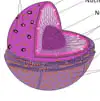
Examine the cell structure shown below. What is the function of this cell structure?
control center
energy conversion
protein manufacturing
transporting materials

The diagram below shows what cell process?
glycolysis
exocytosis
endocytosis
passive transport
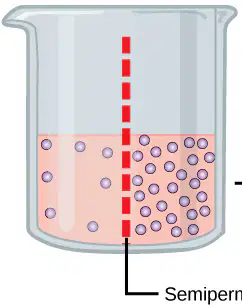
The diagram below shows a container divided into two compartments by a semi-permeable membrane with circles representing salt. Two solutions containing different concentrations of dissolved salt were placed on each side of the membrane. Which describes what will happen to the water level during the process of osmosis?
The water level on the right side of the membrane will increase
The water level on both sides of the membrane will stay the same
The water level on both sides of the membrane will decrease
The water level of the left side of the membrane will increase
Normally, in the process of osmosis, the net flow of water molecules into or out of the cell, depends upon differences in the
rate of movement of insoluble molecules inside the cell.
rate of molecular motion on either side of the cell membrane.
concentration of water molecules inside and outside the cell.
concentration of proteins on the plasma membrane.
What regulates the flow of water through a cell membrane?
the absence of a cell wall
the concentration of the solution
the presence of a cell wall
the thickness of the membrane
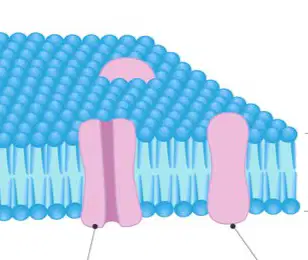
The diagram represents a portion of the cell membrane. How does the protein channel assist in maintaining homeostasis?
It allows some material in and out of the cell.
It converts energy to ATP.
It synthesizes carbohydrate molecules.
It synthesizes proteins.
Match the following parts of the Cell Theory
Cells are the ______ of life
basic unit
All cells come from...
pre-existing (other) cells
All organisms are made of
cells
A molecule of K+ (potassium) attaches to a carrier protein located on the cell membrane. A molecule of ATP attaches to the interior of the same carrier protein. The protein changes shape and allows the molecule of K+ to enter the cell. What is this process most likely classified as?
facilitated diffusion
exocytosis
endocytosis
active transport
A salt water plant is placed in a freshwater lake. Predict the direction in which water will move across the plant's cell wall and the effect of that movement on the plant.
water would move into the plant's cells, causing the plant to wilt.
water will move out of the plant's cells, causing the plant to wilt.
water would move out of the plant's cells, causing the plant to swell.
water would move into the plant's cells, causing the plant to swell.
A cell with a 10% solute (salt) concentration is placed into a beaker with a solute (salt) concentration of 20%. What will happen to the cell over time?
The cell will gain water and expand.
The cell will bot again and lose equal amounts of water. It will, therefore, remain the same size.
The cell will lose water and shrink.
The cell will undergo no exchange of water with its surroundings.
Blood plasma and sea water are nearly isotonic. What will happen to a red blood cell placed in distilled water.
Distilled water: a type of purified water. Salts, minerals, and other organic materials are removed by collecting the steam from boiling water.
It will swell
It will disintegrate
It will shrink
It will divide
Deverne says that one difference between birds and mammals is that birds lay eggs, while mammals do not. Is this a true statement? Explain.
(a)
Give an example of a way that a reptile can change its internal body temperature.
(a)
What is the function of a lateral line on a fish?
(a)
The Cell Theory:
1. All living organisms are composed of one or more (a) . (Unicellular or Multicellular)
2. All cells arise from (b) cells. (Not from Spontaneous Generation)
3. Cells are the structural and functional unit of (c) . (Nothing living smaller than a Cell)
Compare AND contrast snakes and lizards.
Include (1)ONE way they are alike AND different.
(a)
Describe the life cycle of amphibians using an example.
(a)
Match the following processes to their location in the cell.
light independent reaction
(Calvin Cycle)
stroma (chloroplasts)
Krebs Cycle
mitochondrial matrix
light dependent reaction
(ETC)
thylakoid membrane
(chloroplasts)
glycolysis
cytoplasm
Electron Transport Chain
inner membrane of the mitochondria (cristae)
The combination of chemical reactions through
which an organism builds up or breaks down
materials as it carries out its life processes is called ...
absorption
metabolism
digestion
consumption
What is metabolism?
the chemical processes that occur within a living organism in order to maintain life
the chemical processes that build molecules in the body
the chemical processes that break down molecules in the body
When is glucose synthesized?
The combination of chemical reactions through which an organism builds up or breaks down materials as it carries out its life processes is called ...
absorption
metabolism
digestion
consumption

Directs all cell activities through the DNA located there.
Lysosomes
Nucleus
ribosomes
Mitochondria

In which part of the plant cell does photosynthesis take place?
Nucleus
Mitochondria
Chloroplast
Ribosome
Tap on all of the prokaryotic cells
Sort the following statements based on if the statement is talking about prokaryotes or eukaryotes
Place the following terms in their corresponding categories
nucleus
no nucleus
ribosomes
Determine where the following organelles can be found (if the organelle can be found in more than one, place in the middle of the two columns).
A table comparing the characteristics of four samples is shown. Click on the sample name that is most likely a prokaryote.
Label the Table
Prokaryotic or Eukaryotic?
prokaryotic
eukaryotic
See how much you remember! Match the following characteristics that belong to Eukaryotes, Prokaryotes, or BOTH!
- No nucleus
- No membrane-bound organelles
- DNA in the cytoplasm
- Single Celled
Prokaryote
- Nucleus
- Membrane bound organelles
- DNA in the nucleus
- Single & Multi celled
Eukaryote
- Ribosomes
- DNA
- Cell Division
- Plasma Membrane
Prokaryote and Eukaryote
Which cell is generally MUCH larger?
Based on the structure of the cell seen under the microscope, scientist determined the cell was a (a) cell.
Prokaryotic cells and Eukaryotic cells are BOTH surrounded by a (a) , have (b) , contain (c) , and contain (d) .
This cell pictured is a (a) because it has (b) nucleus (c) membrane bound organelles.
Label correctly.
Prokaryote
Eukaryote

