
Font size
 Worksheets
AP Micro Unit 5
Total questions: 25
Worksheet time: 25mins
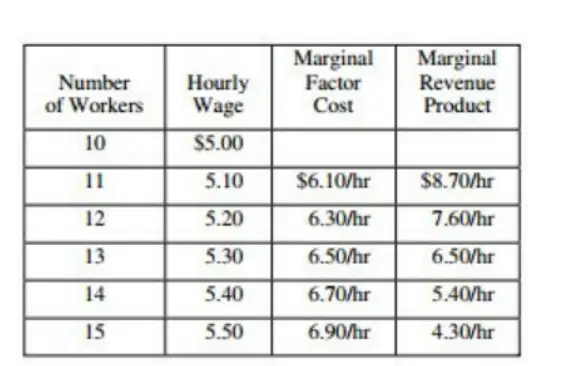
According to the information in the table above, the twelfth worker would increase the hourly profit by 4MI56.
$0.20
$1.10
$1.30
$2.40
$5.20

The graph above shows the marginal revenue product curve and supply curve of labor for a firm. The introduction of new management techniques dramatically increases workers productivity. Which of the following changes is most likely to occur?
The supply curve will shift to the left, increasing the wage rate.
The supply curve will shift to the right, increasing employment.
The marginal revenue product curve will shift to the right, increasing wage rate.
The marginal revenue product curve will shift to the left, reducing employment.
Neither the marginal revenue product curve nor the supply curve will shift, but the wage will increase and employment will fall.

The graph above shows a monopsony labor market. In the absence of any regulations, which of the following represents the number of workers the firm will hire and the wage rate it will offer to those workers? 4MI52
Number of Workers: 15, Wage Rate: $30
Number of Workers: 20, Wage Rate: $20
Number of Workers: 20, Wage Rate: $40
If a large number of unskilled workers enter the labor market, which of the following is most likely to occur in the labor market for unskilled workers?
The supply curve will shift to the right and the wage rate will decrease.
The supply curve will shift to the left and the wage rate will increase.
The demand curve will shift to the left and the wage rate will decrease.
The demand curve will shift to the right and the wage rate will increase.

In the monopsonistic labor market shown in the diagram, which of the following indicates the number of workers the firm will hire and the wage rate it will pay, respectively?
L1, W3
L1, W1
L1, W2
L2, W2

What wage and quantity combination will this firm choose to maximize profits?
600 workers, $70 per day
600 workers, $35 per day
400 workers, $25 per day
400 workers, $55 per day
Oreo cookies are now extremely expensive to purchase. Instead of buying Oreo cookies, I now want to buy Chips Ahoy. What determinant of demand does this likely fall under?
Change in Consumer Price Expectations
Change in Price of Complementary Good
Change in Number of Consumers in the Market
Change in Price of Substitute Good
A decrease in the price of machinery will likely have which result?
The demand for labor will increase.
The demand for labor will decrease.
The supply of machinery will decrease.
Firms will hire to the point where MRP = W.
If worker productivity increases, which of the following will likely occur?
Demand for workers will increase; wage rate will increase
Demand for workers will decrease; wage rate will increase
Demand for workers will increase; wage rate will decrease
Supply of workers will increase; wage rate will decrease

Assume that a company sells widgets for $5 per widget. What is the marginal revenue product of hiring the 3rd worker?
(a)

What is the opportunity cost of moving from point B to C on the curve?
30 tons of wheat
30 tons of steel
5 tons of wheat
5 tons of steel
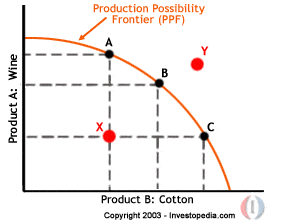
What does point Y represent on the PPC?
Efficiency
Unattainable / impossible
Inefficency
Nothing

Which of the following constitute the fundamental questions every economic system must answer?
I, III, V only
I, II, and IV only
I, II, and V only
II, IV, and V only
What happens to the equilibrium price and quantity of a good when there is an increase in demand and no change in supply?
A) Equilibrium price increases, equilibrium quantity increases
B) Equilibrium price decreases, equilibrium quantity decreases
C) Equilibrium price increases, equilibrium quantity decreases
D) Equilibrium price decreases, equilibrium quantity increases
If the government imposes a price ceiling below the equilibrium price, what is the likely outcome?
A) Surplus
B) Shortage
C) No effect
D) Increase in supply
Which of the following is an example of a public good?
A) National defense
B) A sandwich
C) A private car
D) A smartphone
What is the primary goal of a firm in a perfectly competitive market?
A) Maximize revenue
B) Maximize profit
C) Maximize market share
D) Minimize costs
In the context of microeconomics, what does the term 'marginal cost' refer to?
A) The total cost of production
B) The cost of producing one more unit of a good
C) The cost of producing all units of a good
D) The average cost of production
What is the effect of a subsidy on the supply curve of a good?
A) Shifts the supply curve to the left
B) Shifts the supply curve to the right
C) No effect on the supply curve
D) Causes a movement along the supply curve
Which of the following best describes 'elastic demand'?
A) Demand that is not affected by price changes
B) Demand that changes significantly with price changes
C) Demand that changes slightly with price changes
D) Demand that is perfectly inelastic
What is the likely effect on the labor market if a minimum wage is set above the equilibrium wage?
A) Increase in employment
B) Decrease in employment
C) No change in employment
D) Increase in demand for labor
Which of the following is a characteristic of a monopoly?
A) Many sellers
B) No barriers to entry
C) Unique product with no close substitutes
D) Perfect information
What is the role of 'opportunity cost' in decision making?
A) It represents the total cost of a decision
B) It is the cost of the next best alternative foregone
C) It is the cost of all alternatives foregone
D) It is the cost of the chosen alternative
In a competitive market, what happens when a firm experiences an increase in production costs?
A) The firm's supply curve shifts to the right
B) The firm's supply curve shifts to the left
C) The firm's demand curve shifts to the right
D) The firm's demand curve shifts to the left
What is the effect of an increase in consumer income on the demand for a normal good?
A) Demand decreases
B) Demand increases
C) No change in demand
D) Demand becomes perfectly elastic

