
Font size
 Worksheets
Exchange Rate
Total questions: 25
Worksheet time: 25mins
What is an exchange rate?
The rate at which goods are exchanged between two countries
The price of one nation's currency in terms of another's
How many US dollars you can exchange for RMB at Travelex
The price of goods in terms of a foreign currency

According to the table, what is the USD equivalent of 1 Australian?
0.97 USD
1.32 USD
1.28 USD
1.03 USD

According to the table, what is the Euro equivalent of 1 USD?
1.32 Euros
0.53 Euros
.76 Euros
1.59 Euros
How is an exchange rate determined in the money market?
The forces of supply and demand
Government/the Federal Reserve Bank
Whatever sellers of goods are willing to take
Investors decide the value of the currency they wish to invest
The price of one nation's currency in terms of another country's currency is called
fiscal policy
monetary policy
the exchange rate
the discount rate
price in one country in relation to other currencies in the international exchange market is known is-
equilibrium rate
fixed exchange rate
exchange rate
flexible exchange rate
The exchange rate is determined when
Demand for Forex=Supply of Forex
Demand for Forex > Supply of Forex
Demand for Forex < Supply of Forex
Match the following vocab terms
exchange rate
what currencies are worth, comparatively
appreciation
currency increases in value- stronger
depreciation
currency decreases in value- weaker
currency
used as a medium of exchange
What does it mean when an economist says a currency is stronger?
It can be exchanged for more of a lesser foreign currency
It can be converted to prices in any currency
There a few things it could buy
It will buy fewer foreign goods

Why do countries need an exchange rate?
to promote tourism
to determine GDP
to see who has the most money
to trade with each other
If real interest rates in Europe rose relative to that in the US, what would happen to US dollars in the foreign exchange markets?
The supply of US dollars would decrease.
The demand of US dollars would decrease.
The supply of US dollars would increase.
There would be no change.
Why do changing exchange rates help one country and hurt the other?
One side loses purchasing power and the other gains it
Takes money away from one side and gives it to the other
Causes war between the two countries
One country's government introduces tariffs to protect local industries
What type of exchange rate system do most countries operate under?
Flexible
Floating
Fictitious
Fixed
If the US $ were to appreciate in relation to the Euro, what effect would this have?
European consumers would have more purchasing power in US
US consumers can buy more European goods and services for fewer $$
US consumers can buy more English goods and services for fewer $$
European tourists to the US will spend more $$
If the Mexican Peso depreciates in relation to the Chinese Yuan, how is Mexico affected?
Mexico has less purchasing power in Chinese currency
Mexico benefits from increased purchasing power
Mexico would have more Chinese investors
They would be invaded by China
What is likely to cause a rise in a country’s foreign exchange rate?
a fall in its exports of goods and services
a fall in its imports of goods and services
a fall in its inflow of income
a rise in its outflow of transfers
A developing country’s two major sources of income from international trade are fishing and tourism. If the country’s exchange rate depreciated, what is likely to happen?
Imported goods would become cheaper for local people.
The country would definitely become poorer.
The price of fish sold as exports would become cheaper.
Tourists to the country would be discouraged by higher prices.
When the US$ exchange rate falls it will usually
help to reduce a US trade deficit.
increase the foreign price of US exports.
reduce the price of US imports.
reduce US inflation

The US currently trades in oil with the UK. The discovery of new oil and gas deposits in the US will mean that its oil imports decrease and its oil exports increase.
From the initial equilibrium point of X, which letter indicates the new equilibrium point for the US exchange rate?
A
B
C
D
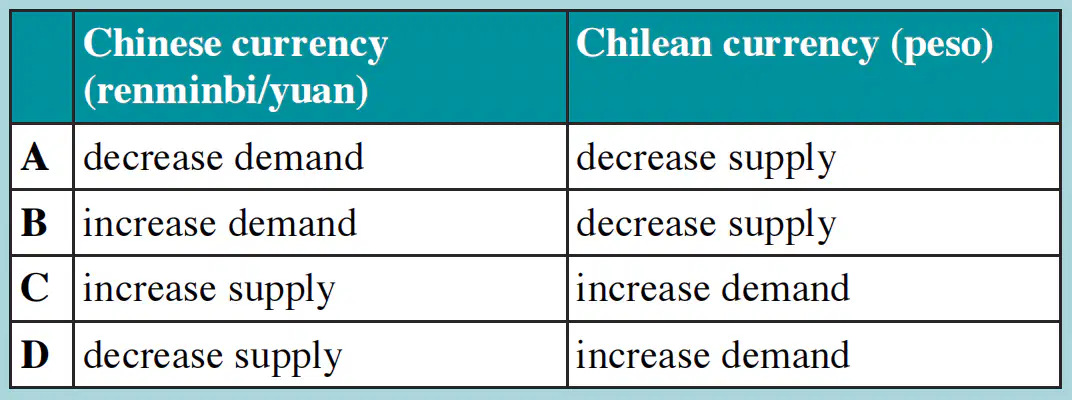
A Chinese firm buys copper from Chile. What effect will this transaction have on the foreign exchange market?
A
B
C
D
What is the primary function of an exchange rate in international trade?
To determine the value of goods in a foreign market
To establish the cost of currency conversion between countries
To regulate the amount of currency in circulation
To set the price of commodities globally
Which of the following factors can cause a country's currency to appreciate?
A decrease in interest rates
An increase in inflation
A rise in foreign investment
A trade deficit
How does a fixed exchange rate system differ from a floating exchange rate system?
A fixed exchange rate is determined by market forces, while a floating rate is set by the government
A fixed exchange rate is set by the government, while a floating rate is determined by market forces
Both systems are determined by market forces
Both systems are set by the government
What impact does a strong domestic currency have on a country's exports?
Makes exports cheaper for foreign buyers
Makes exports more expensive for foreign buyers
Has no impact on export prices
Increases the demand for exports
Why might a country choose to devalue its currency?
To increase the purchasing power of its citizens
To make its exports more competitive
To reduce inflation
To attract foreign tourists

