
 Worksheets
World History EOC Review
Total questions: 15
Worksheet time: 15mins
Which event represents a breakdown of relations between the United States and the Soviet Union after World War II?
The Soviet Union joining the North Atlantic Treaty Organization (NATO)
The United States and the Soviet Union sponsoring the Marshall Plan
The Soviet Union imposing the Berlin Blockade
The United States and Soviet Union joining the United Nations
What was the MAIN reason tanks were introduced during World War I?
To locate and remove land mines from the battlefield
To transport military supplies to the front lines
To overcome trench defenses and end stalemates
To monitor enemy troop movements
Which World War II action occurred under the leadership of General Douglas MacArthur?
the liberation of the Philippines
the invasion into North Africa
the victory at Normandy
the occupation of Berlin
Why did President Franklin Roosevelt create the Fair Employment Practices Committee during World War II?
to ensure that government contractors paid adequate wages for women
to ensure that government contractors avoided racial discrimination in hiring
to ensure that government contractors provided a safe working environment
to ensure that government contractors avoided excessive overtime for workers
At the height of the Cold War rivalry between the United States and the Soviet Union, HUAC’s influence soared and contributed to a climate of domestic fear stoked by its sensational and often unsubstantiated investigations. —“The Permanent Standing House Committee on Un-American Activities,” The committee mentioned in this statement was investigating suspected members of the
Communist Party
Navajo Talkers
Flying Tigers
Civilian Conservation Corps
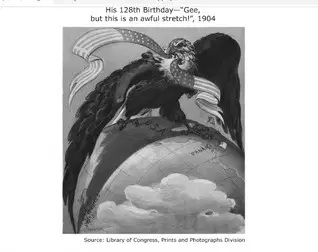
What message about imperialism did this political cartoon convey?
The closer an acquired territory was, the more self-government it should be allowed to exercise.
Imperialism was not likely to improve access to overseas markets.
It was not worth angering European powers to annex new territories
The farther imperialist expansion extended, the harder it would be for the United States to maintain control.
The Gulf of Tonkin Resolution increased the power of the executive branch by —
allowing the president to use military force without a declaration of war by Congress
authorizing the president to choose the Senate Majority Leader
allowing the president to introduce bills to Congress
expanding the president’s right to executive privilege
In what way was Alvin C. York influential in World War I?
He inspired others to oppose the conflict.
He inspired others with his military strategy.
He motivated others with his example of heroism
He motivated others to oppose new weapons technology
What were the so-called "SALT 1" talks about?
increasing mineral trade between the U.S. and Soviet Union
reducing nuclear weapons/missile
improving the taste of bland foods
learning how to store nuclear waste in salt domes
How did OPEC affect the US in the 1970s?
Led to the opening of trade and diplomacy with the Middle East
Americans lost faith in their government
Resulted in sharp increase of gas prices, inflation and unemployment
Helped sign SALT
The Camp David Accords negotiated during the Carter Administration were an attempt to -
End rapidly inflating oil prices
Establish peace in the Middle East
Decrease U.S. control of Panama Canal
Encourage the use of solar and otherclean energy sources
President Bush and the United Nations sent in troops in January 1991, their goal was the restore peace in Kuwait. What was the name of this conflict, which lasted six weeks?
World War II
Vietnam War
Persian Gulf War
This means war
Which ancient civilization is credited with the development of the first known form of writing, cuneiform?
A) Ancient Egypt
B) Ancient China
C) Mesopotamia
D) Indus Valley
What was the primary purpose of the Great Wall of China during the Qin Dynasty?
A) To serve as a trade route
B) To protect against invasions from northern tribes
C) To mark the boundary of the empire
D) To promote tourism
Which event marked the beginning of the Protestant Reformation in Europe?
A) The signing of the Magna Carta
B) The fall of Constantinople
C) Martin Luther's Ninety-Five Theses
D) The French Revolution

