
 Worksheets
Reading Comprehension Butterworts and Their Habits
Total questions: 25
Worksheet time: 13mins
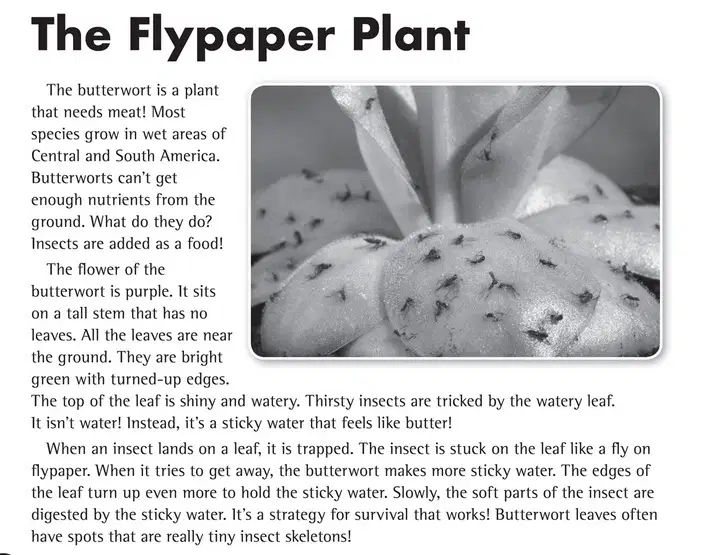
What does the word "nutrients" most likely mean in the sentence: "Butterworts can’t get enough nutrients from the ground."
A type of plant
Substances needed for growth
Pieces of insects
A kind of soil
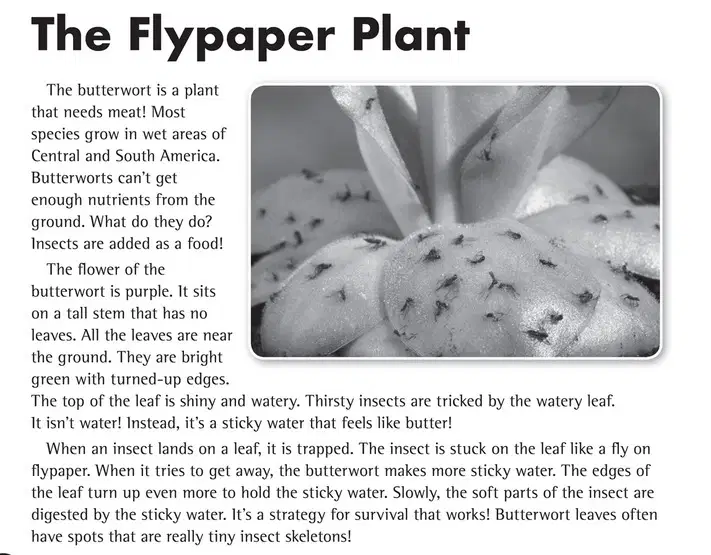
What does "trapped" mean in the sentence: "When an insect lands on a leaf, it is trapped."
Set free
Caught and unable to escape
Hidden from view
Changed into food
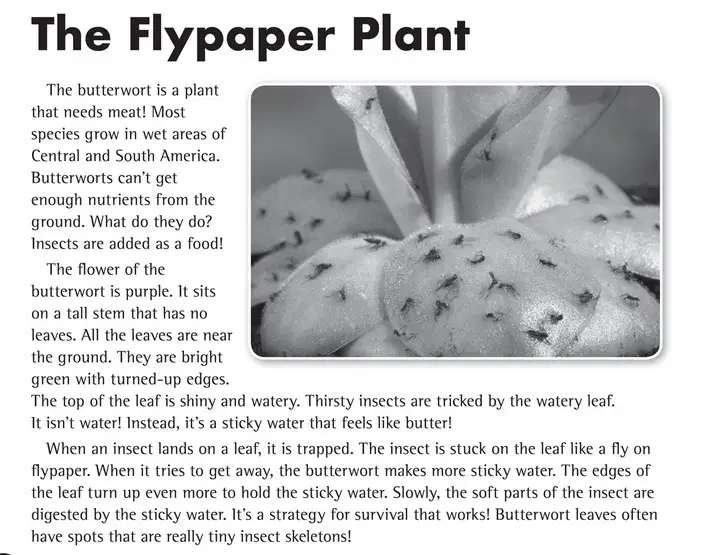
The word "sticky" in the text is closest in meaning to:
Slippery
Rough
Thick and glue-like
Dry
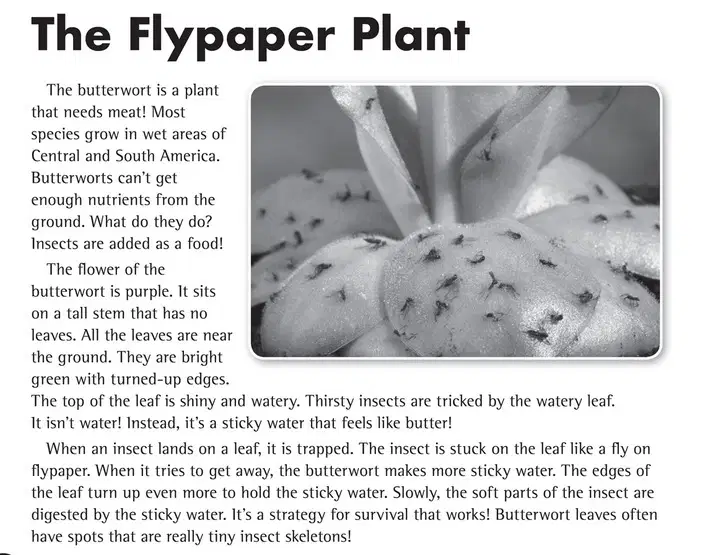
In the sentence, "Butterworts can’t get enough nutrients from the ground," the word "enough" means:
Too little
The right amount
Too much
None
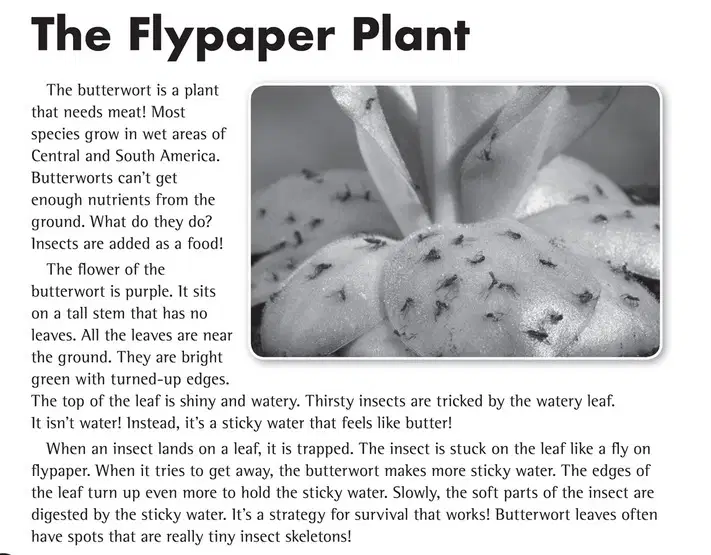
The phrase "turn up" in the text means:
Move upwards
Change color
Disappear
Grow larger
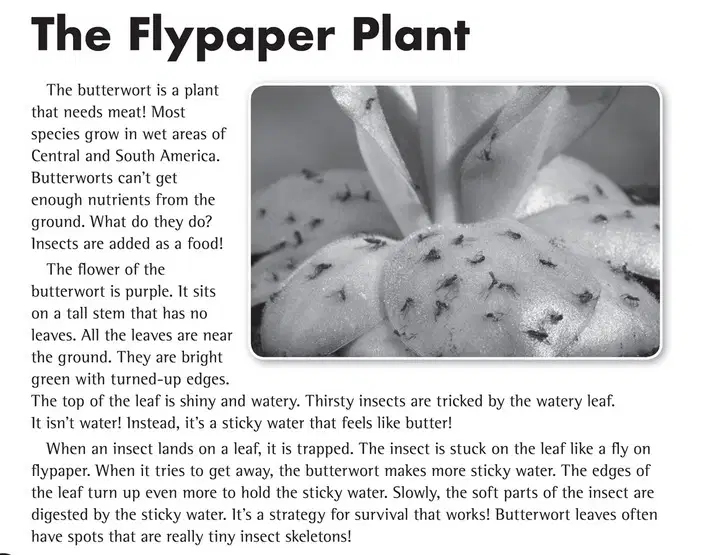
What does the word "digested" mean in the sentence: "Slowly, the soft parts of the insect are digested by the sticky water."
Broken down into simpler substances
Thrown away
Covered in water
Made stronger
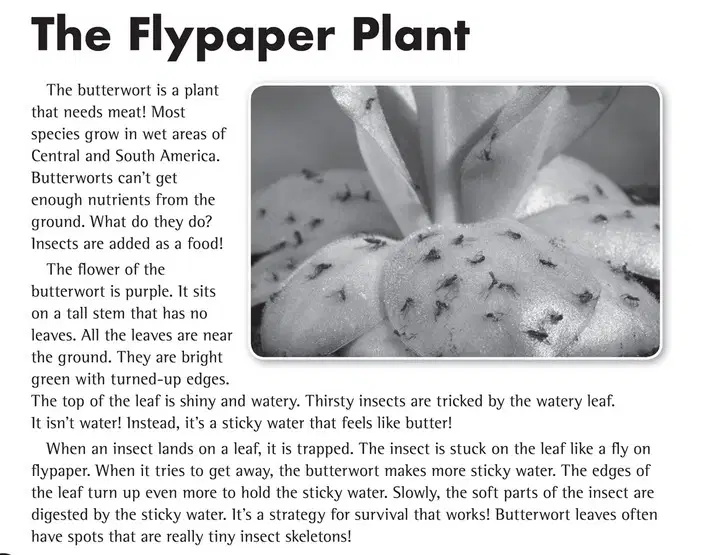
Which word is a synonym for "strategy" in the sentence: "It’s a strategy for survival that works!"
Trick
Plan
Game
Habit
What does "survival" mean in the passage?
Living and staying alive
Finding new insects
Changing color
Becoming weaker
The phrase "feels like butter" suggests that the sticky water is:
Hard
Smooth and soft
Cold and wet
Dry
What does "skeletons" mean in the sentence: "Butterwort leaves often have spots that are really tiny insect skeletons!"
Entire living insects
The hard remains of an insect’s body
Sticky parts of the leaf
The wings of an insect
What is the main idea of the passage?
Butterwort plants need a lot of water to survive.
Butterwort plants trap and digest insects for nutrients.
Butterwort flowers are very beautiful and purple.
Butterwort plants are dangerous to humans.
Which sentence best describes why butterworts eat insects?
They enjoy the taste of insects.
They need insects because they lack nutrients from the soil.
They want to keep insects away from other plants.
They only eat insects when there is no sunlight.
Which detail best supports the main idea that butterworts trap insects?
"The flower of the butterwort is purple."
"Thirsty insects are tricked by the watery leaf."
"Butterworts grow in wet areas of Central and South America."
"The leaves are bright green with turned-up edges."
What would happen if the butterwort didn’t produce sticky water?
It would not be able to trap insects for food.
It would grow taller.
It would turn brown.
It would need more water to survive.
Why do the edges of the butterwort leaves turn up when an insect lands?
To make the leaf look bigger
To hold more sticky water and trap the insect
To help insects drink the water
To allow the insect to escape
How does the butterwort trick insects?
It smells like food to attract them.
It looks like a safe place to drink water.
It moves its leaves quickly.
It makes a loud noise to scare them.
What is the best title for this passage besides "The Flypaper Plant" ?
"The Purple Flower of Butterwort"
"How Butterworts Catch Insects"
"Plants That Live in Wet Areas"
"The History of Carnivorous Plants"
Based on the passage, which of the following is true?
Butterworts only grow in dry areas.
Butterworts eat insects to get nutrients.
Butterworts do not need insects to survive.
Butterworts have no flowers.
What can we infer about the sticky water on butterwort leaves?
It is made of the same substance as real water.
It is important for catching and digesting insects.
It is used to keep the leaves fresh.
It helps insects drink water safely.
Why is the butterwort compared to flypaper in the title?
It looks like flypaper.
It is made from paper.
It traps insects like flypaper does.
It flies like an insect.
Which detail best supports the idea that the butterwort traps insects?
"The flower of the butterwort is purple."
"The top of the leaf is shiny and watery, tricking insects."
"Butterwort plants grow in wet areas of Central and South America."
"The leaves are bright green with turned-up edges."
What happens when an insect lands on a butterwort leaf?
It drinks the water and flies away.
It gets stuck because of the sticky substance.
It hides under the leaf for protection.
It helps the plant by cleaning its leaves.
Which sentence best explains how the butterwort digests insects?
"The insect is stuck on the leaf like a fly on flypaper."
"Slowly, the soft parts of the insect are digested by the sticky water."
"Butterwort leaves often have spots that are really tiny insect skeletons!"
"Thirsty insects are tricked by the watery leaf."
What is the function of the sticky water on butterwort leaves?
To keep the plant hydrated
To trap and digest insects
To attract butterflies
To make the leaves look shiny
Based on the passage, what can we infer about butterworts?
They have adapted to survive in places with poor soil nutrients.
They need insects only when they are young.
They are harmful to all insects, including bees and butterflies.
They prefer to grow in dry areas with little rain.

