
 Worksheets
Geography Ch 2
Total questions: 30
Worksheet time: 29mins
What is the position of the sun during the equinox?
Directly over the North Pole
Directly over the South Pole
Directly over the equator
Directly over the Tropic of Cancer
Depending on the season, parts of the world have 20-plus hours of sunlight or 20-plus hours of darkness because of the earth's tilt and revolution around the sun.
True
False
On the equinox, sunrise and sunset are roughly how many hours apart worldwide?
10 hours
12 hours
14 hours
16 hours
The main idea of Earth's rotation and revolution is:
Earth's rotation causes day and night, while its revolution causes seasons.
Earth's rotation causes seasons, while its revolution causes day and night.
Earth's rotation and revolution have no effect on Earth.
Earth's rotation and revolution are the same process.
Which phenomenon is responsible for the change in seasons?
During the summer solstice in the Northern Hemisphere, what happens?
The day is the longest day of sunlight in the year.
The day is the shortest of the year.
The night is the longest of the year.
The night is the shortest of the year.
The difference between spring and autumn equinoxes in the Northern Hemisphere is:
Spring equinox occurs in March, and autumn equinox occurs in September.
Spring equinox occurs in September, and autumn equinox occurs in March.
Both equinoxes occur in the same month.
Spring equinox occurs in June, and autumn equinox occurs in December.
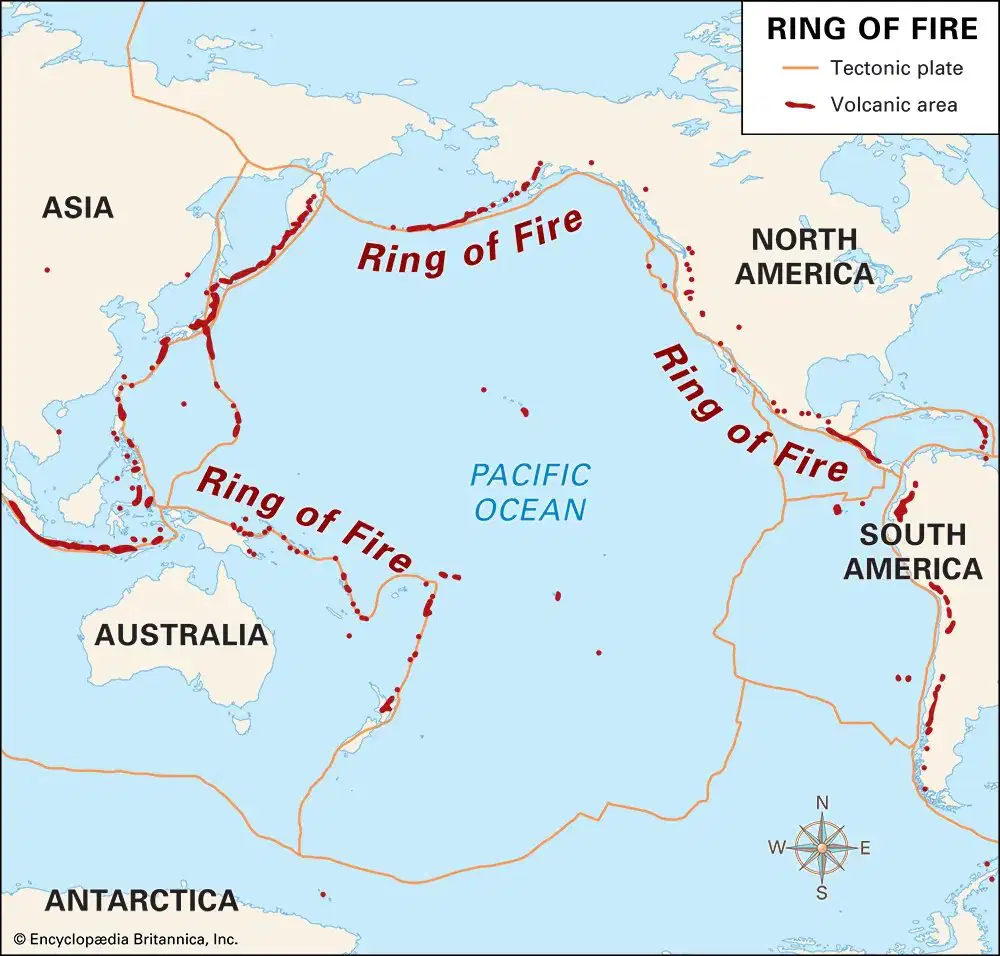
According to the diagram, Which ocean does the ring of fire exist in ?
Pacific
Southern
Artic
Atlantic
The prediction of how this will affect the Himalayas is:
It will cause more snowfall.
It will lead to increased tourism.
It will result in glacial melting.
It will have no significant impact.
What is the main characteristic of each layer of Earth?
The crust is solid and rocky, the mantle is semi-solid and flows slowly, the outer core is liquid, and the inner core is solid.
The crust is liquid, the mantle is solid, the outer core is semi-solid, and the inner core is gaseous.
The crust is gaseous, the mantle is liquid, the outer core is solid, and the inner core is semi-solid.
The crust is semi-solid, the mantle is gaseous, the outer core is solid, and the inner core is liquid.
A butte is a:
large flat-topped hill with steep sides
small hill with a rounded top
narrow ridge of rock
flat area of land

The continental margin is characterized by which of the following features as shown in the diagram?
Steep slopes and deep ocean trenches
Flat plains and shallow waters
Mountainous regions and volcanic activity
Coral reefs and sandy beaches
What is the main idea of the section 'Waters of the Earth'?
The section discusses the distribution and importance of water on Earth.
The section explains the chemical composition of water.
The section describes the history of water on Earth.
The section focuses on the economic value of water.

Which process in the hydrologic cycle involves water vapor cooling and changing into liquid droplets?

Fill in the blank: The Mississippi River begins as a small stream in northern ________.
Minnesota
Wisconsin
Iowa
Illinois

According to the chart, which continent has two of the longest world rivers, and what are they?
Africa: Nile and Congo
South America: Amazon and Paraná
Asia: Yangtze and Yellow
North America: Mississippi and Missouri
The difference between climate and weather is:
Climate refers to long-term atmospheric conditions, while weather refers to short-term changes.
Climate and weather are the same and can be used interchangeably.
Weather refers to long-term atmospheric conditions, while climate refers to short-term changes.
Climate and weather both refer to short-term atmospheric conditions.
Interpret Maps: Compare the weather map and the climate map. What differences do you notice?
The weather map shows short-term atmospheric conditions, while the climate map shows long-term patterns.
The weather map shows long-term patterns, while the climate map shows short-term atmospheric conditions.
Both maps show the same information.
The weather map shows ocean currents, while the climate map shows wind patterns.
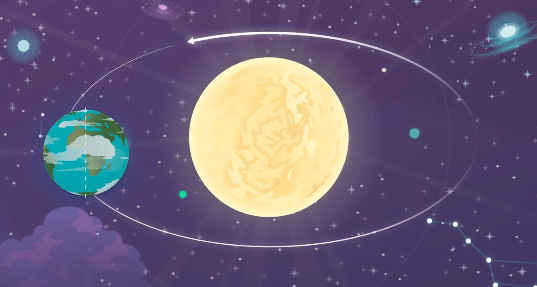
How long does it take for Earth to complete one full rotation?
2 hour
4 hours
24 hours
240 hours

The imaginary pole that runs through the center of the Earth is called Earth's _______________.
Pole
Axis
Arm
Hemisphere
Which hemisphere do we live in?
Northern Hemisphere
Southern Hemisphere
Western Hemisphere
Eastern Hemisphere
TRUE OR FALSE? The season we experience in June in the Northern Hemisphere is the exact same as the season someone in the Southern Hemisphere would experience.
True
False
Which term best describes Earth's spin on its axis?
revolution
rotation
orbital period
year
Which term best describes Earth orbiting around the sun?
revolution
rotation
orbital period
day
The table below classifies statements about patterns that happen in the sky. How should each column of the table be labeled to make the table correct?
Climate
Weather
Label the path of the sun during the equinox and solstice.
equinox (fall and spring)
summer solstice
winter solstice

