
 Worksheets
STAAR History Review
Total questions: 26
Worksheet time: 13mins
Name
Class
Date
1.
Which statement accurately describes the reasons for establishing Plymouth and Jamestown?
a)
Both colonies were established to bring wealth to stockholders
b)
Plymouth’s founders intended to produce raw materials, while Jamestown’s founders expected to discover gold.
c)
Both colonies were established to limit the expansion of other European empires.
d)
Plymouth was founded as a refuge from religious persecution, while Jamestown was founded for commercial profit.
2.

This excerpt provides one example of which constitutional principle?
a)
Federalism
b)
Checks and balances
c)
Popular sovereignty
d)
Individual rights
3.

What was another reason Congress passed this act in 1862?
a)
To promote settlement in the West
b)
To protect industry in the Northeast
c)
To improve transportation in the South
d)
To improve transportation in the South
4.

The numbered river on this map played a major role in
a)
the defeat of British troops at the Battle of Saratoga
b)
the exploration of new territory acquired from France
c)
the defeat of British invaders at the Battle of Fort McHenry
d)
the settlement of territory previously claimed by the Dutch
5.

This sequence of events resulted in the adoption of the
a)
Articles of Confederation
b)
Bill of Rights
c)
Treaty of Paris
d)
Declaration of Independence
6.

The U.S. foreign policy illustrated in this cartoon was intended to
a)
prevent further European colonization in the Western Hemisphere
b)
deter Spain from inciting revolution in former U.S. colonies
c)
encourage European powers to invest in Latin America
d)
keep the war between France and Spain from spreading to Latin America
7.
The Fifteenth Amendment was ratified in order to
a)
establish legal requirements for the education of former slaves
b)
mandate fair labor contracts between African American workers and plantation owners
c)
abolish the institution of slavery
d)
protect the voting rights of African American men
8.

Which statement best explains the changes shown in this table?
a)
Slaves from the Upper South were moved to the Lower South to work on cotton plantations
b)
The Upper South experienced an agricultural labor shortage in the antebellum period.
c)
Slaves were transferred from the Lower South to the Upper South to work in newly built factories.
d)
The Lower South lost population as settlers migrated west to establish new plantations.
9.

What was one effect of these events on the 1828 presidential election?
a)
Votes were cast by secret ballot.
b)
Property qualifications for voting were strengthened.
c)
Poll taxes were reduced.
d)
Voter participation increased.
10.
Which of these prompted Congress to propose the Fourteenth Amendment?
a)
The popular sovereignty provision in the Kansas-Nebraska Act
b)
The positions taken in the Know-Nothing Party platform
c)
The Black Codes enacted by southern states after the Civil War
d)
The opposition by southern states to the Emancipation Proclamation
11.

Which of these completes this graphic organizer?
a)
Parliament repeals the Stamp and Sugar Acts.
b)
King George III allows colonists to petition Parliament for tax relief.
c)
Parliament passes the Intolerable Acts.
d)
King George III appoints colonial representatives to Parliament.
12.
Which group was among the first to call for an end to slavery?
a)
American Indians, because they viewed the plight of slaves as similar to their own
b)
Quakers, because slavery contradicted their religious beliefs
c)
British loyalists, because Great Britain had ended the slave trade
d)
Puritans, because the New England economy did not rely on slavery
13.
In the debate over the ratification of the U.S. Constitution, which point would have been made by a Federalist?
a)
“The existing national government lacks the ability to add new states to the union.”
b)
“The states are in danger of losing the ability to raise revenue.”
c)
“The existing national government lacks the power to perform essential functions.”
d)
“The states are unable to protect the rights of the people.”
14.

Which of the following best completes this excerpt?
a)
Saratoga
b)
Concord
c)
Trenton
d)
Yorktown
15.

Which of the following was the most direct result of the environmental modifications listed above?
a)
Federal regulations were adopted to ensure safety and ease of travel on the road.
b)
State governments cooperated closely to maintain road quality.
c)
Improved transportation to western states expanded trade and settlement.
d)
Road construction became a major industry in the United States.
16.
What was one long-term consequence of the sharecropping system?
a)
Agricultural workers organized labor unions.
b)
Many former slaves became trapped in a cycle of debt.
c)
Many agricultural workers moved to cities to start small businesses.
d)
Landowners sold property to pay wages to former slaves.
17.

Patrick Henry was criticizing which aspect of the Constitution in this excerpt?
a)
The eligibility requirements for congressional office
b)
The power granted to the central government
c)
The establishment of a separate judicial branch
d)
The difficulty of the amendment process
18.
Boston and New Orleans were both founded as
a)
port cities
b)
farming communities
c)
industrial centers
d)
military outposts
19.
The United States acquired the Oregon Territory when
a)
a treaty divided U.S. and British claims to the land
b)
Mexico sold the territory to the United States for $10 million
c)
the territory’s settlers voted for annexation by the United States
d)
Russia sold the land to the United States for $7.2 million
20.

Which constitutional guarantee did this act violate?
a)
Freedom of assembly
b)
The right to due process
c)
Freedom of the press
d)
The right to a jury trial
21.
What was one major effect of the Second Great Awakening?
a)
Churches turned away from public politics and focused on internal religious issues.
b)
People were inspired to join reform movements to address social problems.
c)
Religious leaders petitioned legislatures to extend suffrage to women.
d)
Politicians were encouraged to promote states’ rights rather than federal unity
22.
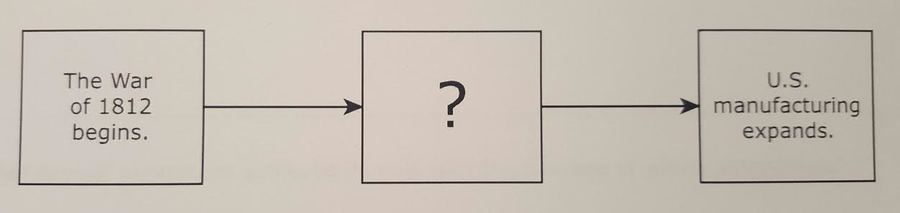
Which sentence best completes the diagram?
a)
The supply of British goods decreases.
b)
Congress ends the European embargo.
c)
Exports to Great Britain increase.
d)
Congress reduces tariffs.
23.
Which excerpt from the Declaration of Independence best explains why colonists were unhappy about their lack of representation in the British parliament?
a)
“He has refused to pass other Laws for the accommodation of large districts of people.”
b)
“For imposing Taxes on us without our Consent.”
c)
“He has refused his Assent to Laws, the most wholesome and necessary for the public good.”
d)
“For transporting us beyond Seas to be tried for pretended offences.”
24.
The abolitionist movement achieved its goal with the passage of which amendment?
a)
Twelfth Amendment
b)
Thirteenth Amendment
c)
Fourteenth Amendment
d)
Fifteenth Amendment
25.
• Job opportunities in cities increased.
Agriculture became more mechanized.
• Prices of consumer goods decreased.
These developments occurred as a result of increased
Agriculture became more mechanized.
• Prices of consumer goods decreased.
These developments occurred as a result of increased
a)
industrialization
b)
westward migration
c)
expansion of U.S. territory
d)
government regulation of business
26.
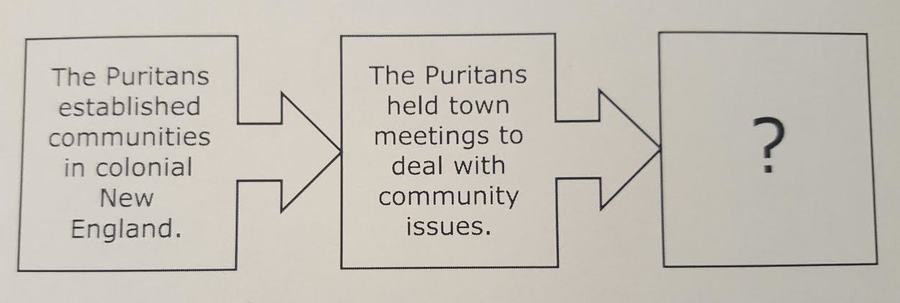
Which sentence best completes this diagram?
a)
The Puritans allowed women to participate in government.
b)
The Puritans refused to obey the appointed governor
c)
The Puritans outlawed slavery in Massachusetts.
d)
The Puritans developed a form of representative self-government.
100 %

