Wayground logo

Free Printable Worksheets

Font size

S
M
L
XL
Worksheets

mcas 2nd

Total questions: 131

Worksheet time: 11hrs 55mins

Name
Class
Date
1.

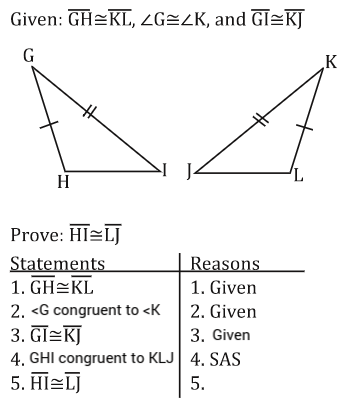
What is the theorem that justifies the congruence of the two triangles?

a)

HyL

b)

HyA

c)

LA

d)

LL

2.

What is the second corresponding congruent part of this two right triangles?

a)

Hypotenuses

b)

Legs

c)

Acute Angles

d)

None

3.

What is the theorem that justifies the congruence of the two right triangles?

a)

HyL

b)

HyA

c)

LA

d)

LL

4.

What is the theorem that justifies the congruence of the two right triangles?

a)

HyL

b)

HyA

c)

LA

d)

LL

5.

What is the theorem that justifies the congruence of the two right triangles?

a)

HyL

b)

HyA

c)

LA

d)

LL

6.

What is the theorem that justifies the congruence of the two right triangles?

a)

HyL

b)

HyA

c)

LA

d)

LL

7.

State what information is required to prove the triangles are congruent

a)

A

b)

B

c)

C

d)

D

8.

Which one of these is NOT a triangle congruency theorem?

a)

HL

b)

SSS

c)

AAA

d)

ASA

9.
Fill in the blank.
a)

Given

b)

Reflexive Property

c)

Transitive Property

d)

They're the same side!!!!!! 

10.

Which postulate or theorem proves the triangle congruent?

a)

LL: Leg

Leg

b)

Not enough information

c)

LA: Leg

Acute angle

d)

HA: Hypotenuse

Acute angle

e)

HL: Hypotenuse Leg

11.

In the right triangles, which parts are congruent? Choose two.

a)

GH‾ ≅ JK‾\overline{GH}\ \cong\ \overline{JK}  

b)

HI‾ ≅ KL‾\overline{HI}\ \cong\ \overline{KL}  

c)

GI‾ ≅ JL‾\overline{GI}\ \cong\ \overline{JL}  

d)

∠G ≅ ∠J\angle G\ \cong\ \angle J  

e)

∠I ≅ ∠L\angle I\ \cong\ \angle L  

12.
What is the correct choice for Statement 5?
a)

HL Theorem

b)

Congruent segments are two segments with equal measurements.

c)

LL Theorem

d)

CPCTC

13.

What additional information is required to prove the 2 triangles are congruent by LA postulate? Given angle V is congruent to angle A.

a)

A)

b)

B)

c)

C)

d)

D)

14.

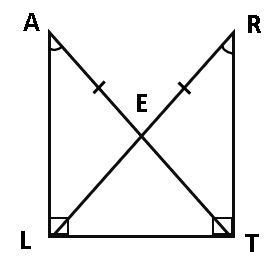
What triangle is congruent to ΔLAT\Delta LAT  ?

a)

ΔLET\Delta LET  

b)

  ΔLRT\Delta LRT

c)

  ΔRET\Delta RET

d)

ΔTRL\Delta TRL  

15.
Name the angles from SMALLEST to LARGEST
a)
Q, R, P
b)
P, Q, R
c)
R, P, Q
d)
R, Q, P
16.
Name the sides from SMALLEST to LARGEST
a)
RS, ST, TR
b)
ST, RT, RS
c)
RT, ST, RS
d)
RT, RS, ST
17.
Can a triangle be formed with side lengths:
4, 7, 10
a)
yes
b)
no
c)
not enough information
18.
Can a triangle be formed with side lengths:
10, 12, 22
a)
yes
b)
no
c)
not enough information
19.
Find the largest angle in Δ PRQ
a)
∠R
b)
∠P
c)
∠Q
d)
∠S
20.
Find the largest side in Δ BCD
a)
Segment BC
b)
Segment DB
c)
Segment DC
d)
Segment AB
21.
Order the sides from least to greatest. 
a)
DE, VE, DV
b)
VE, DE, DV
c)
DV, VE, DE
d)
DE, DV, VE
22.

What is n ?

a)

67

b)

113

c)

134

d)

180

23.

What is x ?

a)

36

b)

39

c)

75

d)

111

24.

What is the value of x and y ?

a)

x = 41, y = 92

b)

x = 88, y = 92

c)

x = 47, y = 88

d)

x = 88, y = 47

25.

What is the measure of angle 4?

a)

35

b)

92

c)

123

d)

145

26.

Select all that are TRUE. You will want to write this one out on paper!

a)

AB > AE

b)

BE > CE

c)

BE > CD

d)

CD < DE

e)

CE > BC

27.
Find the largest side in Δ BCD
a)
Segment BC
b)
Segment DB
c)
Segment DC
d)
Segment AB
28.

Name this triangle by its angles and sides.

a)

acute, scalene

b)

acute, isosceles

c)

obtuse, equilateral

d)

equiangular, equilateral

29.

Using the Hinge Theorem, compare QT and ST

a)

QT < STQT\ <\ ST

b)

QT > STQT\ >\ ST

c)

QT = STQT\ =\ ST

d)

QT‾ ≅ ST‾\overline{QT}\ \cong\ \overline{ST}

30.
Find the largest side in Δ BCD
a)
Segment BC
b)
Segment DB
c)
Segment DC
d)
Segment AB
31.

Given: AD‾≅BC‾\overline{AD}\cong\overline{BC}  and  m∠DAC > m∠ACBm\angle DAC\ >\ m\angle ACB  which statement below is true based on the Hinge Theorem?

a)

m∠DCA>m∠BACm\angle DCA>m\angle BAC  

b)

AB>DCAB>DC  

c)

m∠ADC>m∠CBAm\angle ADC>m\angle CBA  

d)

DC>ABDC>AB  

32.

Name this triangle by its sides.

a)

scalene

b)

isosceles

c)

equilateral

d)

obtuse

33.
Identify the smallest angle.
a)
∠K
b)
∠L
c)
∠M
34.

Choose the TRUE statement.

a)

m∠HGI > m∠JGIm\angle HGI\ >\ m\angle JGI

b)

m∠HGI  <  m∠JGIm\angle HGI\ \ <\ \ m\angle JGI

c)

m∠HGI=m∠JGIm\angle HGI=m\angle JGI

d)

The above statements are all false.

35.
Using the hinge theorem, we can say that Angle 1 _____ Angle 2.
a)
Less than
b)
Greater than
c)
Equal to 
d)
Half of
36.

Choose the TRUE statement.

a)

m∠C<m∠Fm\angle C<m\angle F

b)

m∠C>m∠Fm\angle C>m\angle F

c)

m∠C=m∠Fm\angle C=m\angle F

d)

The above statements are all false.

37.

Name this triangle by its sides

a)

scalene

b)

isosceles

c)

equilateral

d)

acute

38.

Using the Converse of the Hinge Theorem, which inequality relates ∠FBG and ∠BFA?

a)

m∠FBG <m∠BFAm\angle FBG\ <m\angle BFA

b)

m∠FBG >m∠BFAm\angle FBG\ >m\angle BFA

c)

m∠FBG ≥m∠BFAm\angle FBG\ \ge m\angle BFA

d)

m∠FBG ≤m∠BFAm\angle FBG\ \le m\angle BFA

39.

Find the range of possible values for x.

Hint: why can we use the SSS inequality theorem? What does this tell us about how the angles are related to each other? Can you write an inequality to represent this relationship?

Do this one on paper or a whiteboard!

a)

72<x<24\frac{7}{2}<x<24

b)

x<6x<6

c)

24<x24<x

d)

112<x<6\frac{11}{2}<x<6

40.
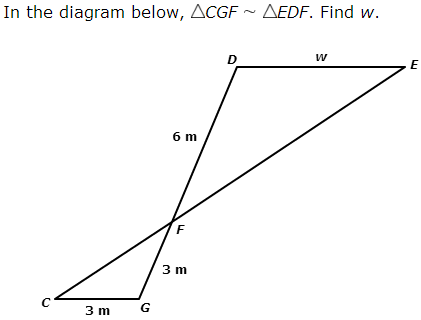
Review the picture.  Find the missing side measurement in the picture using a proportion.
a)
w = 18 m
b)
w = 6 m
c)
6 m
d)
w = 0.16 m
41.
a)
SIMILAR BY SSS
b)
SIMILAR BY SAS
c)
SIMILAR BY AA
d)
THEY ARE NOT SIMILAR
42.
Are the triangles similar? If so, what similarity shortcut is used? Show all work.
a)
Similar.  SAS
b)
Similar.  AA
c)
Similar. SSS
d)
Not Similar
43.
The triangles are similar by...
a)
SAS
b)
AA
c)
ASA
d)
SSS
44.
The triangles are similar by...
a)
SAS
b)
AA
c)
ASA
d)
SSS
45.

Are these two triangles similar and if so, identify the correct similarity statement.

a)

AA~

b)

SSS~

c)

SAS~

d)

None of these

46.

ΔPRQ ∼ ΔDEF\Delta PRQ\ \sim\ \Delta DEF  
What is the scale factor of  ΔPRQ \Delta PRQ\  to  ΔDEF\Delta DEF ?

a)

5: 6

b)

3: 5

c)

2: 3

d)

5: 3

47.

ΔPRQ ∼ ΔDEF\Delta PRQ\ \sim\ \Delta DEF  
What is  m∠Dm\angle D  ?

a)

35

b)

89

c)

56

d)

40

48.

ΔPRQ ∼ ΔDEF\Delta PRQ\ \sim\ \Delta DEF  
What is  DEDE  ?

a)

48

b)

33.33

c)

60

d)

40

49.
Find missing side
a)
5
b)
7
c)
9
d)
11
50.
Complete each proportion.
AB / BM  =  ? / CD
a)
BC
b)
AC
c)
MD
d)
MC
51.
Two equilateral triangles are ___ similar.
a)
always
b)
sometimes
c)
never
52.
Two right triangles are ____ similar.
a)
always
b)
sometimes
c)
never
53.

Which triangles are similar to triangle A?

a)

B

b)

C

c)

Both

d)

None

54.
Determine if the triangles are similar. Justify.
a)
Yes, by SSS.
b)
Yes, by SAS. Scale Factor is 1:2.
c)
Yes, by SAS. Scale Factor is 3:1.
d)
No, not similar.
55.
If two figures are similar, the corresponding sides are ______________.
a)
equal
b)
congruent
c)
proportional
d)
none of these
56.
If two figures are similar their angles are______.
a)
proportional
b)
congruent
c)
supplementary
d)
complementary
57.
A power pole 10 m tall casts a shadow 8 meters long, at the same time that a building nearby casts a shadow 14 m long.  How tall is the building?
a)
9 m
b)
15.2 m
c)
12 m
d)
17.5 m
58.

Two consecutive angles of a parallelogram measures (x + 30) and 2(x-30) respectively. What is the value of x?

a)

40

b)

50

c)

60

d)

70

59.

Two consecutive angles of a parallelogram measures (x+30) and 2(x-30) respectively. What is the measure of the smaller angle?

a)

20

b)

40

c)

60

d)

80

60.
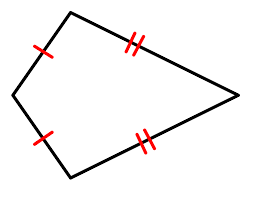
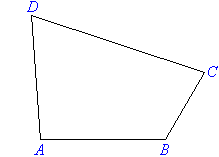
What shape is this?
a)
Rectangle
b)
Kite
c)
Trapezoid
d)
Parallelogram
61.
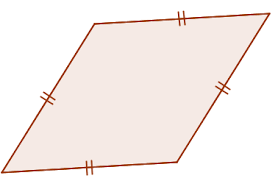
What shape is this?
a)
Quadrilateral
b)
Rectangle
c)
Square
d)
Rhombus
62.
What shape is this?
a)
Rectangle
b)
Square
c)
Rhombus
d)
Trapezoid
63.
A _______________ is a quadrilateral with two sets of parallel sides.
a)
trapezoid
b)
parallelogram
c)
kite
d)
triangle
64.
How many degrees are in the missing angle?
a)
60°
b)
114°
c)
70°
d)
360°
65.
Which of the following properties is true about parallelograms?
a)
Base angles are congruent.
b)
Diagonals are congruent.
c)
Opposite sides are parallel.
66.
Which of the following properties is true about squares?
a)
Four congruent sides.
b)
Exactly one diagonal bisects a pair of opposite angles.
c)
Exactly one pair of parallel sides.
67.
Which of the following properties is true about rectangles?
a)
Four congruent sides.
b)
Four right angles.
c)
Diagonals bisect opposite angles.
68.

The shown quadrilateral is a rectangle. If AB is 10 what is the length of DC

a)

10

b)

5

c)

15

69.
What do a rhombus and a rectangle have in common?
a)
they are both parallelograms
b)
they always have four right angles
c)
they are not polygons
d)
they have five sides
70.

Is there enough information to determine that this quadrilateral is a parallelogram?

a)

YES

b)

NO

71.

3 angles of a quadrilateral are 110, 120 and 50. What is the measure of the 4th angle?

a)

60

b)

70

c)

80

d)

130

72.

Which is NOT a property of a parallelogram?

a)

Diagonals bisect each other

b)

Both pairs of opposite sides are parallel

c)

Diagonals are congruent

d)

Both pairs of opposite angles are congruent

73.

The figure is a parallelogram.  

Solve for x.  

a)

7

b)

2

c)

4

d)

9

74.

The figure PQRS is a rhombus. What is the value of y?

a)

-4

b)

-3

c)

3

d)

4

75.

If PONS is a rectangle, PN = 2x - 5 and OS = 17. Solve for the value of x.

a)

6

b)

11

c)

12

d)

22

76.
Find x.
a)
103
b)
77
c)
83
d)
73
77.

Which of the following group of quadrilaterals have congruent diagonals?


I. Parallelogram

II. Rectangle

III. Rhombus

IV. Square

a)

All of the above

b)

II, III and IV

c)

II and IV, only

d)

III and IV, only

78.

Which of the following group of quadrilaterals have diagonals that are perpendicular to each other?


I. Parallelogram

II. Rectangle

III. Rhombus

IV. Square

a)

All of the above

b)

II, III and IV

c)

II and IV, only

d)

III and IV, only

79.
ABCD is a rhombus
What is the measurement of angle AED? 
a)
60 
b)
45
c)
90
d)
180
80.

Find the value of x.

a)

13.33

b)

4.8

c)

5

d)

7.5

81.

Find the missing length.

a)

28

b)

20

c)

14

d)

8

82.

In the fig, DE ll BC. find the value of EC

a)

4

b)

18

c)

12

d)

16

83.
Name a segment parallel to segment AC
a)
segment DE
b)
segment DB
c)
segment AC
d)
segment BC
84.

If a line divides any two sides of a triangle in the same ratio then the line is ----------- to the third side

a)

parallel

b)

perpendicular

c)

co-incides

d)

none of the above

85.
In similar Polygons, corresponding sides are ___ and corresponding angles are ___. (Fill in the blanks)
a)
congruent, proportional 
b)
proportional, congruent 
c)
congruent, congruent
d)
proportional, proportional
86.

In  ΔABC\Delta ABC  , DE ∥\parallel  BC so that AD = 2.4 cm, AE = 3.2 cm and EC = 4.8 cm. Then AB = ? 

a)

3.6 cm

b)

6 cm

c)

6.4 cm

d)

7.2 cm

87.
Find the missing length indicated.
a)
30
b)
25
c)
45
d)
50
88.

ΔABC ∼  ΔDEF,\Delta ABC\ \sim\ \ \Delta DEF,  AB=4 cm BC=3.5 cm CA=2.5 cm and DF=7.5 cm, then perimeter of  ΔDEF\Delta DEF  is

a)

10 cm

b)

14 cm 

c)

25 cm

d)

30 cm

89.

Find x.

a)

4

b)

6

c)

8

d)

12

90.

Find x.

a)

12

b)

16

c)

24

d)

30

91.

Find x.

a)

9√11

b)

32√11

c)

16√22

d)

8√22

92.

Find x.

a)

10

b)

74

c)

7

d)

25

93.

Find x. Have your answers in Radical form (if there is). Use "sqrt" for square root.

a)

81

b)

9

c)

9√95

d)

95

94.

In the figure, which of the following relationship(s) is/are true?

I. CE=AE×ERCE=\sqrt[]{AE\times ER}  

II. CR=ER×ARCR=\sqrt[]{ER\times AR}  

III. CA=AE×ARCA=\sqrt[]{AE\times AR}  

a)

II only

b)

I and III only

c)

II and III only

d)

I, II, and III

95.

If AE is 9 cm and ER is 4 cm, how long is CE?

a)

36

b)

13

c)

6

d)

4

96.

Find the value of x.

a)

15

b)

60

c)

144

d)

169

97.

Solve for x. Use property 1

a)

500 or 105\sqrt[]{500}\ or\ 10\sqrt[]{5}  

b)

600 or 106\sqrt[]{600}\ or\ 10\sqrt[]{6}  

c)

700 or 107\sqrt[]{700}\ or\ 10\sqrt[]{7}  

d)

1000or 1010\sqrt[]{1000}or\ 10\sqrt[]{10}  

98.

Given the right triangle and its measurement in the figure, what is the measure of b?

a)

2 cm2\ cm

b)

2 5 cm2\ \sqrt{5}\ cm

c)

4 5 cm4\ \sqrt{5}\ cm

d)

8 cm8\ cm

99.

In the figure, if BC = 10 cm, what is the measure of AC?

a)

5 cm5\ cm

b)

10 cm10\ cm

c)

10 2 cm10\ \sqrt{2}\ cm

d)

20 cm20\ cm

100.
a)
A
b)
B
c)
C
d)
D
101.
a)
A
b)
B
c)
C
d)
D
102.
a)
A
b)
B
c)
C
d)
D
103.
a)
A
b)
B
c)
C
d)
D
104.
a)
A
b)
B
c)
C
d)
D
105.
a)
A
b)
B
c)
C
d)
D
106.
a)
A
b)
B
c)
C
d)
D
107.
a)
A
b)
B
c)
C
d)
D
108.
a)
A
b)
B
c)
C
d)
D
109.
a)
A
b)
B
c)
C
d)
D
110.
a)
A
b)
B
c)
C
d)
D
111.
a)
A
b)
B
c)
C
d)
D
112.

What is the ratio for Tangent

a)

Opp/Adj

b)

Adj/Opp

c)

Opp/Hyp

d)

Hyp/Opp

113.

What is the ratio for cosine

a)

Opp/Adj

b)

Adj/Hyp

c)

Opp/Hyp

d)

Hyp/Opp

114.
Choose the correct ratio.
a)
cos(33)=x/14
b)
sin(33)=x/14
c)
cos(33)=14/x
d)
sin(33)=14/x
115.

Tan X

a)

30/40

b)

30/50

c)

40/30

d)

40/50

116.

Cos D

a)

8/6

b)

8/10

c)

10/6

d)

6/10

117.

Which Trigonometric ratio is equivalent to AdjacentOpposite\frac{Adjacent}{Opposite}  ?

a)

sec⁡θ\sec\theta  

b)

csc⁡θ\csc\theta  

c)

tan⁡θ\tan\theta  

d)

cot⁡θ\cot\theta  

118.

Use the 45-45-90 theorem to solve for the hypotenuse.

a)

16

b)

8

c)

8√2

d)

√16

119.
a)
A
b)
B
c)
C
d)
D
120.
Find the missing side lengths.
a)

a = 4, b = 4

b)

a = 4, b = 2√2

c)

a = 2√2,  b = 4

d)

a = 4, b = 4

121.
Which side is the short leg of this 30-60-90 triangle?
a)
6
b)
m
c)
n
122.
What is the length of u and v in this 30-60-90 triangle?
a)
u = 8 v = 4√3
b)
u = 4√2 v = 8
c)
u = 16 v = 8
d)
u = 4√3 v = 8
123.
a)
x=10√3   y=30
b)
x=30√3   y=10
c)
x=10,   y=30√3
d)
x=30   y=10√3
124.
a)
a=√6   b=√2
b)
a=4   b=2
c)
a=√6   b=2
d)
a=2   b4
125.

Find x.

a)

22

b)

11311\sqrt{3}

c)

11211\sqrt{2}

d)

11

126.

What is the area of the rectangle shown?

a)

84 square feet

b)

19 square feet

c)

5 square feet

127.
What is the surface area of the rectangular prism pictured?
a)
17 sq yards
b)
84 sq yards
c)
108 sq yards
d)
168 sq yards
128.
What is the surface area of the triangular prism in inches squared?
a)
150
b)
180
c)
240
d)
3120
129.

Calculate the surface area.

a)

65π cm2

b)

90π cm2

c)

85π cm2

d)

70π cm2

130.

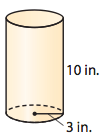
Given a cylinder with a surface area of 2543 cm2 and radius of 9 cm, calculate the height of this cylinder to the nearest cm.

a)

36 cm

b)

45 cm

c)

10 cm

d)

283 cm

131.

Calculate the surface area of the given shape. Round to the nearest tenth.

a)

282.7 in2

b)

56.5 in2

c)

188.5 in2

d)

245.0 in2