
 Worksheets
7th Grade STAAR Vocabulary Review
Total questions: 102
Worksheet time: 3hrs 24mins
a set of numbers that can be written as a ratio or fraction of integers (including decimals that terminate and decimals that make a repeated pattern)
rational numbers
irrational numbers
whole numbers
integers
a set of whole numbers and their opposites
negative numbers
integers
terminating decimal
mixed numbers
a set of positive numbers counting numbers, including zero. NO FRACTIONS OR DECIMALS
negative numbers
irrational numbers
improper fractions
whole numbers
sum
addition
subtraction
multiplication
division
difference
addition
subtraction
multiplication
division
product
addition
subtraction
multiplication
division
quotient
addition
subtraction
multiplication
division
the part of a fraction bar that tells the total number of equal parts in a whole or set
Denominator
Mixed Number
Numerator
Order of Operations
a number in the form ba where a and b are whole numbers and b is not equal to zero
Fluency
Fraction
Least Common Denominator
Denominator
a number in the form ba where a and b are whole numbers and a > b where b is not equal to zero
Order of Operations
Unit Fraction
Numerator
Improper Fraction
a number that is composed of a whole number and a fraction
Mixed Number
Order of Operations
Improper Fraction
Fluency
the part of a fraction written above the fraction bar that tells the number of fractional parts specified or being considered
Denominator
Unit Fraction
Numerator
Mixed Number
To multiply decimals we have to line the decimals up first.
Always
Sometimes
Never
To divide decimals we must move the decimal on the outside and the inside of the division symbol.
Always
Sometimes
Never
When do you use "Keep Change Flip"?
multiplying fractions
dividing fractions
multiplying integers
dividing integers
"Keep Change Change" is used when we ________.
(check all that apply)
add integers
subtract integers
add the opposite
multiply integers
We use the rule "if the signs are the same the answer is positive and if the signs are different the answer is negative" when we are _____________. (check all that apply)
adding integers
subtracting integers
multiplying integers
dividing integers
A negative times a negative is a ___________.
negative
positive
A positive times a negative is a ______________.
negative
positive
A positive plus a negative is a negative.
Always
Sometimes
Never
The constant ratio of 2 variables related to proportionality.
rate
ratio
scale
constant of proportionality
A ratio that compares 2 quantities with different measurements.
rate
ratio
scale
unit rate
The rate in which the second quantity in the comparison is one unit.
rate
scale
scale drawing
unit rate
A pair of numbers, such as (1, 2), used to locate or graph points on the coordinate plane is called an/a_____________.
Quadrant
Y-axis
X-axis
Ordered Pair
The coordinate plane is divided by a horizontal number line called what?
Y-axis
Origin
X-axis
Quadrant
The vertical number line in the coordinate plane is called what?
Y-axis
Origin
Quadrant
X-axis
Two quantities are considered (Proportional, Nonproportional) if they have a constant ratio or unit rate. Choose 1.
Proportional
Nonproportional
Two quantities are considered (Proportional, Nonproportional) when they do not have a constant ratio. Choose 1.
Proportional
Nonproportional

The two ratios are considered _______________ because they have the same value.
Direct Variations
Rate of Change
Nonpropotional
Equivalent Ratios
What is probability?
What actually happens in an experiment
The chance that something will happen
Counting outcomes using theory
Analyzing data from past events
Outcomes that have the same
probability of occurring
Prediction
Probability
Equally Likely
Sample Space
What is another word for chance?
sample space
dependent
probability
outcome
What is a set of all possible outcomes for an event?
sample space
probability
impossible
complement
What is theoretical probability?
They are outcomes where the first affects the outcome of the second.
A situation that occurs and leads to results (outcomes).
It is the expected probability of an event that has not actually been tested.
Outcomes that have the same chance of occurring.
An event that has a probability of zero is _____________.
equal
certain
dependent
impossible
What is it called when two events occur and the first event affects the second event?
impossible
dependent
independent
certain
What is it called if an event has a probability of one?
impossible
independent
certain
mutually exclusive
Tree Diagram
A diagram used to show the sample space
A game where there is not a chance of each player being equally likely to win
Compound events
A game where each player has an equally likely chance of winning
Two or more events in which the outcome of one event does not affect the outcome of the other events
An arrangement, or listing, of objects in which order is important
An event consisting of two or more simple events
the number of times an event occurs
probability
frequency
a probability greater than 0 but less than 1/2
likely
unlikely
a probability greater than 1/2 but less than 1
likely
unlikely
Mark all that apply for <
fewer than
below
more than
at least
less than
Mark all that apply for >
greater than
maximum
more than
at most
above
Mark all that apply for ≤
less than or equal to
is not greater than
maximum
at most
minimum
Mark all that apply for ≥
greater than or equal to
minimum
at least
is not less than
maximum
What kind of circle will be used for <
open/unshaded to the left
closed/shaded to the left
open/unshaded to the right
closed/shaded to the right
What kind ofcircle will be used for >
open/unshaded to the left
closed/shaded to the left
open/unshaded to the right
closed/shaded to the right
What kind of circle will be used for ≤
open/unshaded to the left
closed/shaded to the left
open/unshaded to the right
closed/shaded to the right
What kind of circle will be used for ≥
open/unshaded to the left
closed/shaded to the left
open/unshaded to the right
closed/shaded to the right
Always flip the symbol when multiplying or dividing by a negative.
true
false
A letter used to represent a number or quantity that can change.
operations
constant
term
variable
An equation uses an __________________ sign to show that both sides are equivalent.
inequality
equal
An _____________________ sign shows that both sides are not equal.
equal
inequality
Fewer than
<
>
≤
≥
Below
<
>
≤
≥
More than
<
>
≤
≥
Larger than
<
>
≤
≥
Exceeds
<
>
≤
≥
Maximum
<
>
≤
≥
At most
<
>
≤
≥
No more than
<
>
≤
≥
Minimum
<
>
≤
≥
At least
<
>
≤
≥
No less than
<
>
≤
≥
Solving equations and inequalities use "inverse" operations. What does inverse mean?
the same operation
a different operation
the opposite operation
flip the symbol
What is the definition of a supplementary angle?
Two angles that measure 180 degrees
A right angle
Two angles that measure 90 degrees
Two angles that have the same measure


The mean is...
the middle
the average number (added together, then divided by the number of dots)
The most frequent number
The middle when in order
The median is
The middle score
Scores added & divided by the number of scores
The most frequent score
The middle when in order from least to greatest
an outline of your plan for spending and saving
banking
bank
budget
debit card
a card used for making purchases with funds you borrow and payback later.
debit card
credit card
expenses
loan
a card that allows you to make purchases with money from your checking account
credit card
debit card
expenses
prepaid card
the money you spend regularly for items or services
expenses
investment
currency
loans
a fee you pay to borrow money, or the payment you receive on savings
investment
interest
prepaid card
budget

What is income?
the amount you spent
the amount you don't save
money that you earn
money that spent on expeneses
Taking money out of an account is called a _____.
withdrawal
deposit
income
expense
Placing money into an account is called a ____.
withdrawal
deposit
income
expense
Which items are examples of liabilities?
Furniture you own
Mortgage
Car loan
Your house which you own.
Which of the following is an example of a fixed expense?
Rent
Food
Credit card bill
Car payment
Which of the following is an example of a variable expense?
Food
Credit card bill
Loan
Utility bill
The equation for simple interest is I = Prt
What does the I stand for?
Interest earned
Prinicipal
Interest rate
Time
The equation for simple interest is I = Prt
What does the P stand for?
Interest earned
Prinicipal
Interest rate
Time
The equation for simple interest is I = Prt
What does the r stand for?
Interest earned
Prinicipal
Interest rate
Time
The equation for simple interest is I = Prt
What does the t stand for?
Interest earned
Prinicipal
Interest rate
Time
Which of the following is the correct formula for simple interest?
I = Prt
P = Irt
rt = PI
t = PrI

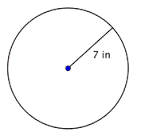
Does this picture show the diameter or radius of a circle?
Diameter
Radius
The distance across a circle through its center.
Arc
Diameter
Circumference
Pi
The distance all the way around the circle is called the...
radius
diameter
circumference
area
____ is when two figures are the same shape and have proportional sides with congruent angles.
Composite Figure
Scale Factor
Congruent
Similar Figures
The distance around the edge of a polygon is the ____
Perimeter
Radius
Area
Circumference
The size of a two-dimensional (2D) surface is the ____
Radius
Diameter
Area
Perimeter
____ is the ratio of corresponding sides in similar figures.
Scale Factor
Composite Figure
Similar Figures
Pi
The ratio between the circumference and the diameter of a circle is ____
Congruent
Diameter
Pi
Like term

