
Font size
 Worksheets
3 PRECALCULUS
Total questions: 78
Worksheet time: 3hrs 36mins
What type of sequence is this?
5, 9/2, 4, 7/2, 3, 5/2, 2
Arithmetic sequence
Arithmetic series
Harmonic sequence
Geometric sequence
The sum of the first n terms of an arithmetic series is -85.5. The first term of the series is -27/3 and the common difference is 1/2. How many terms are in the series?
16
17
18
20
What is the sum of the first 35 terms in an arithmetic series with the first term 18, common difference -12?
770
775
870
875
Find the sum of the first 105 terms in an arithmetic series with the first term 95876 is 7, 271, 880. Find the last term?
6998
6754
7168
72636
Find the sum of the first 15 terms in a geometric series with the first term 81, 920 and the ratio 1/2.
32/3
5
18
1589/3
Find the sum of the first 20 terms in a geometric series with the first term 9 and the common ratio -1.
-20
20
15
415/2
Find the sum of the the following series
2+6+18+54+....
-1
1
infinity
No sum
Find the sum of the following sequence
9, 13.5, 20.25, 30.375, ...
-18
18
No sum
Find the sum of the following series
2+4/3+8/9+16/27+ ...
So sum
6
-6

Expand the summation.
-1800
-1818
-1825
-1795

Expand and simplify
802
1002
1396
1755

Expand and simplify if possible.


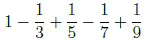
Write the expression in sigma notation


Expand the expression


Expand the expression





How many terms are there in the expansion
100
97
99
101



Which of the following is not an arithmetic sequence?
11, 2, -8, -19, …
-3, -5, -7, -9, …
57, 51, 45, 39, …
4, 7, 10, 13, …
Which could be the graph of 4(x−3)2+9y=1?


What is the coordinate of the center and radius of the circle whose equation is (x−9)2+(y+1)2=4?
C(-9,1); r=2
C(9,-1); r=2
C(-9,1); r=16
C(9,-1); r=16

Find the equation of the circle graphed on the left.
x2+y2=4
x2−y2=16
x2+y2=16
x2+y2=8
Which describe the graph of 9x2−4y2=1?
Circle
Parabola
Ellipse
Hyperbola
When graphed, which equation would produce a parabola?
y2=25−x
x2−y2=25
x2+4y2=1
x−y=25
Which of the following is the general term of the sequence 1, 4, 27, 256, …?
n
n2
2n−1
nn
An ellipse has a major axis of 20 and a minor axis of 12. A possible equation for this ellipse is______
200x2+144y2=1
20x2+12y2=1
100x2+36y2=1
10x2+6y2=1
If the general term of a sequence is n+1n−1 , find the 3rd term of the sequence.
-2
31
21
3
1. The graph of y2=−4x is a parabola that _______
opens to the right with a vertex at
(0, 0)
opens to the left with a vertex at
(0, 0)
opens upward with a vertex at
(0, 4)
opens downward with a vertex at
(-4, 0)
In an angle, the common end point is known as
vertex
point of intersection
initial side
terminal side
A full revolution of a circle is equivalent to
2π radian
360 mm
90 rev
It refers to the length of a line that bounds a circle.
arc
radian
circumference
radius
270° is equivalent to?
π
2π
23π
4π
9π
Convert the angle measure into degrees
20°
30°
35°
60°
What is the measure of a given angle in radians if its arc length is 4π and the radius has a length of 12 ?
2π
3π
25π
3π
It is the measure of an angle formed when the initial side rotates all the way around its vertex until it reaches its initial position.
arc length
revolution
circumference
area
Which of the following is not an example of coterminal angles?
45° and −315°
30°, 390°, and −330°
3π and −53π
6π and 67π
What is the reference angle of the 135 degrees?
10°
15°
35°
45°
Which of the following is an example of a quadrantal angle?
45°
60°
135°
360°
There are 5-steps in solving a non-linear inequality, which of the following is the correct sequence?
P: Critical Values
Q: Solving Method (Number line method/Table sign method)
R: Rewrite the inequalities so that RHS is 0
S: Solution
T: Linear factor(s) of the variable/unknown
R, Q, P, T, S
R, P, T, Q, S
R, T, P, Q, S
R, P, T, Q, S
|x| ≥ 10
x ≥ 10 or x ≤ -10
x ≥ -10 or x ≤ 10
-10 ≤ x ≤ 10
10 ≤ x ≤ -10

The figure shows the steps to solve a rational inequality
x−2x−8≤0 . What is the solution of the inequality?x<2
x≤8
2≤x≤8
2<x≤8
Choose the best solution for 11+i−2−i .
11+i−2−i×11−i−2−i
11+i−2−i×11−i11−i
11+i−2−i×−2+i−2+i
11+i−2−i×−11−i−11−i
and g(x) = x - 2
Find f(g(5))
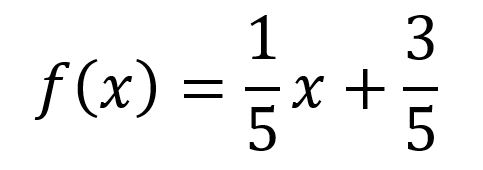
Which is f -1(x)?
f -1(x) = 5x + 3
f -1(x) = 5x - 3
f -1(x) = 5x - 15
f -1(x) = 1/5(x) + 3/5

(3x - 4x3 + 6x4 + 1) / (x + 3)
2x3 + 5x2 + 9 ÷
x + 3

Find tan(θ).
tan(θ) = 5/13
tan(θ) = 12/13
tan(θ) = 12/5
tan(θ) = 5/12

Which trigonometric ratio should you use?
Tangent Ratio
Sine Ratio
Cosine Ratio
Any ratio
The correct way to convert 5.6 rad to degree is......
5.6×π180
5.6×180π
5.6÷π180
5.6÷180π
The correct method to convert 56° to radian is.........
56+π180
56×π180
56×180π
56+180π
Which of the following figure is refering to area of sector?
Yang manakah rajah di bawah menunjukkan luas sektor?


log33x = 5


3a15
9a15
9a8
27a15
For the function y=sin(2x+π) , what is the phase shift?
2π to the right
π to the right
2π to the left
π to the left
Find the inverse of g(x)=x−3
g−1(x)=(x+3)2
g−1(x)=(x−3)2
g−1(x)=(x)2+3
g−1(x)=(x+3)
Solve x−3=x−5
Let p(x)=3x3+9x2−3x−9 and state the maximum number of real zeros and the maximum number of relative extrema.
Find the zeros of p(x)=3x3+9x2−3x−9
x = 1, x = 1, x = -3
x = 1, x = -1, x = 3
x = -1, x = -1, x = -3
Divide 2x5+3x4−15x−2 by x+1
2x4+x3+x2+x−16 R.14
2x4+x3−x2+x+16 R.14
2x4+x3−x2+x−16 R.14
2x4−x3−x2+x−16 R.14
Use the Remainder Theorem to find the remainder when p(x)=x5+3x2−10
is divided by x+2
-30
Use Descartes’s Rule of Signs to describe the possible number of positive and
negative zeros of p(x)=3x4−6x3+15x2+10x−8.
Write a standard form polynomial of least degree with integral coefficients
that has the given zeros for the polynomial p(x) has rational coefficients and zeros of 3 and 1 + √ 2 .
x^3 - 5x^2 + 5x + 3
Find all the zeros of p(x)=x3+x−10
x=2, −1±2i
x=2, 1±2i
x=−2, −1±2i
x=−2, 1±2i
Identify any asymptotes and
point discontinuities of g(x)=x−21+1
Solve 4x−3=x+1x+13
x = 0
x = 3 or x = -3
x = -1 or x = 1
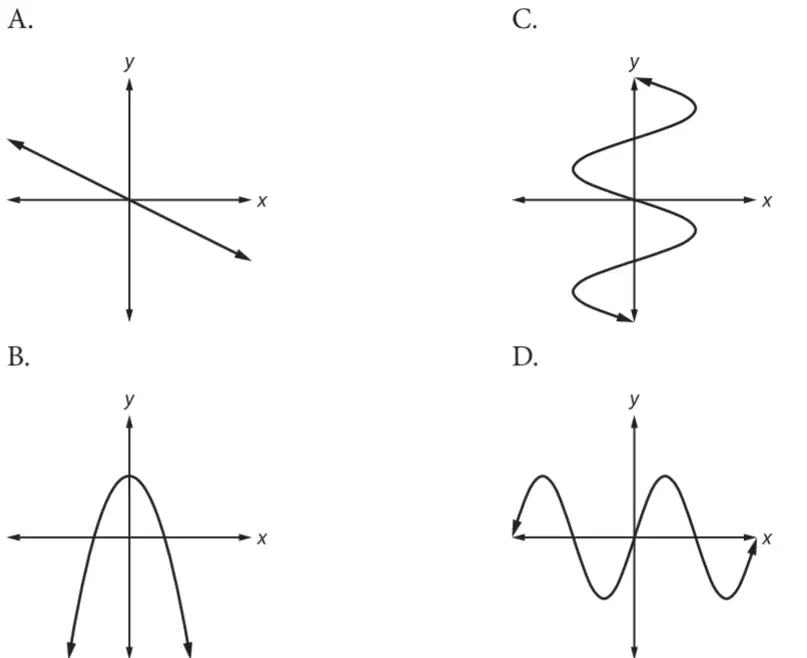
Which of the following relations are functions? List all correct answers.
A
B
C
D
Write the slope-intercept form equation of the line passing through (3, −4) and
perpendicular to y=−21x−5
y = -2x - 10
y = 2x + 10
Find the center and length of a radius of a circle whose diameter has endpoints (0, 6)
and (8, −2).
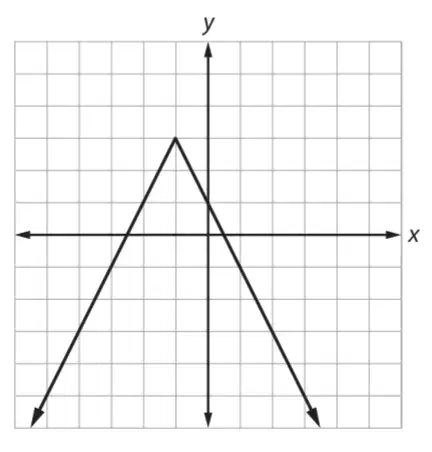
Write a function rule for the illustrated transformation of f (x) = ∣x∣.
f(x) = 2|x + 1| + 3
f(x) = -2|x + 1| + 3
f(x) = -2|x - 1| + 3
If f(x)=x−6 and g(x)=x2+7 write a function rule for (f∘g)(x)
f(g(x))=x2−1
f(g(x))=x2+1
f(g(x))=x2+1
f(g(x))=x2−1
Are f(x)=x2+1 and g(x)=x2−1 inverse functions?
Yes
No


Solve for x
4
2
-2
-4

