

wayground logo

Free Printable Worksheets

Font size

S
M
L
XL
Worksheets

Unit 6 Exam Review

Total questions: 61

Worksheet time: 1hrs 9mins

Name
Class
Date
1.
Jane Addams was instrumental in improving the conditions of immigrants and advancing urban reform primarily through the use of...
a)
Child labor laws.
b)
Settlement homes.
c)
Media outlets and muckraking journals.
d)
Political machines.
2.
A labor dispute at a Carnegie Steel plant that ended in an armed battle between the strikers and the private guards hired by Carnegie, resulting in the deaths of sixteen people.
a)
Homestead Strike
b)
Haymarket Strike
c)
Pullman Strike
d)
Carnegie Strike
3.
The major goal of the Social Gospel movement in the late nineteenth and early twentieth centuries was to...
a)
Encourage support for Charles Darwin’s theory of biological evolution.
b)
Send missionaries to convert American Indians to Protestantism.
c)
Draw attention to the struggles of the urban poor and work to reform economic and social problems.
d)
Promote the spread of Protestantism in the United States territorial possessions.
4.
The organizational business technique pioneered by Andrew Carnegie of controlling all facets of an industry, from raw material to final product, within a single company is known as?
a)
Stock watering.
b)
Laissez-faire.
c)
Horizontal integration.
d)
Vertical integration.
5.
British biologist whose theories of human and animal evolution by means of natural selection that seriously disturbed the churches and created religious and intellectual controversy.
a)
Mark Twain
b)
Charles Darwin
c)
Horatio Alger
d)
Frederick Jackson Turner
6.
Which of the following movements was led by Walter Rauschenbusch who believed religion and human dignity would help the middle class overcome problems of industrialization. The movement helped create organizations like the Salvation Army, YMCA, and settlement houses.
a)
Social Darwinism
b)
Temperance
c)
Populism
d)
Social Gospel
7.
Between 1890 and 1915, the majority of "new immigrants" to the United States were...
a)
Considered physically and mentally superior to earlier immigrants because they had literacy and occupational skills, and experience in democratic government.
b)
Allowed to settle on farms in the Midwest.
c)
From the British Isles and Germany, and had experience in democracy.
d)
From Southern and Eastern Europe, practiced Judaism and Eastern Orthodox faiths, and lacked literacy and occupational skills.
8.
High-rise urban buildings that provided barracks-like housing for urban slum dwellers were called:
a)
Dumbbell tenements.
b)
Steerage.
c)
Skyscrapers.
d)
Apartment buildings.
9.
Mark Twain's sarcastic name for the post-Civil War era, which emphasized its atmosphere of greed and corruption.
a)
Jim Crow Age
b)
Gospel of Wealth
c)
Gilded Age
d)
Era of Good Feelings
10.
The Supreme Court's Plessy v. Ferguson ruling upheld...
a)
The legality of business trusts or monopolies.
b)
Racial segregation.
c)
Government subsidies of business.
d)
The right for workers to join unions.
11.
Which third political party that emerged in the 1890s to express rural grievances of the farmers and mount major attacks on the Federal Government on the issue of the gold standard?
a)
Federalist Party
b)
Know Nothing Party
c)
Free-Soil Party
d)
Populist Party
12.
An American inventor who was responsible for developing the telephone. This greatly improved communications in the country and provided job opportunities for women working as switchboard operators.
a)
Alexander Graham Bell
b)
Mark Twain
c)
Charles Guiteau
d)
Chester Arthur
13.
An American investigative journalist, educator, and the biggest opponent of lynching in the South during the Gilded Age whose newspaper Free Speech, asked the federal government for a federal anti-lynching law?
a)
Susan B. Anthony
b)
Carrie A. Nation
c)
Ida B. Wells
d)
Ida Tarbell
14.
Tension over the "Ghost Dance" and whether Sioux land would be taken by the U.S. government after the discovery of gold in the Black Hills of South Dakota resulted in a battle between the Sioux and U.S. Army. Almost 300 Native-Americans and 29 U.S. soldiers were killed resulting in the end of the Indian Wars in the West.
a)
Bull Run
b)
Little Bighorn
c)
Sand Creek
d)
Wounded Knee
15.
The policy of noninterference by the government in matters of economics or business which allowed "Big Business" to thrive during the Gilded Age (literally meaning "hands off" or "allow to do").
a)
Laissez-Faire
b)
Vertical Integration
c)
Horizontal Integration
d)
Nativism
16.
Term that refers to industrialists or big business owners of the Gilded Age who serve the nation in a positive way by raising production, and expanding markets. By amassing a personal fortune, they contributed positively to the country in some way (libraries, schools, public services).
a)
Robber Barons
b)
The Grangers
c)
Knights of Labor
d)
Captains of Industry
17.
Political machines often gained power by...
a)
Changing the gold standard.
b)
Promising to reduce immigration.
c)
Helping and reaching out to immigrants.
d)
Organizing reformers to reduce corruption.
18.
One reason for the country's industrial success was its vast abundance of...
a)
Natural resources.
b)
Gross national product.
c)
Technology.
d)
Enterprise.
19.
When a single company achieves control of an entire market, it is known as...
a)
A corporation.
b)
A monopoly.
c)
An integration.
d)
An oligarchy.
20.
The vast majority of immigrants arriving on the East Coast passed through a processing center located where?
a)
Angel Island
b)
Long Island
c)
Ellis Island
d)
Staten Island
21.
The Homestead Strike was a protest 
a)
in Colorado demanding safer working conditions. 
b)
Chicago demanding an eight-hour workday.
c)
against the Pullman Palace Car Company’s unsafe working conditions
d)
against the Carnegie Steel Company’s plan to cut jobs.
22.

Which development made it possible to construct this type of building?

a)

The invention of a new process for manufacturing steel

b)

The government’s focus on educating engineers

c)

The manufacturing of glass that blocks ultraviolet sun rays

d)

The importation of stronger kinds of wood

23.

The Grangers were

a)

people who started the conservation movement.

b)

farmers who wanted government action to protect farmers against big business.

c)

farmers who used to work for the railroads.

d)

an organization for young men who needed training for factory jobs.

24.

The first great industrial trusts, the ____________ was organized through a principle of “horizontal integration” that ruthlessly incorporated or destroyed competitors.  (LT 6.5)

a)

American Railway Trust

b)

American Steel Company

c)

Standard Oil Company

d)

Unified Meat Industry Trust

25.

The major factor in drawing country people off the farms and into the big cities was (LT 6.6)

a)

the development of the skyscraper.

b)

the availability of industrial jobs.

c)

the compact nature of those large communities.

d)

the advent of new housing structures known as dumbbell tenements.

26.

Most “new” immigrants in the late 19th century... (LT 6.8)

a)

 A) eventually returned to their country of origin.

b)

 B) tried to preserve their Old Country culture in America.

c)

 C) were subjected to stringent immigration restrictions.

d)

 D) quickly assimilated into the mainstream of American life.

27.

Labor unrest in the 1870s and 1880s resulted in... (LT 6.9)

a)

 A) Congress passing legislation supporting the formation of unions.

b)

B) a ban on Irish immigration.

c)

C) the use of federal troops to keep peace during strikes.

d)

D) many associating labor unions with radicalism.

28.

The Pullman Strike (1894) resulted in the first instance of…  (LT 6.9)

a)

 A) management recognition of the right of workers to organize and strike.

b)

 B) violence during a labor strike.

c)

C) a united front between urban workers and agrarian Populists.

d)

D) government use of a federal court injunction to break a strike.

29.

What was the prominent location many migrants came through when arriving on the East coast

a)

Plymouth Rock

b)

Ellis Island

c)

Angel Island

d)

New Orleans

30.

Who was the populist candidate who ran in the 1898 election?

a)

Eugene Debs

b)

William McKinley

c)

Henry Cabot Lodge

d)

William Jennings Bryan

31.

What is the term used to describe the housing conditions of urban workers

a)

Tenement housing

b)

Settlement housing

c)

Hull House

d)

tenant farm

32.

What was the term commonly used to describe Capitalists like Andrew Carnegie and John D. Rockefeller?

a)

Nativists

b)

Muckrakers

c)

Benevolent barons

d)

Robber barons

33.

Which of these refers to the economic system whereby consumers get an array of options to choose from and prices fluctuate based on market demand?

a)

free-enterprise

b)

planned economy

c)

mercantilism

d)

colonialism

34.

Places that often thrived economically for the time that mines were discovered nearby were commonly referred to as what?

a)

urban city

b)

boom town

c)

desert jewels

d)

company towns

35.
Who created this cartoon depicting the corruption of Boss Tweed?
a)
Jacob Riis
b)
Thomas Nast
c)
Jane Addams
d)
Thomas Durant
36.
The most notorious of the political machines was --------------------in New York City.
a)
Hull House
b)
Pendergast Hall
c)
Daly Machine
d)
Tammany Hall
37.
Which of the following describes the Pendleton Act?
a)
It created a required examination for all government jobs
b)
It made the government purchase a certain amount of silver each month
c)
It divided the South into five military districts
d)
It limited the amount of immigrants that could enter the US
38.

At the end of the nineteenth century, the desire of American business to control supplies and processes of raw materials and shipping led to

a)
automation of industry
b)
horizontal integration
c)
vertical integration
d)
development of the "putting-out system"
39.

Cleveland's decision to send federal troops to end the Pullman strike demonstrated what?

a)
That the government cared about the concerns of the unions
b)
That the government was frustrated with big businessmen
c)
That the government cared more about big businesses rather than the workers
d)
That the government wanted to take on a stronger role in regulating businesses
40.

In the late 19th Century, the ideas of Social Darwinism were used primarily to _______________.

a)

explain the differences in income between the rich and the poor

b)

urge Congress to end immigration

c)

encourage the passage of compulsory education laws

d)

support the growth of new political parties

41.

What is the term for a city government marked by corruption, bribery, and kickbacks (common during the Gilded Age)?

a)

credit mobilier

b)

corrected democracy

c)

exchequer

d)

political machine

42.

Wealthy people used Social Darwinism to justify their position in life.

a)

True

b)

False

43.

Select the term that best describes the Gilded Age

a)

The time when everything was covered in gold

b)

Businesses were struggling financially

c)

businesses grew at a rapid rate and many problems lied below perceived prosperity

d)

Businesses achieved unprecedented success with an increase in pay for all workers

44.

Select the statement that best describes the difference between the AFL and the Knights of Labor

a)

The Knights of Labor allowed only skilled workers to join their union

b)

The AFL allowed skilled and unskilled laborers to join their union

c)

The Knights of Labor allowed skilled and unskilled workers to join their union

d)

Both labor unions worked to improve lives for the owners of major companies

45.

Select all the statements that are true about The People's Party

a)

Called for political reform

b)

Also known as the Populist Party

c)

Created to limit the growth of corporate power

d)

Worked to gain rights for the people

46.

Select all the terms that describe the "New South"

a)

term used to describe the South after the Civil War

b)

A time when African American farmers became equal to White farmers

c)

Promoted the idea that the South should industrialize

d)

A term used to describe the South before the Civil War

47.

Select the statement that best describes the Social Gospel

a)

A movement that aimed to alleviate social problems

b)

A movement that encouraged people to be more social

c)

A movement that encouraged social distancing in a global pandemic

d)

A movement that aimed to help out people who were not social

48.

Select the statement that best describes the Dawes Act

a)

It allowed whites and blacks to remain separate but equal

b)

It sought to assimilate Native Americans to American culture

c)

It gave more power to women in the workforce

d)

The act was created with the purpose of welcoming immigrants to America

49.

Why is the year 1865 significant?

a)

The Civil War started

b)

Abraham Lincoln was elected

c)

The Civil War ended

d)

Reconstruction ended

50.

The Gilded Age was characterized by (select all that apply)

a)

The rise in trusts and monopolies

b)

The growing gap between the rich and the poor

c)

An increase in factory jobs

d)

A rise in unions to demand fair working conditions

51.

Select all the statements that led to an increase in urbanization during the Gilded Age

a)

Increased immigration from Southern and Eastern Europe

b)

Increased immigration from Mexico

c)

Increase in factory jobs

d)

A rise in political machines that provided services in exchange for political support

52.

Which of the following wealthy men invested heavily in oil?

a)

Andrew Carnegie

b)

John D. Rockefeller

c)

J.P. Morgan

d)

Cornelius Vanderbilt

53.

What year was the Pullman Strike?

a)

1894

b)

1877

c)

1892

d)

1790

54.

This movement advocated for a return to traditional ways of life and challenged white dominance in society.

a)

Ghost Dance Movement

b)

Temperance Movement

c)

The Pullman Strike

d)

The People's Party

55.

What happened at Sand Creek in 1864?

a)

The Navajo started their "Long Walk."

b)

The US Army killed many Native Americans.

c)

Native Americans gave up their fight for lands.

d)

Native Americans killed many settlers.
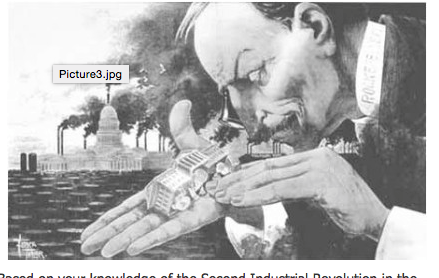
56.
The Farmer's Alliance and the Grange, both founded during the Gilded Age, stood for additional government regulation of trade and creating the conditions for more political power and economic well being for farmers (as compared to industrialists).  What 1890s group was founded, supporting these ideas, and attacking the Gold Standard?
a)
Progressives
b)
Free Soil Party
c)
IWW
d)
Populists
57.
Based on your knowledge of the Industrial Revolution in the United States, what statement is this cartoon making?
a)
The federal government is ruining the oil industry by placing too many restrictions and regulations on business owners.
b)
The oil industry is thriving due to a healthy working relationship with the federal government.
c)
The owner of Standard Oil has too much power and influence over the federal government.
d)
Emissions from oil refineries are polluting the air and harming the environment.
58.
What New York politician ran a political machine in New York City beginning in 1869, during the Gilded Age, that was incredibly corrupt.  For example, a projected cost of $250,000 for a courthouse turned in to $13,000,000 because of kickbacks and bribes.
a)
Daley
b)
Grant
c)
Tilden
d)
Tweed
59.
During the Gilded age, workers came together to work for better pay, working conditions, and less hours. Leaders such as Samuel Gompers help led many of this workers in....
a)
Philanthropy
b)
Labor Unions
c)
Political Bosses
d)
Credit Unions
60.

One industrial capitalist from this era was J.P. Morgan. He monopolized [controlled] the _____ industry.

a)

oil

b)

steel

c)

railroad

d)

banking

61.

What is the definition of laissez-faire?

a)

Putting the government in charge of everything.

b)

Allowing the population to decide what occurs in economics.

c)

Letting things take their own course; what will be will be.

d)

Letting the wealthy decide what occurs.
