wayground logo

Free Printable Worksheets

Font size

S
M
L
XL
Worksheets

ICP - 1st Semester Final Exam

Total questions: 64

Worksheet time: 1hrs 4mins
Name
Class
Date
1.
Which unit measures the amount of space something takes up?
a)
meter
b)
liter
c)
kilogram
d)
second
2.
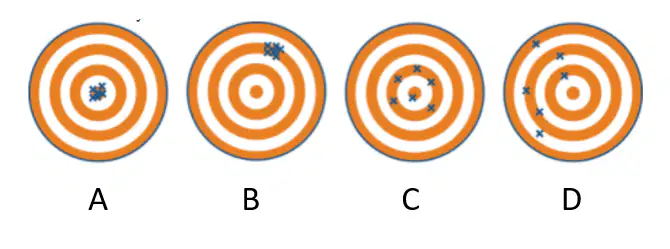
Which target has high precision but low accuracy?
a)
A
b)
B
c)
C
d)
D
3.
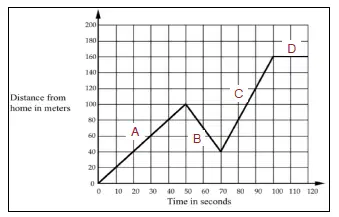
How far did the object travel in the first 50 seconds?
a)
20 m
b)
50 m
c)
80 m
d)
100 m
4.
At which point is the object traveling backwards?
a)
A
b)
B
c)
C
d)
D
5.
What is the object doing a point D?
a)
Moving forward at a constant speed
b)
Moving forward and accelerating
c)
Not moving
d)
Moving backwards at a constant speed
6.
How fast is the object traveling at point C?
a)
2 m/s
b)
4 m/s
c)
6 m/s
d)
8 m/s
7.
You are driving at 100 mi/hr. How much time will it take to cover a distance of 325 miles?
a)
32500 hr
b)
0.31 hr
c)
325 hr
d)
3.25 hr
8.
Find the acceleration of a sprinter how started at rest and ended going 13 m/s in 8 seconds. (Make sure you have the right units.)
a)
1.6 m/s
b)
1.6 m/s/s
c)
104 m/s/s
d)
104 m/s
9.
You are driving 50 mi/hr. How far do you get in 2 hours?
a)
105 km
b)
50 mi
c)
25 mi
d)
100 mi
10.
What is the velocity of a car that has traveled 527 miles in 12.3 hours?
a)
6482.1 mph
b)
55.45 mph
c)
62.95 mph
d)
42.84 mph
11.
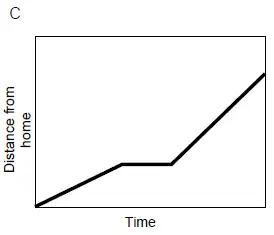
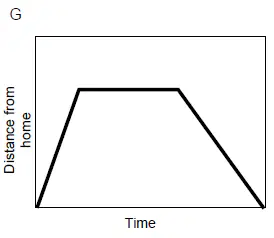
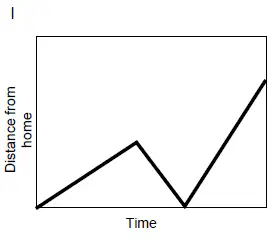
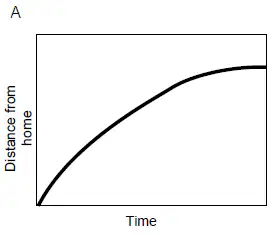
Jane was driving her car to get lunch. She drove 30 mph for 2 minutes. The she was stopped at the drive through for 5 minutes. She then headed back towards home, driving for 5 minutes. Which graph below represents Jane's motion?
a)
Option 1
b)
Option 2
c)
Option 3
d)
Option 4
12.
A bicyclist takes the following trip. P3 - P2 - P1 (starts at P3 and ends at P1). All values are in kilometers. What is the distance of the bicyclist?
a)
3 km
b)
5 km
c)
7 km
d)
9 km
13.
A bicyclist takes the following trip. P3 - P2 - P1 (starts at P3 and ends at P1). All values are in kilometers. What is the displacement of the bicyclist?
a)
3 km
b)
5 km
c)
7 km
d)
9 km
14.
A bicyclist takes the following trip. P4 - P2 - P4 (starts at P4 and ends at P4). All values are in kilometers. What is the displacement of the bicyclist?
a)
0 km
b)
11 km
c)
16 km
d)
22 km
15.
Which of the following is way for an object to accelerate?
a)
increase speed
b)
decrease speed
c)
change direction
d)
all of them would be a way to accelerate an object
16.
If I drop an egg from the roof the school, how fast will it be going right before it splats on the ground 4 seconds later?
a)
39.2 m/s
b)
39.2 m/s/s
c)
78.4 m/s
d)
78.4 m/s/s
17.
An object is dropped from a height of 25 m. How long will it take to hit the ground?
a)
2.26 s
b)
245 s
c)
2.55 s
d)
5.10 s
18.
Two clowns are pushing an elephant at a circus. One is pushing with a force of 208 N to the left and the other is pushing with a force of 115 N to the right. What is the net force?
a)
46.5 N
b)
93 N
c)
323 N
d)
161.5 N
19.
If an object is moving forward and speeding up, in which direction is the net force acting?
a)
forward
b)
backward
c)
the net force is zero
d)
impossible to tell
20.
If an object is moving forward at a constant speed, in which direction is the net force acting?
a)
forward
b)
backward
c)
the net force is zero
d)
impossible to tell
21.
In a car crash, passengers are thrown forward because of which of Newton's Laws?
a)
Newton's 1st Law
b)
Newton's 2nd Law
c)
Newton's 3rd Law
22.
An insect flying through the air smacks into the windshield of a rapidly moving train. The force on the insect is:
a)
smaller than the force on the windshield
b)
bigger than the force on the windshield
c)
equal to the force of the wind shield
d)
zero
23.
For a given force on an object, the more mass the object has,
a)
the more current it has
b)
the more acceleration
c)
the less acceleration
24.
The net forces on a grocery bag is 25 N. If the acceleration is 0.5 m/s/s, find its mass.
a)
250 kg
b)
50 kg
c)
12.5 kg
25.
A physical science text book has a mass of 2.2 kg. What is weight of the book?
a)
4.45 N
b)
4.45 pounds
c)
21.56 N
d)
21.56 pounds
26.
Which of Newton's Laws describes the picture below?
a)
Newton's 1st Law
b)
Newton's 2nd Law
c)
Newton's 3rd Law
27.
In which of the following situations is work NOT being done?
a)
A car takes off from a stoplight and travels 3 blocks.
b)
A woman lifts a child to her shoulders to watch a parade.
c)
A weightlifter holds 500 pounds above his head.
d)
One team wins a tug-of-war contest.
28.
Calculate the work down if 35 N of force is used to push a grocery cart 5 meters.
a)
7 watts
b)
175 watts
c)
7 J
d)
175 J
29.
Calculate the Power done if you do 175 J of work in 19 seconds.
a)
9.2 watts
b)
760 watts
c)
0.37 watts
d)
0.11 watts
30.
Which of the following is not a force?
a)
gravity
b)
mass
c)
air resistance
d)
friction
31.
In the diagram below, which set up of answers is correct?
a)
0 - 25 - 75 - 125 - 250
b)
250 - 175 - 125 - 50 - 0
c)
0 - 50 - 125 - 175 - 250
d)
250 - 200 - 125 - 75 - 0
32.
What is the potential energy of a 315 kg boulder sitting at the top of a hill 45 meters above the ground?
a)
138,915 J
b)
318,938 J
c)
7 J
d)
14,175 J
33.
What is the best example of potential energy?
a)
a battery
b)
a moving car
c)
a vibrating atom
d)
a rotating wheel
34.
You serve a volleyball with a mass of 2.1 kg. The ball leaves your hand with a speed of 30 m/s. What is the kinetic energy of the ball?
a)
945 J
b)
992 J
c)
1890 J
d)
3969 J
35.
True or False: A material in which electricity is does not conduct well is called a conductor.
a)
True
b)
False
36.
A material through which charges can flow freely is called a
a)
conductor
b)
insulator
c)
series
d)
parallel
37.
The voltage in a circuit is decreased. Which of the following would occur?
a)
the current would stay the same
b)
the current would decrease
c)
the current would increase
d)
it is impossible to say what would happen to current
38.
The resistance in a circuit is decreased. Which of the following would occur?
a)
the current would decrease
b)
the current would increase
c)
the current would stay the same
d)
it is impossible to say what would happen to current
39.
Which of the following is not true about a parallel circuit?
a)
when you take out one light bulb, the others go out
b)
there more than one path for electricity to take
c)
your house is wired in a parallel circuit
40.
A 15-ohm resistor is connected to a 12-V battery. What is the current through the resistor?
a)
1.25 amps
b)
0.8 amps
c)
180 amps
41.
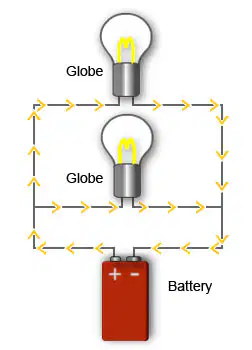
What type of circuit is shown below?
a)
Series
b)
Parallel
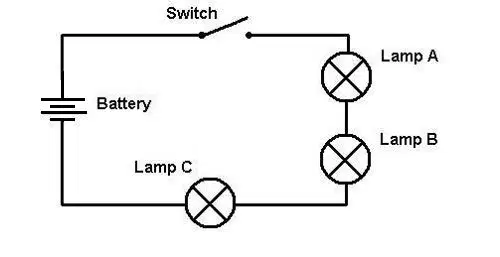
42.
If bulb B would go what would happen to the other bulbs?
a)
Bulb A would continue to work but C would be out
b)
Bulb C would continue to work but A would be out
c)
Both bulbs would continue to work
d)
Both bulbs would not be working
43.
What is the resistance of an electric frying pan that draws 11 amps of current when connected to a 110-V circuit?
a)
0.1 ohms
b)
10 ohms
c)
1210 ohms
44.
What is the power of the frying pan if it uses 11 amps of current and is connected to a 110-V circuit?
a)
0.1 watts
b)
10 watts
c)
1210 watts
45.
At which point has the greatest potential energy?
a)
A
b)
B
c)
C
d)
D
e)
E
46.
At which point has the greatest kinetic energy?
a)
D
b)
A
c)
B
d)
C
e)
E
47.
The strongest parts of the magnet are ...
a)
fronts
b)
backs
c)
poles
d)
middle
48.
The picture is an example of an:
a)
Electric circuit
b)
Electromagnet
c)
Electric nail
d)
Electric power cell
49.
Are the magnetic field lines in the picture correct?
a)
Yes, because they point from north to south.
b)
No, because they point from north to south (they're supposed to go the other way).
c)
Yes, because the North pole is on the left in all pictures.
d)
No, because the North pole is on the left in all pictures (it's supposed to be on the right).
50.
Which will make an electromagnet WEAKER?
a)
more coils of wire around nail
b)
an extra battery attached
c)
thicker wire
d)
reduce the coils around the nail
51.

What are the units for measuring distance in physics?

a)

Kilograms

b)

Newton

c)

Meters

d)

Seconds

52.
A cheetah travels 75 m in 3 s. What is her velocity over the interval?
a)
225 m/s
b)
25 m/s 
c)
0.04 m/s
53.

A train accelerates uniformly from 20 m/s to 40 m/s in 5 seconds. Calculate the train's acceleration.

a)

2 m/s²

b)

4 m/s²

c)

6 m/s²

d)

8 m/s²

54.

What is force?

a)

A push or pull

b)

A force that slows or stops an object in motion

c)

Energy

d)

Energy transferred from an object over a certain distance

55.

If you slide a hockey puck on ice, it eventually stops because of:

a)

Gravity

b)

Magnetism

c)

Friction

d)

Air resistance

56.

What is inertia?

a)

The tendency of an object to resist changes in its motion

b)

The speed of an object in motion

c)

The force that pulls objects to the ground

d)

The force that moves objects in a circular path

57.
Four solid balls, each with a different mass, are moving at the same speed.  Which ball would require the most force to stop its motion?
a)
ball with a mass of 5 kg
b)
ball with a mass of 10 kg
c)
ball with a mass of 15 kg
d)
ball with a mass of 20 kg
58.
What is the SI unit used to measure force? 
a)
pounds 
b)
grams 
c)
newtons 
d)
friction
59.
A golf ball accelerates off a tee at 15m/s2, changing its velocity from 0m/s to 50 m/s down the fairway. How long did it take the golf ball to accelerate?
a)
750 seconds
b)
35 seconds
c)
0.3 seconds
d)
3.3 seconds
60.

Gasoline for your car

a)

Chemical Energy

b)

Nuclear Energy

c)

Thermal Energy

d)

Electrical Energy

61.

Heat energy from the movement of atoms

a)

Sound Energy

b)

Elastic Energy

c)

Chemical Energy

d)

Thermal Energy

62.

A cheetah can run briefly with a speed of 31.0 m/s. Suppose a cheetah with a mass of 47.0 kg runs at this speed. What is the cheetah’s kinetic energy?

a)

1457 Joules

b)

22,584 Joules

c)

15 Joules

d)

45,167Joules

63.

What is the gravitational potential energy of an 85 kg mountain climber at the summit of a 6267 m volcano?

Let g = 9.8N/kg

a)

5,220,411 J

b)

532,695 J

c)

73.7 J

d)

54,356.6 J

64.
A battery converts what type of energy to another?
a)
sound to kinetic
b)
light to heat
c)
mechanical to electrical
d)
chemical to electrical