
 Worksheets
Q3-Science 9 Reviewer
Total questions: 40
Worksheet time: 20mins
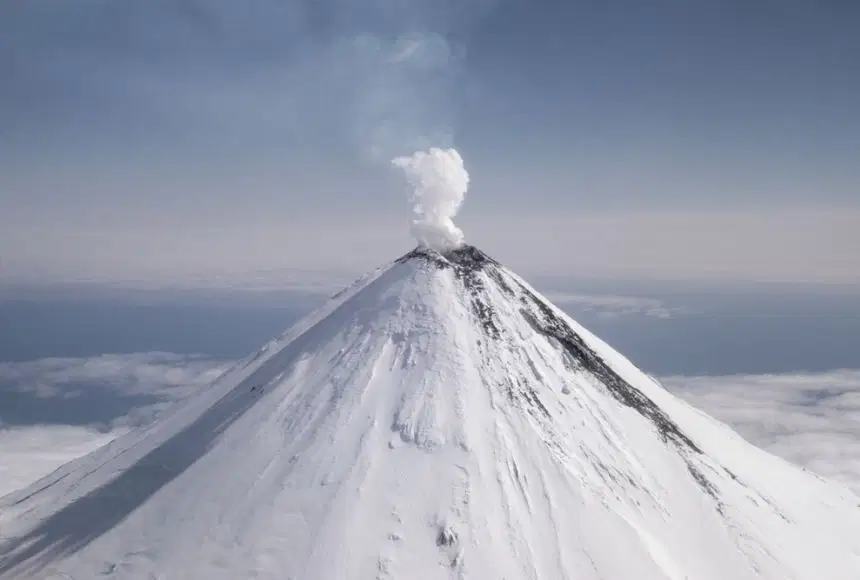
What kind of volcano according to structure does the picture below represent?
cinder cone
composite
shield
hawaiian
Which statement BEST describes an extinct volcano?
Volcanoes no longer produce eruptions but might again sometime in the future.
Volcano has had at least one eruption during the past 10,000 years.
Volcano has not had an eruption for at least 10,000 years and is not expected to erupt again in a comparable time scale in the future.
Volcano that is not erupting but is supposed to erupt again.
Two volcanoes are being monitored in a study: Mount Rainier and Mount St. Helens. Mount Rainier has had no signs of volcanic activity for the past 10,000 years and there are signs of changes due to weathering throughout its slopes. On the other hand, Mount St. Helens has been showing no signs of volcanic eruption for the past decades, yet scientists expect it to show activity soon based on recent seismic readings and gas emissions. What types of volcanoes are Mount Rainier and Mount St. Helens?
Mount Rainier is active while Mount St. Helens is dormant.
Mount Rainier is inactive while Mount St. Helens is active.
Mount Rainier is inactive while Mount St. Helens is dormant.
Mount Rainier is dormant while Mount St. Helens is inactive.
Volcanic eruptions are classified based on their characteristics and intensity. Which of the following statements CORRECTLY describe types of volcanic eruptions?
I. Phreatomagmatic – violent eruption due to contact between magma and water.
II. Hydrothermal – a periodic weak to violent eruption characterized by fountain lava.
III. Plinian – an excessively explosive type of eruption of gas and pyroclastic.
I and II
I and III
II and III
I, II, and III
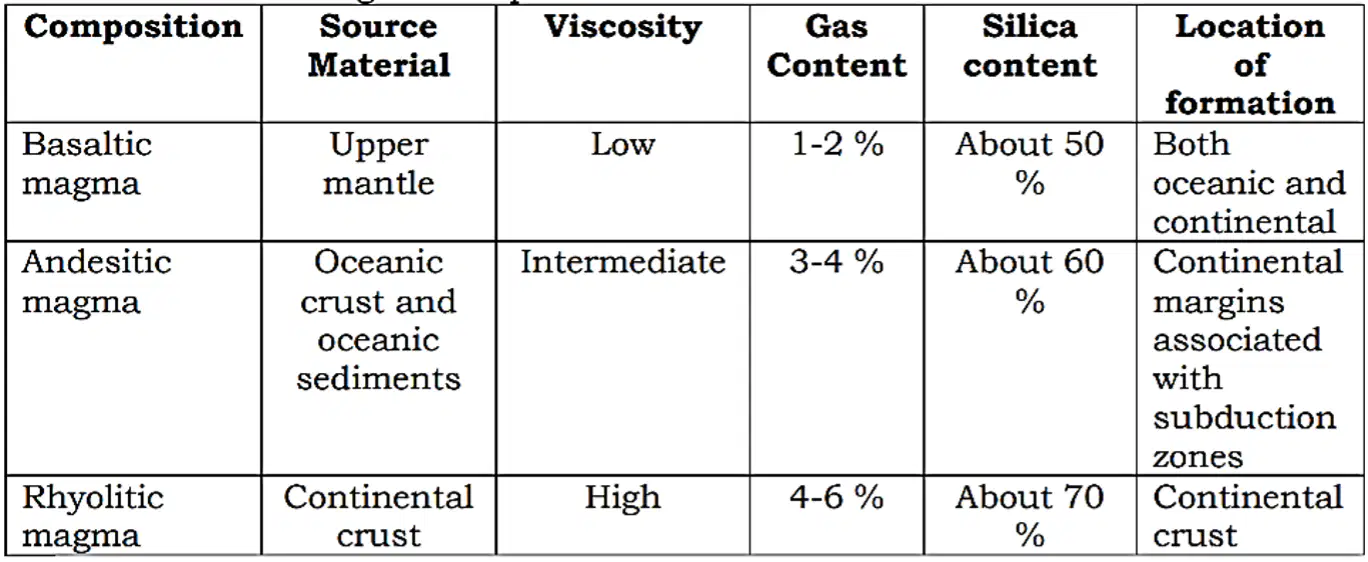
Based on the table above, which of these statements accurately compares the three magma compositions?
I. Rhyolitic magma has the highest gas content, highest silica content, and the most viscous magma composition.
II. Andesitic magma has greater silica and gas content than basaltic magma but less than the silica and gas content of rhyolitic magma.
III. Basaltic magma has the lowest gas content, but the highest silica content and the least viscous magma composition.
I and II
II and III
I and III
I, II, and III
It is a violent eruption due to the contact between water and magma.
Phreatic eruption
Phreatomagmatic eruption
Hawaiian eruption
Vulcanian eruption
Which precautionary measure is to be taken when you are living near an active volcano?
Wear light-colored clothes.
Wear protective boots and gloves.
Know your evacuation route.
Stay clear of hot lava, flying rocks, and debris.
What is the fundamental driving force behind these eruptions?
Sudden cooling of the Earth's core.
The impact of a large meteorite.
The buildup of pressure from magma within the Earth.
Strong winds and storms.
Which is/are TRUE about the things to do related to volcanic eruption?
I. Before a volcanic eruption, prepare emergency kits.
II. During a volcanic eruption, remove ash accumulated on rooftops.
III. Be updated about volcanic advisories before, during, and after volcanic
eruptions.
I
I and II
I and III
I, II and III

In which location on the map below is LEAST likely to experience volcanic activity or earthquakes?
A
B
C
D

What effect do volcanic eruptions have on the concentration of carbon dioxide in the atmosphere?
A minor effect, because CO, levels in the atmosphere decrease during eruptions.
A minor effect, because volcanoes release little CO2 compared to other sources.
A major effect, because each eruption ejects large amounts of material.
A major effect, because there have been many eruptions.
Which energy comes from the volcano?
Dendrothermal
Hydroelectric
Geothermal
Biomass
What geothermal power plant involves piping steam from the earth directly to a generator?
Binary power plants
Dry steam power plants
Geothermal heat pumps
Flash steam power plants
Which type of geothermal power plant uses high-pressure hot water from underground reservoirs, converts it to steam to drive turbines, and then reinjects the cooled water back into the earth?
Binary power plants
Dry steam power plants
Geothermal heat pumps
Flash steam power plants
Geothermal energy production relies on readily accessible heat sources within the Earth. This limits the geographic areas where geothermal plants can be effectively built. Which of the following locations are most suitable for geothermal energy extraction?
Geyser, hot spring, ocean
Geyser, hot spring, steam vents
Geyser, ocean, river
Ocean, river, sea
Why is geothermal energy considered a clean source of energy?
Water converted to steam can be reused.
Its by-products are non-volatile gases.
It is a cheap source of electrical energy.
The only by-products are heat and steam.
Arrange the standard process of creating electricity through geothermal energy.
I. Hot water becomes steam as it moves to different pressures.
II. Used steam moves to the cooling tower.
III. Cooled steam is injected into the reservoir.
IV. The steam rotates the turbine connected to a generator.
V. Hot water rises from the reservoir.
V, II, III, IV & I
V, I, IV, II, & III
II, IV, III, V & I
IV, V, II, I & III
Do all volcanoes create geothermal energy?
Yes, since volcanoes have magma chambers.
No, volcanoes that are extinct are considered as safe source.
No, only active and dormant volcanoes create geothermal energy.
Yes, all volcanoes have enough heat source to produce this energy.
What is the main difference between a geothermal power plant and a geothermal heat pump?
The geothermal power plant generates electricity for households while a geothermal heat pump can support the energy of residential areas or communities.
The geothermal power plant harvests the energy about ten to thirty thousand feet below the earth’s surface while the geothermal heat pump extends at most a few hundred feet below the earth’s surface.
The geothermal power plant and geothermal heat pumps generate the same amount of electricity.
The geothermal power plant generates a smaller amount of electricity than the geothermal heat pump.
Which is the CORRECT statement about geothermal energy?
It is the heat energy present from outer space.
It is the heat energy present in the interior of the Earth.
It is the heat energy present on the surface of the Earth.
It is the heat energy present on the surface of the ocean.
Why is the Philippines one of the best places to build geothermal power plants?
Because Philippines is a rich country.
Because the temperature in the Philippines is too hot.
Because the Philippines is in the of Pacific Ring of Fire.
Because there is lesser chance that an earthquake might happen.
Thornthwaite's climate classification system uses temperature and precipitation indices to categorize different climate types and their influence on vegetation. Which of Thornthwaite's classifications describes a region with a moderate climate, lacking both the extreme cold necessary for persistent snow cover and the consistently warm temperatures required for the flourishing of flowering plants?
Microthermal
Mesothermal
Megathermal
Exothermal
Why does latitude cause differences in temperature?
It is due to climate change.
It is due to the distances of mountain ranges.
It is due to the distance from the earth to the mountains.
It is due to the curve of the earth and distance from equator.
What is the relationship of altitude and temperature to the climate of an area?
As the altitude increases, the temperature increases.
As the altitude increases, the temperature decreases.
As the latitude increases, the temperature increases.
As the latitude increases, the temperature decreases.
Which statement explains why the Windward side of a mountain usually has more precipitation than the Leeward side of a mountain?
The atmosphere gets denser as elevation increases.
The land on one side is greener and lusher than on the other.
Temperatures are higher on one side of a mountain than on the other.
Mountains force air to rise, and the air cools and releases moisture as it rises.
Why do clouds usually form on the windward sides of the mountains?
The clouds usually form on the windward because this is where air sinks and cools.
The clouds usually form on the windward because this is where the air rises and cools.
The clouds usually form on the windward because this is where air rises and warms.
The clouds usually form on the windward because this is where air sinks and warms.
What would one say about the atmosphere on the mountain's windward side?
The atmosphere is cooler and drier.
The atmosphere is cooler and wetter.
The atmosphere is warmer and drier.
The atmosphere is warmer and wetter.
Ocean currents rotate in opposite directions in the Northern and Southern Hemispheres: clockwise in the north and counterclockwise in the south. What force is primarily responsible for this difference in rotational direction?
Sun’s rays
Coriolis effect
Gravity of the moon
Temperature of water
What climatic phenomenon refers to the rise in global temperatures due mainly to the increasing concentrations of greenhouse gases in the atmosphere?
Climate Change
El Niño
La Niña
Global Warming
Which is NOT one of these gases?
Carbon dioxide
Sulfur dioxide
Methane gas
Nitrous oxide
How can “global warming” cause sea levels to rise?
By causing it to rain more often
By increasing the number of undersea volcanic eruptions
By melting glaciers and ice caps
By creating bigger and more powerful hurricanes
What is the visible relationship between carbon dioxide and temperature?
The carbon dioxide and temperature do not affect each other.
The carbon dioxide and temperature are equal to each other.
The carbon dioxide is inversely related to the temperature.
The carbon dioxide is directly related to temperature.
What ways can be done to reduce the global temperature?
Use materials that emit carbon dioxide.
Monitor the usage of carbon-emitting materials.
Minimize the usage of carbon-emitting substances.
Shift from a renewable source of energy to a nonrenewable source of energy.
How does reforestation decrease global warming?
Trees absorb carbon dioxide.
Trees absorb the sun's energy.
Trees drain greenhouse gases like methane.
Trees provide shade which counteracts global warming.
The trade winds, also known as easterlies, are consistent winds blowing from east to west in the tropics. Under what conditions in the eastern Pacific Ocean do these trade winds become stronger, accompanied by increased air pressure and warmer temperatures?
during normal conditions
during the Christmas seasons
during the El Niño phenomenon
during the La Niña phenomenon
What is the normal movement of the trade winds distributing heat in the Pacific region?
West to East
East to West
East to North
South to North
How could La Niña affect the weather pattern in the Philippines?
I. Strong typhoon
II. Excessive Drought
III. Increased precipitation
IV. Dry and less humid air
V. Warm water in the east of the Philippines
I, II, and III
I, III and V
II, III, and IV
III, IV, and V
How does the greenhouse work?
Light rays from the earth enter the greenhouse, where they are absorbed by plants and converted to heat.
Light rays from the sun enter the greenhouse, where they are absorbed by plants and objects and converted to heat.
Light rays from the sun enter the red house, where they are absorbed by plants and objects and converted to heat.
Light rays from the moon enter the greenhouse, where they are absorbed by plants and objects and converted to work.
Gemini is seen in the Philippines during April and May. These months are also the end of the planting season. This means that the constellation is useful in what field?
navigation
fortune telling
feng shui
agriculture
Why is Ursa Minor very important to seafarers?
It contains the brightest star in the southern hemisphere.
It contains the brightest star in the northern hemisphere.
It contains the north star indicating the north of the earth.
It gives honor to the braveness of the little bear as a representation of the seafarers’ hardship

