
 Worksheets
6th & 7th Unit 5: Understanding Earth's Heat Transfer Methods
Total questions: 49
Worksheet time: 55mins
Explain how conduction, convection, and radiation contribute to the transfer of heat from the Earth's core to its surface. Provide examples of each method in the context of Earth's heat transfer.
Conduction occurs through the movement of tectonic plates, convection through ocean currents, and radiation through sunlight.
Conduction occurs through the solid rock of the Earth's crust, convection through the movement of the mantle, and radiation through the emission of energy from the Earth's surface.
Conduction occurs through the atmosphere, convection through the solid rock, and radiation through the movement of tectonic plates.
Conduction occurs through the ocean, convection through the atmosphere, and radiation through the Earth's magnetic field.
Design an experiment to demonstrate the process of convection using household materials. Describe the setup, procedure, and expected results.
Use a metal rod and a flame to show heat transfer.
Use a pot of water, a heat source, and food coloring to visualize convection currents.
Use a mirror and sunlight to demonstrate radiation.
Use a thermometer and ice to measure temperature changes.
Analyze the role of radiation in the Earth's energy balance. How does it affect the temperature of the Earth's surface?
Radiation only cools the Earth's surface by reflecting sunlight.
Radiation heats the Earth's surface by absorbing sunlight and emitting infrared energy.
Radiation has no effect on the Earth's surface temperature.
Radiation only occurs at night when the Earth emits heat.


The image represents which transfer of heat....
conduction
convection
radiation
cloud cover
Heat transfer with the sun's rays is _______________________.
radiation
condensation
precipitation
conduction
How does the sun heat the Earth?
Conduction
Convection
Radiation
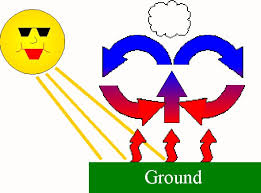
What is the primary method of heat transfer in the Earth's atmosphere?
Evaporation
Radiation
Convection
Conduction
Which of the following is an example of heat transfer by conduction?
Sunlight warming the Earth's surface
Warm air rising in the atmosphere
Boiling water circulating in a pot
Heat traveling through a metal rod
How does convection contribute to weather patterns on Earth?
By emitting infrared radiation
By transferring heat through direct contact
By causing warm air to rise and cool air to sink
By reflecting sunlight back into space
Walking on the hot sand on a beach
conduction
convection
radiation
Walking on the hot sand on a beach
conduction
convection
radiation
Feeling heat from a campfire
conduction
convection
radiation
Which method of heat transfer is energy that is transferred by direct contact?
conduction
convection
radiation
Which method of heat transfer is energy that is transferred through a fluid where hot rises and cold sinks?
convection
conduction
radiation
a metal pot touching a burner
convection
conduction
radiation
boiling water spreading heat throughout all of the liquid
convection
conduction
radiation
As temperature increases, what else increases?
Motion of molecules
Freezing
Solids
Number of particles
Florida's unique sandy soil and subtropical climate are ideal for growing orange trees. Which of these parts of the Earth system are interacting when Florida’s orange trees grow?
biosphere, hydrosphere, and atmosphere
geosphere, cryosphere, and atmosphere
biosphere, hydrosphere, and cryosphere
cryosphere, atmosphere, and hydrosphere
What is climate?
the condition of the atmosphere at any given time and place
cloud cover and temperature
precipitation and humidity at a given time and place
weather conditions in an area over a long period of time
Climate is affected by many factors including:
latitude, elevation, and proximity to bodies of water
tides and currents
wind
snow and sleet
Which two factors determine the climate in a particular region?
temperature and latitude
precipitation and humidity
temperature and precipitation
humidity and air pressure
What is a sea breeze?
cooler air moving inland from the ocean
warmer air moving inland from the ocean
cooler air moving to sea
warmer air moving to sea
What are the three main climate zones?
tropical, thermal, polar
tropical, temperate, polar
cold, super hot, blah
polar, tropical, humid
What climate zone is located near the equator where the sun is directly overhead all year?
polar
tropical
desert
temperate
The temperature and humidity of a swamp is:
very warm during the summer and the higher humidity during the warmer seasons
very cool during the summer and the humidity is low during the warmer seasons
very warm all year long with very little humidity
very cold all year long with little humidity
What is the initial source for global winds and convection in the atmosphere?
heat from the Earth's core
the rotation of the Earth
Moon's gravity
unequal heating of the Earth by the sun
What causes wind?
Too much Taco Bell
Differences in elevation
The uneven heating of the Earth by the sun
Ocean currents

Which layer in the atmosphere protects us form harmful UV radiation?
ozone layer
Troposphere
Ionosphere
Exosphere
The ozone layer protects us from
Increased atmospheric heat
CFCs
UV rays
Decreased atmospheric heat
Areas closer to the equator receive more direct energy from the Sun and have warmer temperatures.
True
False
What is climate?
weather
rain, sleet, snow, or hail
average weather in a region over a long period of time
the amount of ice cream available in a city
The driving force of the Water Cycle is?
The troposphere
The Sun
The oxygen
The clouds

