
 Worksheets
Nutrition Practice Test - 6th Grade Health
Total questions: 28
Worksheet time: 17mins
Name
Class
Date
1.
Select the three options listed that would be a way to reduce the amount of fat in a person's diet?
a)
Drinking milk with a lower fat content (ex. skim milk instead of whole milk).
b)
Eating fruits and vegetables for a snack rather than chips or cookies.
c)
Choosing to eat baked foods rather eating than fried foods (ex. baked chicken instead of fried chicken
d)
Drinking diet soda instead of regular soda
e)
Getting plenty of sleep
2.
Which of the following are a food group from the MyPlate Diagram
a)
Vitamins
b)
Vegetables
c)
Carbohydrates
d)
Grains
e)
Proteins
3.
Carbohydrates are the bodies main source of ________.
a)
Calories
b)
Energy
c)
Fat
d)
Protein
4.
What are the two types of carbohydrates?
a)
Complete and Incomplete
b)
Fat Soluble and Water Soluble
c)
Simple and Complex
d)
Saturated and Unsaturated
5.
Categorize the fat as health or unhealthy.
Categorize the following
Unsaturated
Saturated
Trans
Healthy
Unhealthy
6.
What does fat help absorb and store for later use?
a)
Calories
b)
Minerals
c)
Vitamins
d)
Water
7.
What are the two types of vitamins?
a)
Complete and Incomplete
b)
Fat Soluble and Water Soluble
c)
Saturated and Unsaturated
d)
Simple and Complex
8.
How much activity is recommended for your age group everyday?
a)
30 Minutes
b)
45 Minutes
c)
60 Minutes
d)
90 Minutes
9.
If a person would like to lose weight they must _________.
a)
Consume more calories than they burn.
b)
Consume the same amount of calories as they burn.
c)
Consume fewer calories than they burn.
10.
How many cups of dairy is recommended to have everyday?
a)
2 Cups
b)
2 1/2 Cups
c)
3 Cups
d)
3 1/2 Cups
11.
How many ounces of grains is recommended to have everyday?
a)
5 Ounces
b)
5 1/2 Ounces
c)
6 Ounces
d)
6 1/2 Ounces
12.
How many cups of vegetables are recommended to have everyday?
a)
2
b)
2 1/2
c)
3
d)
5 1/2
e)
6
13.
How many cups of fruit are recommended to have everyday?
a)
2
b)
2 1/2
c)
3
d)
5 1/2
e)
6
14.
A calorie is a unit of _____________.
a)
Carbohydrate
b)
Energy
c)
Fat
d)
Protein
15.
What is the daily recommended amount of calories for your age group?
a)
1,000-1,600
b)
1,300-2,000
c)
1,600-2,500
d)
1,800-2,700
16.
Proteins are responsible for helping to _______.
a)
regulate body temperature.
b)
provide the body with it's main source of energy.
c)
build up, maintain, and replace tissue in the body.
d)
absorb vitamins and store them for later use.
17.
There are four types of fat: saturated, unsaturated, trans, and total fat.
a)
True
b)
False
18.
Your body is able to make vitamins and minerals on it's own.
a)
True
b)
False
19.
A fat soluble vitamin can be stored away for later use.
a)
True
b)
False
20.
Macrominerals are the minerals that you need larger amounts of in your body.
a)
True
b)
False
21.
Complex carbohydrates give you a longer, lasting form energy when compare to simple carbohydrates.
a)
True
b)
False
22.
All fat is bad fat.
a)
True
b)
False
23.
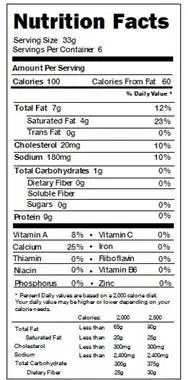
Using the food label, what is the serving size of this item?
a)
33 grams
b)
4g
c)
6
d)
7g
e)
12%
24.
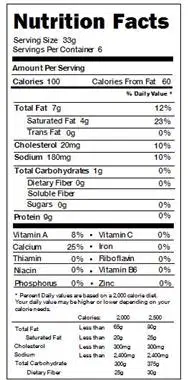
Using the food label, how many servings are in this container?
a)
6
b)
4g
c)
7g
d)
12%
e)
25%
25.
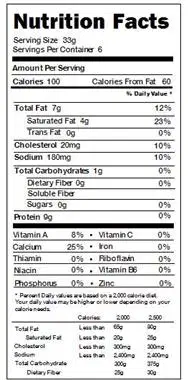
Using the food label, what is the percentage of Vitamin A in a serving of this product?
a)
8%
b)
4g
c)
7%
d)
12%
e)
25%
26.
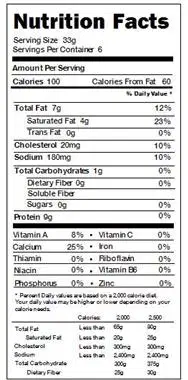
Using the food label, determine how many grams of total fat are in one serving?
a)
7g
b)
4g
c)
6
d)
12%
e)
33 grams
27.

According to the food label, if I were to eat 2 servings of this item, how much of my daily calcium did I have?
a)
50%
b)
12
c)
14g
d)
24%
e)
25%
28.
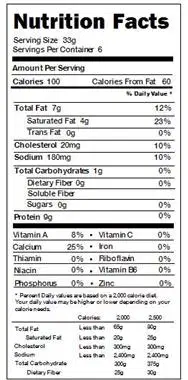
According to the food label, if I were to eat the entire container of this item, how many calories did I consume?
a)
600
b)
6
c)
33
d)
36
e)
100
100 %

