
 Worksheets
FIP USH Unit 4 Test
Total questions: 14
Worksheet time: 7mins
One provision of the Missouri Compromise of 1820 was that Maine be admitted to the Union as a free state. What was the reason for this?
to keep slavery from being legal in Northern states
to keep a balance of free states and slave states
to encourage Southern states to abolish slavery
to create a majority of free states in Congress
What statement about the Missouri Compromise of 1820 is correct?
It began the process of emancipating slaves in the Upper South.
It effectively abolished the slave trade in the District of Columbia.
It was an attempt to preserve the balance between the number of free and slave states in Congress.
It allowed residents of each state to decide for themselves via a referendum if slavery would be allowed.
What role did Manifest Destiny play in the westward expansion of the United States?
Settlers believed that the true destiny of the United States could only be realized by eliminating the influence of American Indian culture within its borders.
Settlers believed it to be the destiny of the United States to expand west to the Pacific Ocean, justifying their actions at the expense of American Indians.
Settlers feared that Great Britain was destined to retake land in North America, and only by conquering the land for the United States could this be prevented.
Settlers feared that American Indian communities were growing in the western territories and would challenge the US government if they were not removed.
One of James K. Polk's goals as president was to fulfill the manifest destiny of the United States. Did he achieve this goal by the end of his term?
Yes, Polk expanded US territory and the country spread from the Atlantic to the Pacific by the end of his term.
Yes, Polk expanded US territory to the northern coast of North America by completing the purchase of Alaska.
No, Polk agreed to cede territory to Mexico in the Treaty of Guadalupe Hidalgo after fighting Mexico to a stalemate.
No, Polk failed to bring an end to the Mexican-American War before the end of this term and the US did not gain territory.
Why did James K. Polk link the annexation of Texas with acquiring the Oregon Country in his 1844 presidential campaign?
It would increase his support among northeastern industrialists seeking new markets for their goods.
Taking land from both Spain and Great Britain would prove he was willing to stand up to world powers.
Potential voters in Texas and Oregon would help his reelection chances if both became states.
It would allow the country to maintain a balance between free and slave states in Congress.
What was one cause of the tensions that led to the Mexican-American War?
the expansion of slavery into the American West
the treatment of American Indians by Mexico
the impressment of Mexicans into the US Navy
the disputed border between Texas and Mexico
What domestic development was caused by the Mexican-American War?
The United States annexed Texas.
Congress enacted the Indian Removal Act.
Tensions between antislavery and proslavery activists increased.
The United States took control of Mexican territory in present-day Canada.
What did the Compromise of 1850 aim to settle?
uproar over the impact of protective tariffs on the Southern economy
the conflict over the balance of free and slaveholding states in the United States
disputes between the United States and Mexico over ownership and control of Texas
the disputed results of the presidential race between Rutherford B. Hayes and Samuel J. Tilden
The United States won California and other new states as a result of the Mexican War. How did gaining these states bring about the Compromise of 1850?
The compromise was a way to settle disagreements about permitting slavery in those states.
The compromise provided a way to pay the war's expenses.
Some of the new states felt California had too much territory.
The new territory caused disagreements about the route for the transcontinental railroad.
What was John Brown's ultimate goal at Harpers Ferry?
to help escaping slaves on their journey to the North
to steal weapons to be used in a potential slave rebellion
to build a community in which African Americans could live freely
to inspire others to create social change using nonviolent protests
How did the election of 1860 contribute to the Civil War?
Northern states were emboldened by the apathy of southern voters and proposed an amendment outlawing slavery.
Southern states believed that Abraham Lincoln intended to prohibit slavery and started to secede from the Union.
Northern states were emboldened by the victory of Abraham Lincoln and passed a Senate bill outlawing slavery.
Southern states believed that the election was too close to call and that John Breckenridge received the most votes.
What did the passage of the Kansas-Nebraska Act, the Supreme Court's Dred Scott decision, and John Brown's raid on Harpers Ferry have in common?
Each intensified debates surrounding slavery and pushed the nation closer to civil war.
Each contributed to the expansion of the power of the president of the United States.
Each centered around the issue of states' rights and the principle of federalism.
Each weakened support for abolitionism and contributed to a decrease in sectionalism.
What government action denied citizenship and its protections to all Black people in the United States?
The Three-Fifths Compromise was added to the Constitution.
The Supreme Court ruled against Dred Scott in Dred Scott v. Sandford.
The Missouri Compromise was repealed by the Kansas-Nebraska Act.
Congress passed the laws comprising the Compromise of 1850.
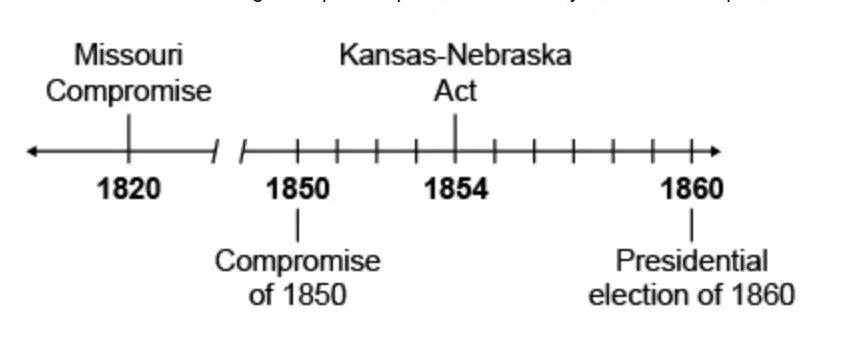
Use the timeline detailing an important period in US history to answer the question. The timeline illustrates
the implementation of Jim Crow laws in the South.
increasing tensions over tariffs prior to the Civil War.
the implementation of Reconstruction in the South.
increasing tensions over slavery prior to the Civil War.

