wayground logo

Free Printable Worksheets

Font size

S
M
L
XL
Worksheets

HENRY 25 ST #10 LVL #3 Geologic Time Exit Ticket

Total questions: 21

Worksheet time: 11mins

Name
Class
Date
1.

Use your copy of the New York Geologic Time Scale. Which of the following is the oldest?

a)

Mastadont (O)

b)

Elliptocephala (A)

c)

Tetragraptus (J)

d)

Cooksonia (P)

2.

Use your copy of the New York Geologic Time Scale. When did the earliest fishes appear?

a)
late cretaceous
b)
middle cambrian
c)
late silurian
d)
early permian
3.

Use your copy of the New York Geologic Time Scale. According to the available fossil evidence, which set of events is listed in the correct order from earliest (oldest) to most recent? Use the 'Life' Section on your large Geologic Time Scale for help.

a)
Extinction of trilobites, extinction of armored fishes (placoderms), extinction of dinosaurs
b)
Appearance of first corals, appearance of earliest insects, appearance of earliest reptiles
c)
Decline of brachiopods, appearance of earliest amphibians, appearance of earliest grasses
4.

Use your copy of the New York Geologic Time Scale. During which time period did Pangaea begin to break up?

a)
late triassic
b)
middle ordovician
c)
early permian
d)
late pennsylvanian
5.

Use your copy of the New York Geologic Time Scale. How many millions of years ago (mya) did the dinosaurs (and many other organisms) go extinct?
a)
251 mya
b)
23 mya
c)
225 mya
d)
65.5 mya
6.

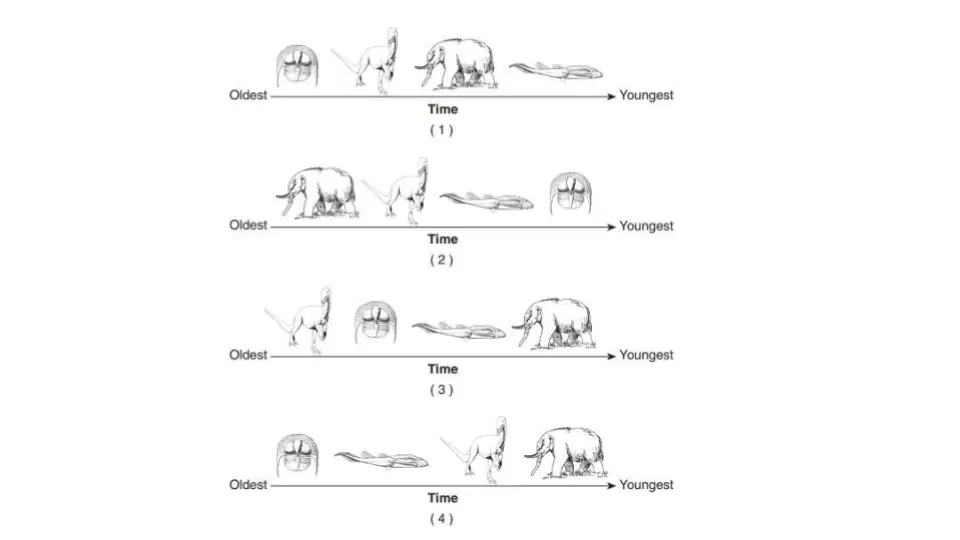
Use your copy of the New York Geologic Time Scale. Which of the sequences of index fossils pictured show the CORRECT order in which these organisms existed on Earth (from oldest to youngest)

a)
1
b)
2
c)
3
d)
4
7.

Use your copy of the New York Geologic Time Scale. What we know now, were trilobites and dinosaurs alive at the same time?

a)
Yes
b)
No
8.

Use your copy of the New York Geologic Time Scale. Which type of organism has been alive for the longest period of time?

a)
vascular plants
b)
mammals
c)
crinoids
d)
gastropods
9.

Use your copy of the New York Geologic Time Scale. During which era did amphibians first appear?

a)
paleozoic
b)
mesozoic
c)
cenozoic
10.

Use your copy of the New York Geologic Time Scale. Which of the following statements is best supported by the evidence seen in the Earth's rock layers and fossil record?

a)
Humans have existed through Earth's entire Geologic History.
b)
The organisms that exist on Earth have NOT changed over time.
c)
99% of the life forms that have existed on Earth throughout time have gone extinct.
d)
Dinosaurs existed on Earth for over 500 million years.
11.

Use your copy of the New York Geologic Time Scale. During which period and epoch was the index fossil Platyceras found?
a)
early silurian
b)
middle devonian
c)
early ordovician
d)
late ordovician
12.
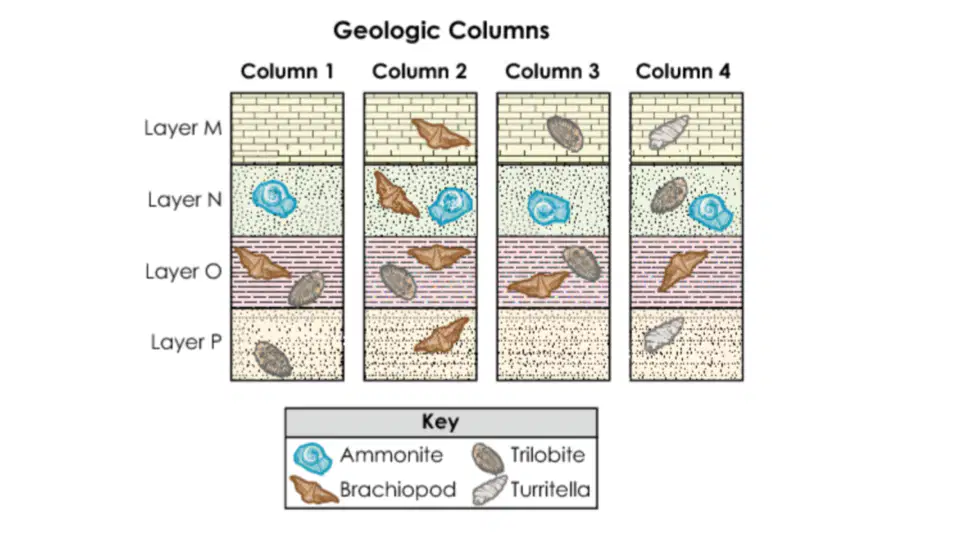
Past Air Test Question: Students are shown a diagram of four geologic columns from different locations that contain the same four rock layers. Select the TWO pieces of evidence that describe why index fossils are most useful in determining the relative ages of the rock layers.
a)
The fossils can be correlated "matched up" across a single layer.
b)
The fossils appear in all but one layer.
c)
The fossils appear in different types of rocks.
d)
The fossils appear in each geologic column.
e)
The fossils do not appear with any other fossils in a layer.
13.

Extra Credit> Past Air Test Question: Scientists study atmospheric conditions recorded in ice core samples from Antarctica. Data from the ice core samples show changes in the atmospheric Carbon Dioxide (CO^2) and average global temperatures in degrees Celsius (C) over time, as shown in the graph below. Which conclusion is supported by the data shown in the graph?

a)
A decrease in the average global temperature causes carbon dioxide in the atmosphere to stabilize.
b)
An increase in the carbon dioxide in the atmosphere causes the average global temperature to decrease.
c)
An increase in average global temperature corresponds to a decrease in carbon dioxide in the atmosphere.
d)
An increase in carbon dioxide in the atmosphere corresponds to an increase in the average global temperature.
14.
Use your copy of the New York Geologic Time Scale. Find the column labeled "Rock Record in NYS." The spaces between the data "bars" represent_______________. These are shown on a geologic column drawing as a wavy line.
a)
missing rock record due to unconformities
b)
different types of rocks
c)
no rocks being made at that time because no erosion and deposition were taking place
d)
fossils not being formed during those years
15.

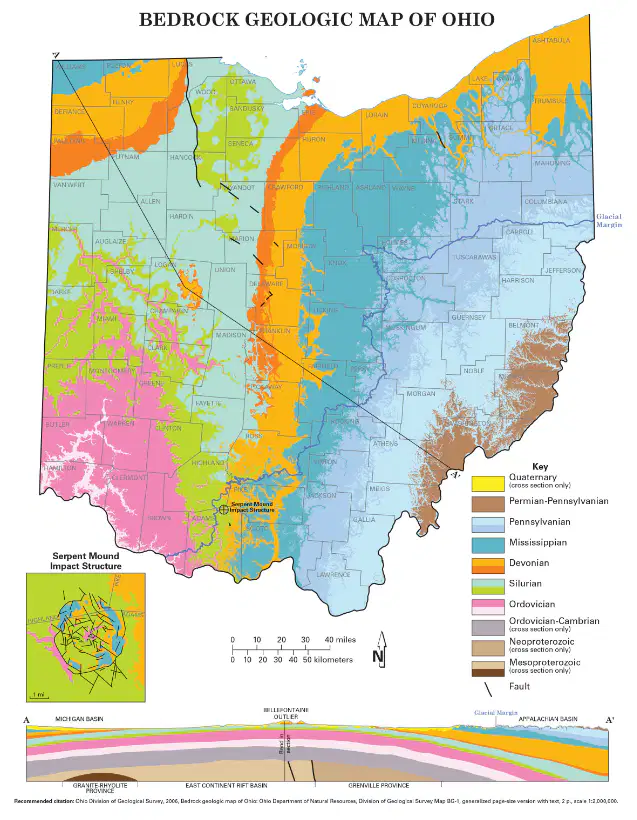
Find Warren County and the Serpent Mound Impact Site areas on the map. The KEY on the map lists the geologic ages from youngest to oldest. Which of the following statements are correct? You may use your large geologic time scale for help.
a)
Rocks in Warren County are younger than the ones at the Serpent Mound Impact Site.
b)
Rocks in Warren County are older than the ones at the Serpent Mound Impact Site.
c)
As you travel across the state of Ohio the rocks get older as you move to the east.
d)
The meteor impact at Serpent Mound did not create faults in the rock layers.
16.
Find Warren County and the Serpent Mound Impact Site areas on this map. The KEY on the map lists the geologic ages from youngest to oldest. Which of the following statements is correct?
a)
The rocks under the surface of Ohio are shaped like an anticline and were created by a divergent plate boundary.
b)
The rocks under the surface of Ohio are shaped like an anticline and were created by a convergent plate boundary.
c)
The rocks are older in the eastern section of Ohio because the glaciers eroded the younger rocks away.
d)
Since Ohio has no faults we don't ever experience earthquakes.
17.

The bulk of the coal driving the Industrial Revolution and contributing to global warming today was deposited during the Carboniferous period (359–299 million years ago). The swamps where the coal originally began resulted in a significant draw down (reduction) of atmospheric carbon dioxide at that time. A combination of climate model simulations and recent estimates for carbon dioxide levels in the atmosphere was used to demonstrate that the cooling due to the diminished greenhouse effect brought our planet close to the limit of global glaciation ∼ 300 million years ago. These findings highlight the climatic importance of the fossil carbon stored in Earth’s coal deposits and thus have implications for climate policy. https://www.ncbi.nlm.nih.gov/pmc/articles/PMC5664543/ The geologic map below shows the coal-bearing rocks of Ohio. These are the locations in Ohio where coal can be mined for heat, etc. Which of the following statements are correct? Select the 2 statements that apply.

a)
During the Permian and Pennsylvanian Periods in Ohio the state must have been closer to the equator and a swampy environment.
b)
During the Permian and Pennsylvanian Periods in Ohio the state must have been further from the equator and a swampy environment.
c)
The rest of Ohio that is not marked with coal deposits were never warm, swampy areas.
d)
The rest of Ohio that is not marked with coal deposits may have had coal at one time but the glaciers have erased all the evidence.
e)
At one time Ohio may have been on 2 continents and that is why there is no evidence for coal in the western section of Ohio.
18.

The geologic map below shows the coal-bearing rocks of Ohio.

Why do we NOT see coal-bearing rocks in eastern Ohio?

a)

Glaciers probably wiped out all the coal.

b)

It was probably mined to use for heat.

c)

Ohio was never in a warm, swampy area for it to form.

d)

Scientists haven't dug deep enough to reach it yet.
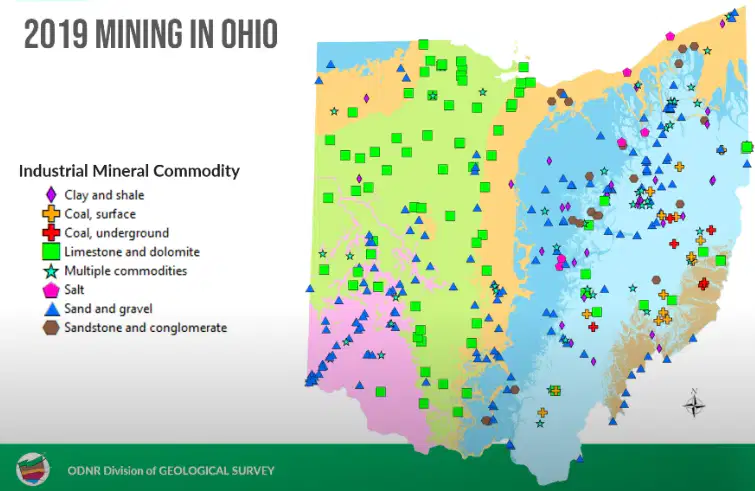
19.
Compare this map to the Ohio Geologic Map. Most of the limestone and dolomite mined in Ohio in 2019 was originally formed during which geologic time period?
a)
Silurian
b)
Ordovician
c)

Mississippian

d)
Cambrian
20.

During which geologic period did Placoderms go extinct?

a)

Middle of Devonian

b)

Beginning of the Carboniferous

c)

End of the Ordovician

d)

Cretaeous

21.

How many families of Cartilaginous fishes were present 65 MYA?

a)

30 families

b)

300 families

c)

25 families

d)

100 families