
 Worksheets
Lipids and Carbs structure/function
Total questions: 29
Worksheet time: 21mins
Carbon is one of the most abundant elements found in the molecules of living organisms. Which of the following statements does not refer to a property of carbon that allows it to play an integral biochemical role in the molecules of living things?
A. It has four electrons in its outer shell meaning it can form four covalent bonds with other atoms
B. When it bonds with hydrogen it creates a dipole that allows it to form hydrogen bonds with water and other polar molecules
C. It can form double and triple bonds with adjacent carbon atoms to allow unsaturated compounds to form
D. Produces a tetrahedral-shaped structure which allows the formation of varied carbon compounds which have different 3-D shapes
Which of the following bonds link two monosaccharides together to form a disaccharide?
A. Hydrogen
B. Ester
C. Glycosidic
D. Peptide
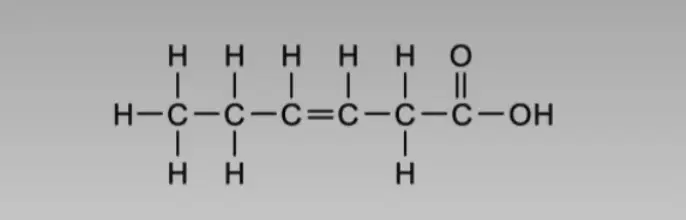
The diagram below shows a component of a triglyceride. Which of the following correctly identifies this component?
A. Fatty acid
B. Glycerol
C. Amino acid
D. Nucleotide
Which of the following features does not explain why lipids are excellent long-term storage compounds?
They can be saturated or unsaturated
Less body mass is required to store a given amount of energy
They are insoluble and will not affect the osmolarity of the cell
Lipids are energy dense molecules
Which of the following is not an example of a useful feature of molecular visualisation software?
Molecules of cellulose, starch and glycogen can be rotated to view their 3D structure
Visual comparisons can be made between the structure of cellulose, starch and glycogen
The specific function of cellulose, starch and glycogen can be displayed
The appearance of the atoms in the molecules can be changed
Which property of carbon makes it a good basis for organic molecules?
It exists in hard and stable forms like graphite and diamond.
It forms a varying number of covalent bonds to other atoms.
It can form millions of different compounds in association with hydrogen and oxygen.
It forms strong, ionic bonds with other atoms.
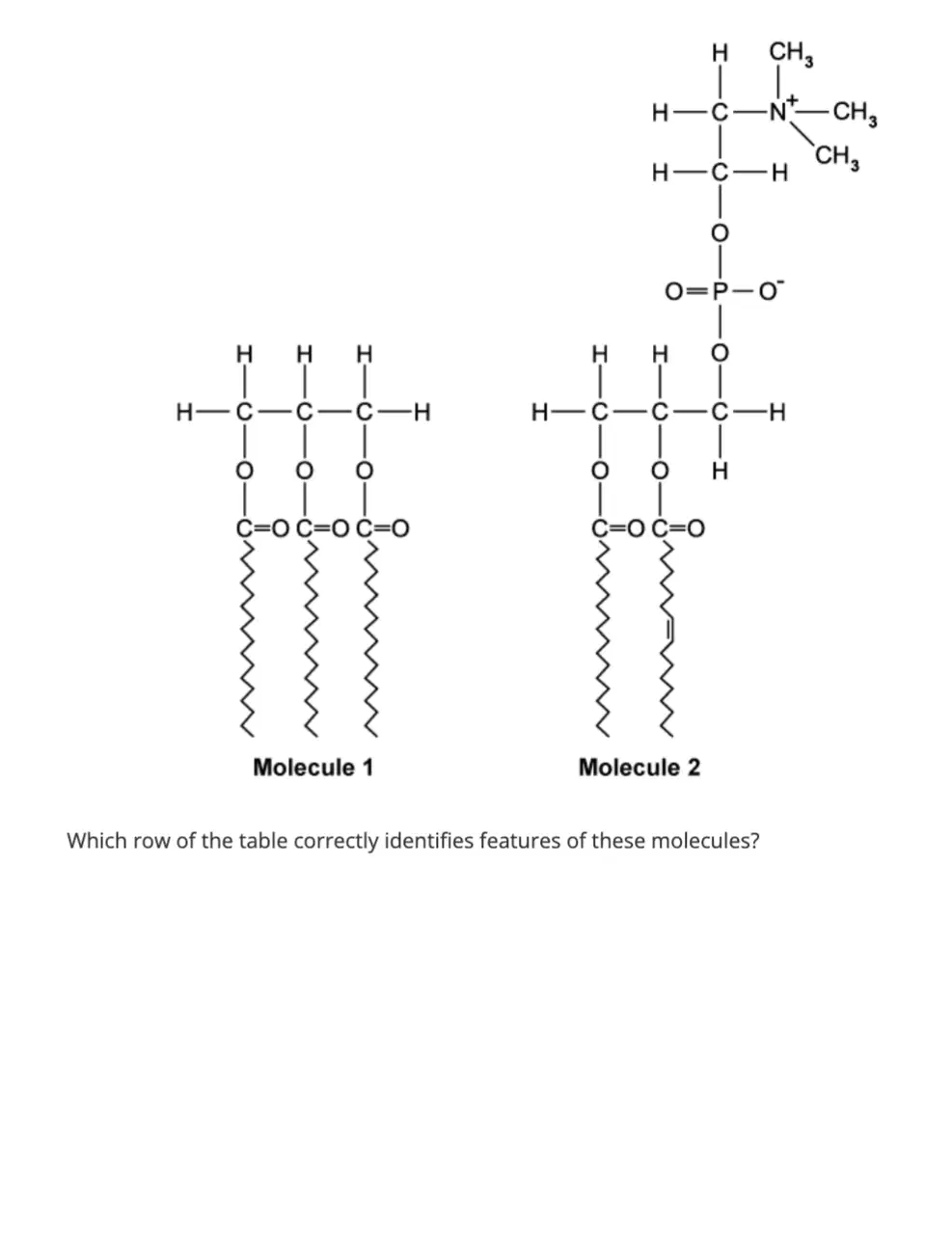
Which row of the table correctly identifies features of these molecules?
Molecule 1 is a triglyceride; Molecule 2 is a phospholipid.
Molecule 1 is a phospholipid; Molecule 2 is a triglyceride.
Both molecules are triglycerides.
Both molecules are phospholipids.
Which statement best explains why the molecular structure of starch is suited to its function?
Many condensation reactions, in the breakdown of amylose and amylopectin, release stored energy.
Many hydrolysis reactions, in the formation of amylose and amylopectin, allow the release of stored energy to fuel cellular processes.
Amylose has a branched structure and amylopectin is coiled to give a compact structure for transport around the plant through the phloem.
The amylose-amylopectin complex is insoluble, so it does not affect the osmolarity of the cell.
There is a naturally-occurring polysaccharide which has the structure of an unbranched chain of the molecule acetylglucosamine held together by β-1,4 glycosidic bonds. Which of the following polysaccharides has a structure similar to that described above?
Glycogen
Cellulose
Amylopectin
Amylose
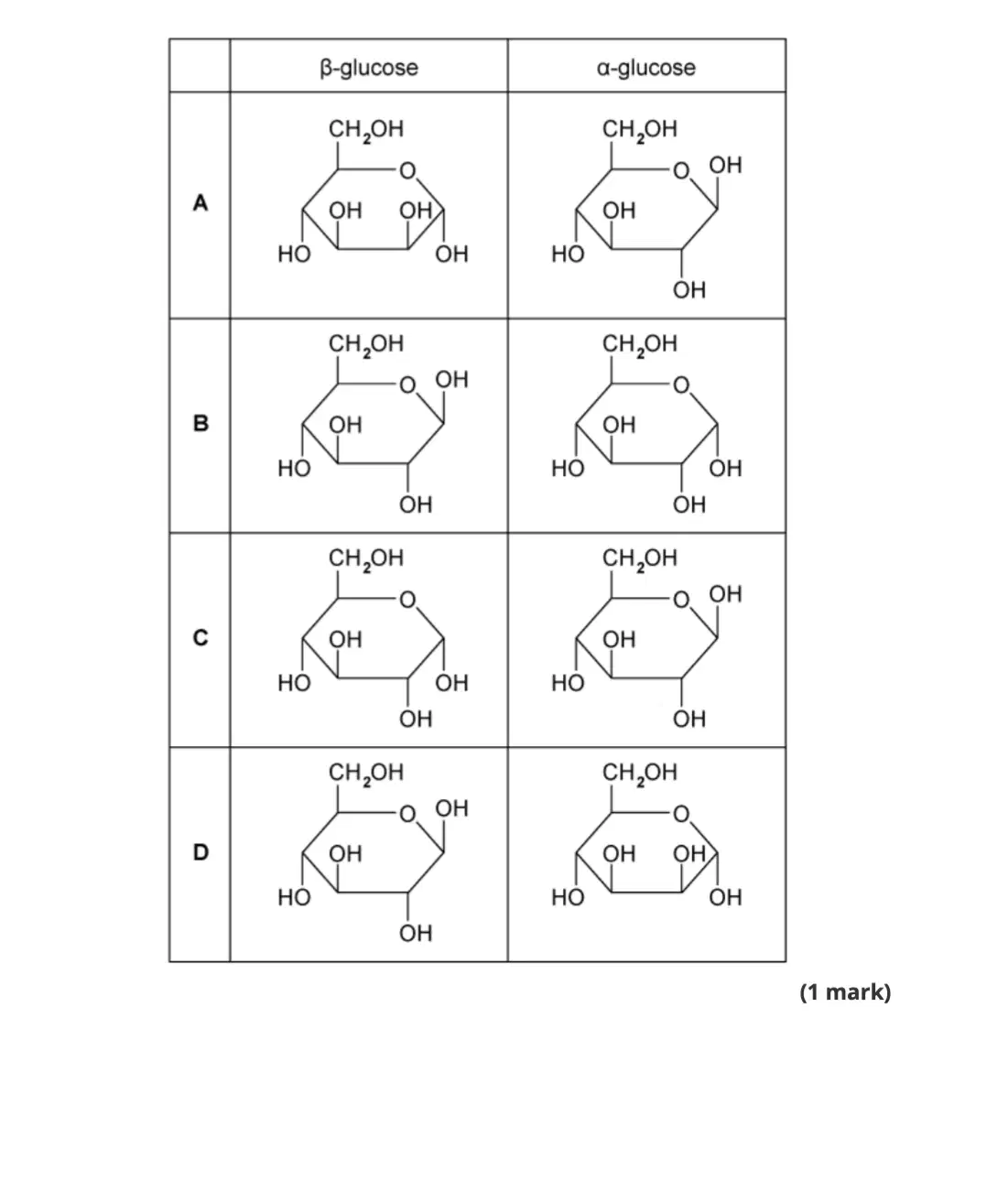
Which of the following diagrams represents α-glucose?
Diagram A
Diagram B
Diagram C
Diagram D
Which of the following statements correctly describes a feature of carbohydrates OR lipids?
Glycosidic bonds form during hydrolysis reactions, joining monosaccharides together to form disaccharides and polysaccharides.
A triglyceride is an example of a polymer as it is formed from many smaller, repeating subunits joined together by covalent bonds.
A triglyceride is not an example of a polymer although it is formed from smaller subunits joined together.
Glycosidic bonds join disaccharides together to form monosaccharides and polysaccharides.
Which of the following occurs when sucrose is formed from monosaccharides?
Condensation of glucose and fructose, using water.
Condensation of glucose and galactose, using water.
Condensation of glucose and fructose, releasing water.
Condensation of glucose and galactose, releasing water.
Apart from being used for energy storage, lipids have a number of other roles. Which of the following is not a role of whole lipids?
Protection for soft internal organs.
Buoyancy aid.
Improving intestinal absorption of nutrients.
Regulators of gene expression.
Which of the following chemical formulae shows a carbohydrate molecule?
C₁₈H₃₄O₂
C₁₈H₃₂O₁₆
C₁₈H₃₂O₂
C₃H₈O₃
Which is the correct reason that cellulose passes through the gut undigested?
There are no enzymes present in the human digestive system capable of cellulose digestion.
Cellulose is not a required nutrient of the human body.
Cellulose provides bulk for effective peristalsis which forces the food through the alimentary canal.
It takes too long for the glucose monomers in cellulose to be hydrolysed, so cellulose is egested before it can be digested.
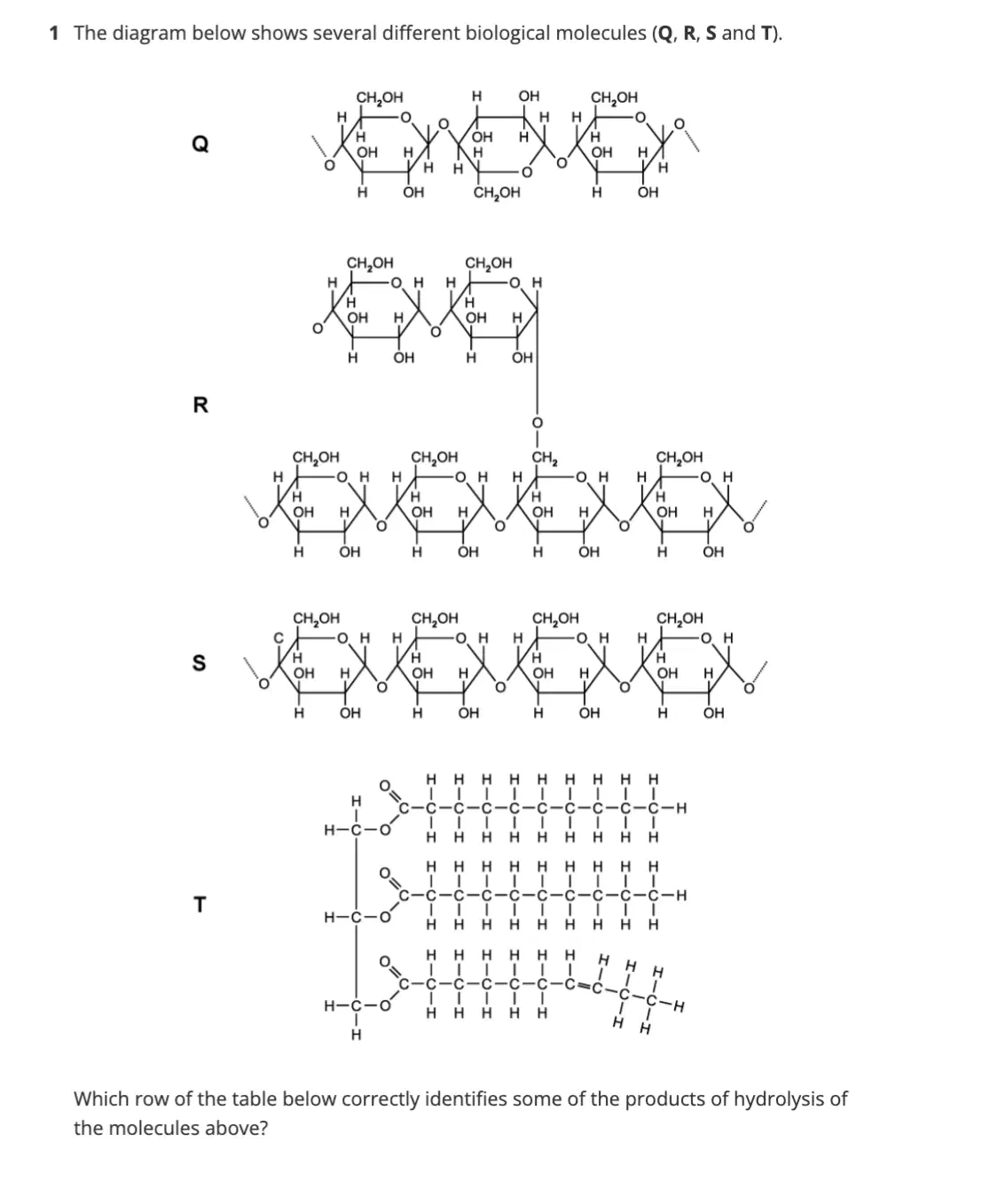
Which row of the table below correctly identifies some of the products of hydrolysis of the molecules above?
A) Q: Alpha Glucose, R: Fructose, S: Galactose, T: Glycerol
B) Q: Beta-Glucose, R: Apha Glucose, S: Apha Glucose, T: Fatty acids
C) Q: Alpha Glucose, R: Galactose, S: Fructose, T: Fatty acids
D) Q: Sucrose, R: Glucose, S: Maltose, T: Amino acids
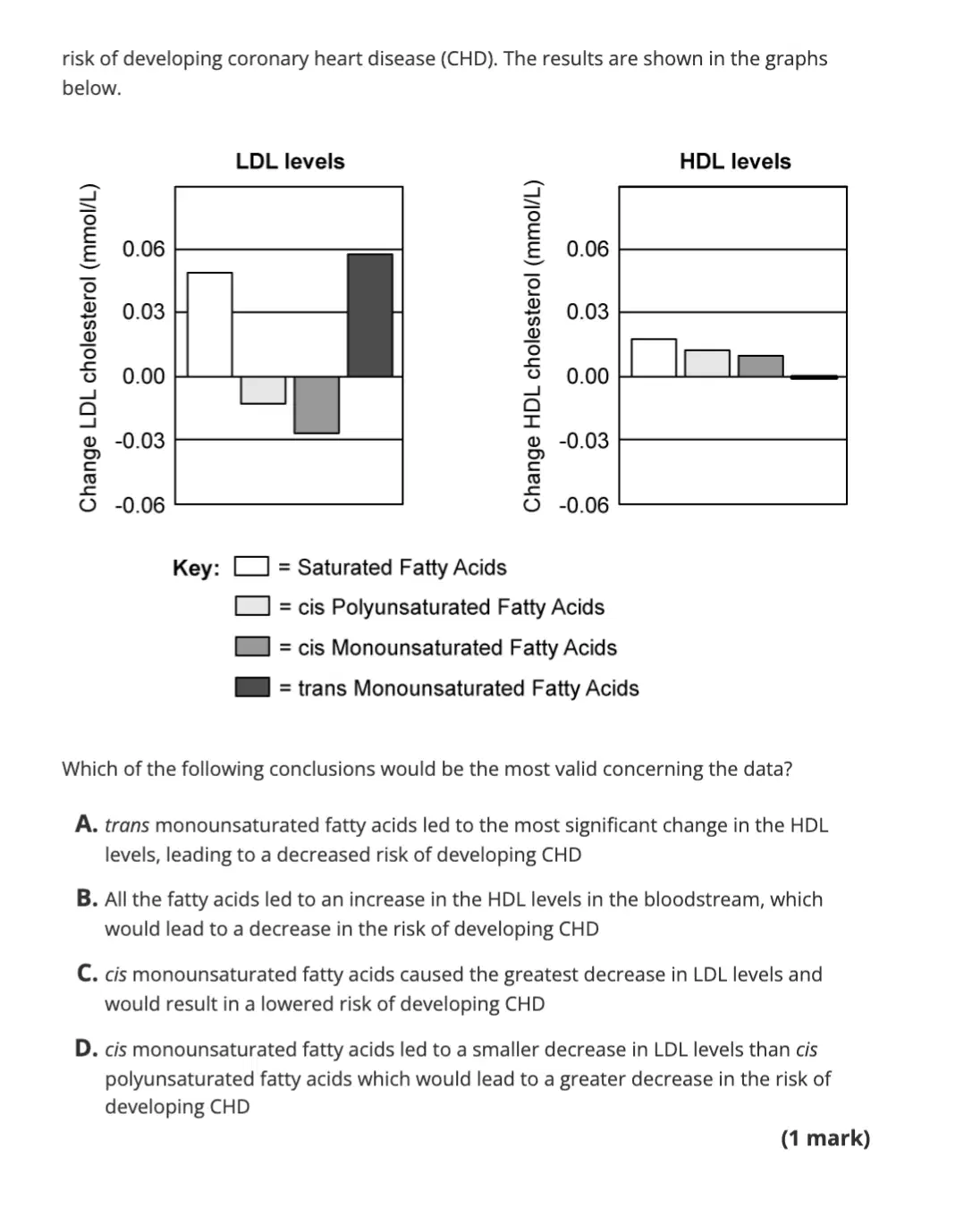
A study was conducted to investigate the effect of different fatty acids on the levels of low-density lipoprotein (LDL) and high-density lipoprotein (HDL) in the human bloodstream. An increase in LDL levels in the blood has been linked to an increase in the risk of developing coronary heart disease (CHD). The results are shown in the graphs below. Which of the following conclusions would be the most valid concerning the data?
trans monounsaturated fatty acids led to the most significant change in the HDL levels, leading to a decreased risk of developing CHD
All the fatty acids led to an increase in the HDL levels in the bloodstream, which would lead to a decrease in the risk of developing CHD
cis monounsaturated fatty acids caused the greatest decrease in LDL levels and would result in a lowered risk of developing CHD
cis monounsaturated fatty acids led to a smaller decrease in LDL levels than cis polyunsaturated fatty acids which would lead to a greater decrease in the risk of developing CHD
Which of the following most accurately describes the formation of a lipid?
An ester bond forms between the -COOH group of three fatty acids and an -OH group on one glycerol molecule, along with the release of three molecules of water
An ester bond forms between the -COOH group of three fatty acids and a -CH group on one glycerol molecule, along with the release of three molecules of water
An ester bond forms between the -COOH group of three fatty acids and an -OH group on one glycerol molecule, along with the absorption of three molecules of water
An ester bond forms between the -COOH group of three fatty acids and a -CH group on one glycerol molecule, along with the absorption of three molecules of water

Choose the letter(s) that correspond to the picture that matches to a monosaccharide
A
B
C
D
E
Which of the following is NOT a monosaccharide?
starch
fructose
glucose
galactose
Fructose is an organic molecule that can be a source of energy for the body. What are the monomers of fructose
amino acids
carbohydrates
monosaccharides
fatty acids
Match the following
Saturated fats
C and H chain with only single bonds
Unsaturated fats
C and H chain with a double C bond
Phospholipid
Carbon/Hydrogen tail, with a polar head
hydrophylic
Interacts with polar molecules (water)
hydrophobic
Does NOT interact with polar molecules

Choose the letter(s) that correspond to the picture that matches to a lipid
A
B
C
D
E

What do disaccharides such as sucrose, and polysaccharides such as starch, have in common?
Which IS NOT a polysaccharide?
Glucose
Starch
Cellulose
Glycogen

