
 Worksheets
Nuclear Processes
Total questions: 33
Worksheet time: 42mins

What particle completes this reaction?
alpha particle
beta particle
gamma particle
neutron

Which type of nuclear radiation is being emitted here?
alpha
beta
gamma
none

Gamma rays are represented by which symbol?
42He
0-1 e
00Y
178O

What is illustrated above?
Alpha decay
Beta Decay
Fission
Fusion
Which subatomic particles are found in the nucleus of an atom?
Protons & Neutrons
Just Neutrons
Protons & Electrons
Neutrons & Electrons
In (a) decay 2 Protons and 2 Neutrons are released.
What is a beta particle?
2 protons & 2 neutrons
a high energy EM wave
an electron
a large unstable nucleus
What is an alpha particle?
An electron
A Helium nucleus (2 protons & 2 neutrons)
A high energy EM wave
The largest subatomic particle
What happens in Nuclear Fusion?
A large heavy nucleus splits apart.
An unstable nucleus emits a helium nucleus.
An unstable nucleus release in the form of gamma radiation.
Two smaller nuclei combine to form a larger nucleus.
What is a Gamma Ray?
a high energy electromagnetic wave
2 protons & 2 neutrons (a Helium nucleus)
an electron
nothing. Gamma rays are just made up from sci-fi
The time it takes for half of a sample of radioactive material to decay is called...
Decay Time
Half Life
Gamma Period
Half Time
What is an isotope?
An atom with the same number of neutrons and electrons, but a different number of protons.
An atom with the same number of protons and electrons, but a different number of neutrons.
An atom with the same number of neutrons and protons, but a different number of electrons.
In the context of isotopes, what does the term "stable" refer to?
An isotope that does not undergo radioactive decay
An isotope that decays very quickly
An isotope that can sustain a chain reaction
An isotope that is commonly found in nature
What is the process in which an unstable atomic nucleus emits charged particles or energy or both?
radioactivity
oxidation
decomposition
none of the above
For the nuclear processes of fusion, fission, and radioactive decay, which is true about all three? In all three processes–
large quantities of energy are required to get them started.
one alpha particle is released along with high-energy radiation.
the total number of protons plus neutrons remains the same.
the driving mechanism is the attractive nuclear strong force.
If nuclear fission, nuclear fusion, and radioactive decay were ordered by the amount of energy released in each process from greatest to least, which of the following would be the correct ranking?
Nuclear fusion, nuclear fission, radioactive decay
Nuclear fission, radioactive decay, nuclear fusion
Nuclear fission, nuclear fusion, radioactive decay
Radioactive decay, nuclear fission, nuclear fusion
In one example of nuclear fusion, deuterium, with one proton and one neutron, and tritium, with one proton and two neutrons, combine to form helium, with two protons and two neutrons. We can conclude that during this process–
alpha particles are absorbed.
the charge of deuterium reverses.
a new atom of tritium is formed.
one neutron must be released.
Nuclear reactions can generate a lot of energy. However, not all nuclear reactions are the same. There are two very distinct types of nuclear reactions: fusion reactions and fission reactions. What are the differences and similarities between nuclear fission and nuclear fusion?
As you have learned, all atoms are made of sub particles called protons, neutrons, and electrons. In the simplest terms, nuclear fission occurs when large, unstable atoms split into smaller atoms to achieve a more stable state. Nuclear fusion is the opposite of fission. Fusion occurs when smaller atoms bind together to form a larger, more stable atom. In both cases, the reaction occurs to bring the atom to a more stable state by a reduction of potential energy.
Nuclear fission reactions occur when the nucleus of an atom is split into fragments. When this occurs, smaller fragments are created. Most often, the result is two fragments with almost the same number of particles as the starting atom. How then is energy released in this reaction? You can compare the mass of the starting atom and the mass of the final products. You will find that the mass of the final products is slightly less than the mass of the starting atom. Yes, in this type of nuclear reaction, mass is lost! This means that matter is lost. This loss of matter is known as the mass defect. Remember, the law of conservation of mass is for nonnuclear changes. Nuclear reactions are described by conservation of mass-energy. The small amount of lost mass is converted directly into large amounts of energy. The energy created from this reaction can be used to generate electricity in power plants or for the huge explosions of atomic bombs.
One type of atom used for fission reactions is an unstable isotope of uranium, known as uranium235. In order for this reaction to occur, a neutron must collide with the uranium 235 nucleus, creating uranium 236. This collision creates enough energy to split the newly formed uranium 236 nucleus into smaller nuclei. A huge amount of energy is released in the process. As the nucleus splits and releases energy, more neutrons are produced. These may collide with another uranium 235 nuclei, causing it to undergo fission. This will create more energy and produce even more neutrons. The reaction will become something called a chain reaction if enough neutrons are produced during collisions to keep the reaction going.
The minimum amount of material that is needed for the reaction to keep going is called the critical mass. The trouble with fission reactions is that radiation and nuclear waste products are created in the process. This is a problem, as many nuclear power plants use fission to produce energy, producing a lot of radioactive by-products as a result.
Conversely, in fusion reactions, the nuclei from atoms with low atomic weights combine to create heavier nuclei. This reaction does not require neutrons in order to occur. Two light nuclei must collide with a great deal of energy. Fusion reactions require extremely high heat. In fact, the heat required can exceed several million degrees Celsius. (Yes, several million!) To put these types of temperatures in perspective, the temperature at the surface of the Sun is around 5,600ºC. Meanwhile, the temperature near the core of the Sun is calculated to be around 15 million ºC. The temperature of the Sun stated here should give you a hint of a nuclear reaction that you can observe. The Sun is a product of an ongoing fusion reaction that has been occurring for billions of years.
Why is such high heat required for these reactions? Remember, the protons of atoms are all positively charged. In order to combine atoms, the repulsion of the positive protons of the combining atoms must first be overcome. Extremely high heat gives the nuclei the kinetic energy needed to overcome the repulsion. And as shown with the Sun, fusion reactions are also very exothermic. Therefore, fusion reactions have the capability of producing more energy than is required to initiate the reaction. This creates a self-sustaining reaction that holds great promise for energy production. A fusion reaction will sometimes begin with a fission reaction to get it started. In the right conditions, it can sustain itself, once started. One of the benefits of fusion reactions is that there are no radioactive by-products. On Earth, fusion reactions result in the element helium. Heavier elements, such as beryllium or carbon, are produced by fusion in stars. Hydrogen bombs are produced by fusion reactions in which several isotopes of the element hydrogen are combined to produce helium.
How can you remember the difference between these two types of nuclear reactions? Think in terms of vocabulary that you may already know. A fissure is a crack or opening that can appear on the surface of Earth. It is a separation. A fission reaction will, therefore, "separate" an unstable atom into parts. A fusion reaction will "fuse" two atoms together.
What is the main difference between nuclear fission and nuclear fusion?
Fission splits large atoms into smaller ones, while fusion combines small atoms into larger ones.
Fission combines small atoms into larger ones, while fusion splits large atoms into smaller ones.
Fission and fusion both split large atoms into smaller ones.
Fission and fusion both combine small atoms into larger ones.
Which of the following is a product of nuclear fusion reactions on Earth?
Helium
Uranium-235
Plutonium
Carbon
What is required to initiate a nuclear fusion reaction?
Extremely high heat
A neutron collision
A critical mass
Radioactive by-products
There are two distinct types of nuclear reactions.
One is a fusion reaction, the other is a fission reaction.
In which reaction is the nucleus of an atom split into two or more atoms?
Fusion
Fission
Neither
Both
Why is the fusion reaction not currently used to produce energy, especially as it is a "clean" form of energy that does not create radioactive or nuclear by-products
There is currently not enough fuel for fusion reactions
Fusion reactions are highly endothermic, making them dangerous
Fusion reactions do not yet produce enough energy
The heat is takes to start a fusion reaction is too high to contain
Fission reactions are currently used to provide energy for many different sources.
Where does the energy produced during the reaction come from?
Mass lost during the reaction, or the mass defect.
Mass created during the reaction, or the mass increase
From the critical mass of the reaction
From the protons created during the reaction
What three sub particles make up all atoms?
Protons
Neutrons
Electrons
Positrons
Quarks
Why does nuclear fission occur?
unstable atoms split into smaller atoms to achieve a more stable state
stable atoms split to become unstable
unstable atoms split to gain energy
unstable atoms split to create protons
What is the primary difference between nuclear fission and nuclear fusion?
Fission involves combining nuclei, while fusion involves splitting them.
Fission releases energy by splitting nuclei, while fusion releases energy by combining nuclei.
Fission occurs naturally in stars, while fusion is man-made.
Fission requires high temperatures, while fusion does not.
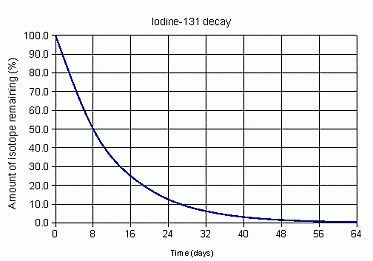
The % of the parent isotope remaining after 1 Half Life.
50%
25%
12.5%
6.25%
The % of the parent isotope remaining after 2 Half Lives.
50%
25%
12.5%
6.25%
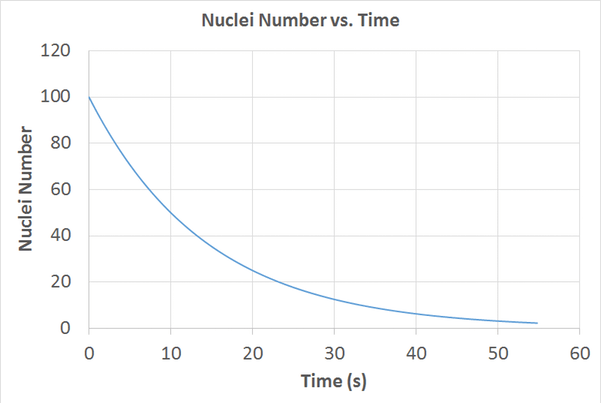
What is the Half life of this isotope?
5 seconds
10 seconds
15 seconds
20 seconds

Why do some elements have half-lives?
they radioactively decay
half of their atom gets stolen
They are Twizzlers that break in half
You have 100 grams of radioactive C-14. The half life of C-14 is 5730 years.
How many grams are left after 1 half life?
100 grams
25 grams
2 grams
50 grams

