wayground logo

Free Printable Worksheets

Font size

S
M
L
XL
Worksheets

grade 9 nuclear summary

Total questions: 45

Worksheet time: 2hrs 34mins

Name
Class
Date
1.

What is a beta particle made of?

a)

One proton

b)

A helium particle

c)

One electron

d)

One proton and one neutron

2.

Of the main types of radiation emitted from naturally radioactive isotopes, which is the hardest to block?

a)

Alpha deca

b)

Gamma Decay

c)

Beta decay

d)

They are all blocked using the same method
3.
TRUE or FALSE: gamma changes the atomic number.
a)
True
b)
False
4.
What is emitted during Alpha Radiation?
a)
A helium nuclei.
b)
A helium atom
c)
Gamma Rays.
d)
Positrons
5.
What is radioactive decay?
a)
The spontaneous breakdown of an atomic nucleus resulting in only energy release
b)
The spontaneous breakdown of an atomic nucleus resulting in only matter release
c)
The spontaneous breakdown of an atomic nucleus resulting in a release of energy and matter
d)
The decay of the use of radios and the increased use of televisions.
6.
When does radioactive decay occur?
a)
When the nucleus of an isotope is unstable
b)
When the nucleus of an isotope is stable
c)
When the electrons of an isotope are spinning
d)
When the electrons of an isotope are shared with another isotope
7.
Isotopes of the same element have different ____________. 
a)
 numbers of protons  
b)
numbers of electrons
c)
 symbols 
d)
numbers of neutrons
8.
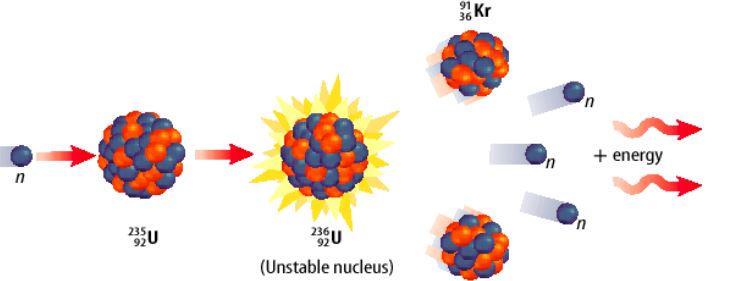
This is an example of...
a)
Fission  reaction
b)
Fusion reaction
c)
Decomposition reaction
d)
Decay
9.
How many protons does gold atom have?
a)
197
b)
79
c)
118
d)
276
10.
What is the mass of an alpha particle?
a)
1
b)
2
c)
3
d)
4
11.

Neutrons ......

a)

has positive electric charge with equal magnitude to that of an electron.

b)

has no net electric charge.

c)

has negative electric charge.

d)

orbiting the nucleus.

12.

What kind of force holds the nucleus together?

a)

Strong Nuclear Force

b)

Weak Nuclear Force

c)

Gravitational Force

d)

Electromagnetic Force

13.

What is the number of neutrons in Cesium?

a)

55 neutrons

b)

76 neutrons

c)

84 neutrons

d)

106 neutrons

e)

139 neutrons

14.
Nuclear power uses ____ for fuel.
a)
steel
b)
coal
c)
uranium
d)
hydrogen
15.
_________ happens naturally due to an unstable nucleus.
a)
fission
b)
fusion
c)
radioactive decay
d)
K-capture
16.
The splitting of a nucleus into smaller nuclei is
a)
fusion
b)
fission
c)
decay
d)
gamma radiation
17.
What is a chain reaction?
a)
When electrons are emitted causing electricity
b)
When a nuclear fission reaction occurs, the protons emitted can strike other nuclei in the sample, and cause them to split
c)
When a nuclear fission reaction occurs, the neutrons emitted can strike other nuclei in the sample, and cause them to split
d)
When a nuclear fission reaction occurs, the electrons emitted can strike other nuclei in the sample, and cause them to split
18.
An example of an uncontrolled fission reaction is _______________
a)
Nuclear power plants
b)
Radio active decay
c)
Atomic Bomb
d)
On the surface of the sun
19.
What do  control rods do in a nuclear reactor?
a)
Regulate the rate of reaction  by absorbing and slowing neutrons
b)
Produce electricity
c)
Produce neutrons to increase the rate of reaction
d)
Reduce heat produced by the uranium rods
20.
Nuclear energy uses _____ to turn turbines to power a generator.
a)
wind
b)
water
c)
steam
d)
solar
21.
One disadvantage of nuclear energy is ___.
a)
it is a fossil fuel
b)
it leaves behind radioactive waste
c)
it emits large amounts of pollution into the atmosphere
d)
there are no disadvantages
22.

Nuclear fission is a nuclear reaction that releases energy by splitting large atoms into smaller ones.

a)

True

b)

False

23.

The new, smaller nuclei are called (a)   nuclei.

24.

Approximately _____ neutrons are released with each fission reaction.

a)

0

b)

2 or 3

c)

10

d)

5

25.

A moderator, such as graphite, is used to...

a)

stop a nuclear reaction happening

b)

speed up neutrons

c)

slow down neutrons

d)

absorb radiation from the reaction

26.

To slow down a nuclear fission reaction, the control rods are...

a)

raised

b)

lowered

27.
What is Half-life?
a)
The amount of time it takes for some of the nuclei in a sample of the isotope to decay
b)
The amount of time it takes for half the electrons in a sample of the isotope to decay
c)
The amount of time it takes for half the nuclei in a sample of the isotope to decay
d)
the amount of time it takes to double the nuclei in a sample of the isotope to decay
28.
Barium-122 has a half-life of 2 minutes. A fresh sample weighing 80 g was obtained. If it takes 10 minutes to set up an experiment using barium-122, how much barium-122 will be left when the experiment begins?
a)
0.25g
b)
2.5g
c)
25g
d)
80g
29.
The half-life of strontium-90 is 25 years. How much strontium-90 will remain after 100 years if the initial amount is 4.0 g?
a)
3.0g
b)
0.25mg
c)
0.3g
d)
0.25g
30.
When nuclei decay, massive amounts of __________ is released.
a)
energy
b)
jello
c)
protons
d)
neutrons
31.
After 4 half-lives, 1g of a sample of Krypton-85 remains unchanged.  What was the original mass of the sample?
a)
16g
b)
32g
c)
0.0625g
d)
4g
32.
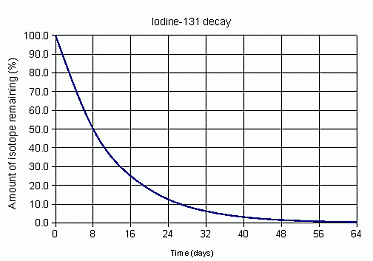
What is the half-life of iodine-131?
a)
32 days
b)
8 days
c)
16 days
d)
24 days
33.

Why do some elements have half-lives?

a)

they are unstable and radioactively decay

b)

half of their atom gets stolen

c)

because they have electrons

34.
If 10 mg of iodine 131 is given to a patient, how much is left after 24 days? The half-life of iodine-131 is 8 days.
a)
1.25mg
b)
1.25g
c)
10g
d)
10mg
35.
Name the instrument used to detect radioactivity.
a)
voltmeter
b)
ohmeter
c)
seismograph
d)
geiger counter
36.
Most of the alpha particles went straight through the gold foil.  This suggested that....
a)
There is no interference between alpha and gold.
b)
Most of the atom is made up of empty space.
c)
The alpha particles were very tiny.
d)
None of the above
37.
Some of the alpha particles fired at the gold foil were deflected at angles.  This was due to...
a)
reflection of the alpha source when it it the fluorescent screen.
b)
The alpha particles hitting the gold nucleus.
c)
Repulsion forces between the positively charged nucleus and the positively charged alpha particles. 
d)
A mis-firing of the alpha source
38.
What did the Plum pudding model suggest about the structure of atoms?
a)
That neutrons and electrons were arranged in a sphere.
b)
 that is was a sphere of positive charge throughout which the electrons were distributed
c)
That an atom was filled with neutrons, protons and a sphere of negative charge. 
d)
That neutrons, protons and electrons were distributed throughout a sphere.
39.
Almost all of the mass of an atom is found in what part?
a)
The electron cloud
b)
The nucleus
c)
The protons
d)
The charge
40.
Rutherford’s gold foil scattering experiment indicated that 
a)
the nucleus of an atom occupies most of an atom’s volume
b)
positive charges are dispersed throughout the atom.
c)
positive charges are concentrated in a very small core at the atom’s center
d)
protons and neutrons are located in the nucleus.
41.

Why did Ernest Rutherford and his colleagues perform the Gold-Foil Experiment?

a)

They wanted to test and confirm the Plum-Pudding model

b)

They wanted to test John Dalton's Model

c)

They were looking for electrons

d)

They wanted to come up with their own Atomic Model

42.

What is an alpha particle?

a)

It is a dominant particle in a subatomic world

b)

It is a particle that has 2+ charge

c)

It is a particle that has 2- charge

d)

It is a helium atom without a charge

43.

What results did Rutherford observe in his Gold-Foil experiment?

a)

He observed that all alpha particles did go through a gold-foil in straight lines

b)

He observed that most alpha particles did not go through a gold-foil and stopped on one side of the gold foil.

c)

He observed that a small number of alpha particles bounced off the gold-foil at very large angles

d)

He observed that all alpha particles slightly deflected from the straight line when going through a gold-foil

44.

Choose one of the conclusions that Ernest Rutherford made about the mass of the atom, based on the experimental results of his Gold-Foil experiment

a)

He concluded that almost all mass of the atom is distributed evenly among subatomic particles

b)

He concluded that almost all mass of the atom is distributed among electrons

c)

He concluded that almost all mass of the atom is concentrated in a small region, in a center of an atom, that has a positive charge

d)

He concluded that almost all mass of the atom is concentrated in a small region, in a center of an atom, that has a negative charge

45.

What subatomic particles are in the nucleus of an atom?

a)

Only protons

b)

Protons and neutrons

c)

Only neutrons

d)

Only electrons

e)

Protons and electrons