
 Worksheets
Upthrust and Archimedes principle
Total questions: 42
Worksheet time: 29mins


Pressure depends on depth
Pressure can be measured in Pascals (Pa) or Newtons per square meter.
1 Pa = 1N/m2
True
False

As the area a force acts on increases, the force exerted on each unit of area
increases
decreases
remains constant
You, Archimedes, suspect that the king’s crown is not solid gold but is instead goldplated lead. To test your theory, you weigh the crown, and find it to weigh 60.0 N and to have an apparent weight of 56.2 N when it is completely submerged in water. What is the density of the crown?
15789.5 kg/m3
11300 kg/m3
7500 kg/m3
19300 kg/m3
What scientific rule states that the buoyant force on an object is equal to the weight of the fluid displaced by the object?
Archimedes' principle
Pascal's principle
Bernoulli's principle
Newton's third law of motion

Calculate the hydrostatic pressure acting in the tank shown:
39.24 kPa
26.29 kPa
29.4 kPa
37.82 kPa

Which liquid is the least dense?
oil
water
syrup
plastic bottle
Pressure exerted on the walls of the blood vessels is termed
Hypertension
Vesicular pressure
Blood Pressure
Heart pressure
A cylinder filled with water, if 3 holes are made on the tube side, which one is the right figure


A cuboid has weight of 450 Newton, what is the pressure?
0,9 Pa
9 Pa
90 Pa
900 Pa

Look on the figure
What is the pressure that occur on the fish?
8000 N/m²
6000 N/m²
4000 N/m²
2000 N/m²
A ship stays afloat as long as the buoyant force is
less than the ship's weight
equal to the ship's weight
less than the ship's speed
greater than the ship's speed
On what factors does upthrust offered by the liquid depend on?
Density of the liquid
Density of the object
Volume of the liquid displaced
None
What happens if the weight of an object is greater than the upthrust?
it floats
it sinks
it bounces
it vibrates
1 Pa = 1N/m2
How do you Calculate Pressure
Force(N)/Area(m2)
Force(kg)/Area(mi2)
Area(m2)/Force(N)
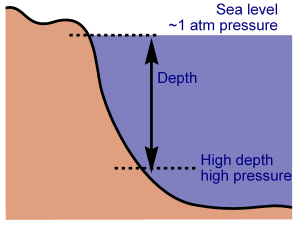
When you increase your depth under water, the water pressure on your body
increases
decreases
stays the same
from the image below which represents the correct force of the fluid pressure on solid objects ...


The up thrust of water acting on a wooden cube of sides 10cm immersed completely in water is
2N
3N
5N
10N
If the weight of an object that is submerged in a fluid is 10 N and the buoyant force on it is 20 N, what will happen to the object?
It will sink
It will float
It will remain in equilibrium
More information is needed
It will sink initially, then float
A boat of mass 810 kg displaces 180 m3 of water when it is lowered into seawater. Calculate the upthrust acting on the hull of the boat and determine whether it will sink or float. Take density of seawater as 1030 kg/m3.
1,818,774 N
1,585,675N
Sink
Float
A boat of mass 210 kg displaces 80 m3 of water when it is lowered into seawater. Calculate the upthrust acting on the hull of the boat and determine whether it will sink or float. Take density of seawater as 1030 kg/m3.
982,544 N
808,344 N
Sink
Float
A cube of brass with dimensions of 500 x 500 x 500 mm and mass of 1,100 kg is lowered into a tank. Determine the upthrust and whether the cube will sink or float if the tank is filled with Crude Oil (Texas).
1.82 kN
1.07 kN
Sink
Float
A cube of brass with dimensions of 500 x 500 x 500 mm and mass of 1,100 kg is lowered into a tank. Determine the upthrust and whether the cube will sink or float if the tank is filled with pure water.
1086.8 N
1226.6 N
Sink
Float

A cube with sides of 80 mm is hung on a weighing scale and weighs 74 N. The cube is lowered into a bucket of pure water until it is fully immersed. What value of weight will the weighing scale show now?
64.72 N
72.33 N
68.98 N
73.20 N

A spherical buoy of diameter 0.5 m and mass 60 kg is attached to the seabed by a mooring rope and floats fully submerged. Calculate the tension in the mooring rope. Take density of seawater as 1020 kg/m3. (Use 2 d.p. throughout calculations)
38.2 N
46.4 N
54.5 N
61.8 N



