wayground logo

Free Printable Worksheets

Font size

S
M
L
XL
Worksheets

Transcription and Translation

Total questions: 42

Worksheet time: 45mins

Name
Class
Date
1.
What will be the resulting mRNA from this DNA sequence:
GAT-TAC-AGA-TTA-CAT?
a)
CTA-ATG-TCT-AAT-GTA
b)
GAU-UAG-UGA-UUA-GUT
c)
CUA-AUG-UCU-AAU-GUA
d)
CAT-ACA-TAC-ATA-TAG
2.
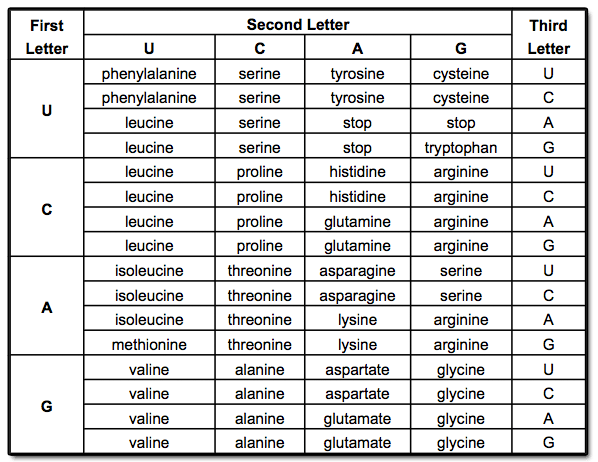
What is the correct amino acid sequence for the mRNA code AUGCCAGUAUGA
a)
Met-Pro-Ala-Val
b)
Met-Pro-Val
c)
Tyr-Gly-His
d)
Tyr-Gly-Arg-His
3.

Every three letters (example: ATC) in DNA codes for what??

a)

Amino Acid

b)

Codon

c)

Anticodon

d)

Amino acid and codon

4.
tRNA is involved in
a)
carrying amino acids 
b)
carrying ribosomes
c)
carrying glucose
d)
carrying lipids
5.
Which amino acid is made from the RNA codon GUA?
a)
Phenylalanine
b)
Leucine
c)
Serine
d)
Valine
6.
In eukaryotes, DNA is located in the
a)
cytoplasm
b)
nucleus
c)
cell membrane
d)
ribosome
7.
When DNA is transcribed to RNA.... 
a)
A pairs with U
b)
G pairs with U
c)
C pairs with T
d)
A pairs with C
8.
How many amino acids are coded for by this sequence of nucleotides:
ATGGGAACTCCA
a)
4
b)
2
c)
6
d)
12
9.

What is the job of rRNA?

a)

Carry info from genes to ribosomes

b)

Carry amino acids to ribosomes

c)

Help excise RNA

d)

Catalyze the amino acid assembly into protein chains

10.
What stops the process of translation?
a)
DNA polymerase stops adding bases at a random time
b)
mRNA transcript falls apart
c)
A stop codon is reached
d)
The ribosome moves on to another protein
11.
For 3 amino acids to be coded for, how many nitrogen bases are needed?
a)
1
b)
3
c)
6
d)
9
12.
Which of the following statements regarding mRNA is correct?
a)
Exons are included in the protein sequence, while introns are left out
b)
Introns are included in the protein sequence, while exons are left out
c)
Exons and Introns can both be included or left out depending on the protein
d)
Exons and Introns are both part of the mRNA sequence, but only exons are part of the rRNA and tRNA
13.

Which of the following is the codon?

a)

CUC

b)

GAG

c)

CTC

d)

Leusine

14.

Which two thing are found on a molecule of tRNA?

a)

amino acids; anticodons

b)

amino acids; codons

c)

ribose sugar; proteins

d)

deoxyribose sugar; codons

15.

The important enzyme related with transcription is?

(a)  

16.
In eukaryotic cells, transcription cannot begin until 
a)
the two DNA strands have completely separated and exposed the promoter.
b)
several transcription factors have bound to the promoter.
c)
the 5' caps are removed from the mRNA.
d)
the DNA introns are removed from the template.
17.
The parts of a gene that do NOT code for amino acids in a protein are called
a)
introns
b)
exons
c)
codons
d)
anticodons
18.
The production of mature mRNA in eukaryotes involves
a)
cutting introns out and spicing exons together
b)
adding the 5' cap
c)
adding the 3' poly A tail
d)
all of these are correct
19.

Which of the following is INCORRECT about amino acid activation?

a)

carried out by amino-acyl tRNA synthetase

b)

this two steps process involved an ATP molecule

c)

amino acid will be bound to ADP by a covalent bond

d)

the activated amino acid is link to the charged tRNA by a covalent bond

20.

What type of mRNA is found in both Prokaryotes and Eukaryotes?

a)

Polycistronic

b)

Monocistronic

c)

Neither

21.

Which stage of transcription involves the unwinding of the DNA double helix?

a)

Initiation

b)

Elongation

c)

Termination

d)

Extermination

22.

RNA Polymerase moves along the (a)   and unwinds the DNA helix.

23.
In eukaryotes, DNA is located in the
a)
cytoplasm
b)
nucleus
c)
cell membrane
d)
ribosome
24.
When DNA is transcribed to RNA.... 
a)
A pairs with U
b)
G pairs with U
c)
C pairs with T
d)
A pairs with C
25.

Which process is used to make mRNA from the DNA in the nucleus?

a)

Replication

b)

Translation

c)

Transcription

d)

Duplication

26.

Which RNA bases would pair with TACGAA in transcription?

a)

TACGAA

b)

AUGCUU

c)

ATGCTT

d)

AAGCAT

27.

Enzyme required for transcription is

a)

DNA polymerase

b)

Helicase

c)

Ligase

d)

RNA polymerase

28.

Which molecule contains the genetic code?

a)

DNA

b)

mRNA

c)

tRNA

d)

rRNA

29.

Transcription occurs along a ____ template forming an mRNA in the ____ direction.

a)

5' to 3'; 5' to 3'

b)

5' to 3'; 3' to 5'

c)

3' to 5'; 5' to 3'

d)

3' to 5'; 3' to 5'

30.

During translation, the ____ site within the ribosome hold the growing amino acid chain while the ____ site holds the next amino acid to be added to the chain.

a)

P, A

b)

A, P

c)

E, A

d)

E, P

31.

Where in the cell would rRNA be found?

a)

nucleus

b)

cytoplasm

c)

ribosome

d)

chloroplast

32.

What is added to the 3'-end of many eukaryotic mRNAs after transcription?

a)

Intron

b)

Exon

c)

Poly tail A

d)

Nucleotide 5' cap

33.

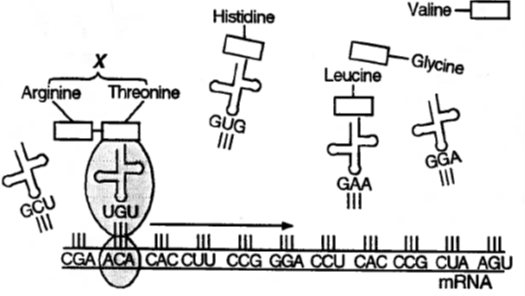
What is occurring in this picture?

a)

Translation

b)

Replication

c)

Translocation

d)

Transcription

34.
How would the DNA sequence GCTATA be transcribed to mRNA?
a)
GCUAUA
b)
CGATAT
c)
CGAUAU
d)
GCUTUT
35.
Which of the following describes RNA?
a)
RNA is usually double-stranded and contains the base thymine
b)
RNA is usually single-stranded and contains the base uracil
c)
RNA is longer than DNA and uses five bases to encode information
d)
RNA is made in the nucleus of eukaryotic cells and stays there to carry out its functions
36.
How many amino acids are coded for by this sequence of nucleotides:
ATG GGA ACT CCA
a)
4
b)
2
c)
6
d)
12
37.
The process represented in the diagram produces a molecule that is complementary to the template strand of DNA. What type of molecule is produced?
a)
New DNA
b)
Polypeptide
c)
Messenger RNA
d)
Carbohydrate
38.
The process to go from mRNA to a protein is called ____
a)
transcription
b)
rRNA
c)
replication
d)
translation
39.
What amino acid is represented by the codon UUA?
a)
Phenylalanine
b)
Tyrosine
c)
Leucine
d)
Stop codon
40.
What process is going on in this photo? 
a)
Transcription 
b)
Translation 
c)
Replication 
d)
All the above 
41.
How many bases are in one codon?
a)
1
b)
2
c)
3
d)
4
42.
What is this a picture of?
a)
mRNA
b)
tRNA
c)
rRNA
d)
pRNA