
 Worksheets
World War II Review Quiz
Total questions: 109
Worksheet time: 2hrs 35mins

[1] Why did the U.S. get involved in WWII?
To respond to the Japanese embargo
Japan captured the Bataan Peninsula in the Philippines
Japan attacked Pearl Harbor on Dec 7, 1941
Germany tried to get Mexico to go to war against the United States
Atomic bombings
Earthquakes
Tsunamis
What kind of leader did Hitler become?
Republican
Totalitarian
Monarch
Communistic
Luftwaffe was ___________.
German Army
German Air Force
British Air Force
Italian Army
The non-aggression treaty allowed Germany and Russia to split _____ between each other.
Poland
America
France
Argentina

The Battle of Iwo Jima was between what countries?
Japan and Gernany
Germany and USA
USA and Japan
USA and China
USA vs Solomon Islands
The Soviet Army was also known as the "The ___ Army."
Blue
Red
Strong
Invincible
The Battle of Stalingrad is known as the...
turning point in the Pacific
turning point in Eastern Europe
turning point in Western Europe
the Battle of the Bulge
Who won the Battle of Stalingrad?
The Germans
The Russians
No one
The USA
Which of the following is NOT an allied power?
Britain
United States
Soviet Union
Italy
Who was the leader of the United States during World War II?
Mussolini
Stalin
Roosevelt (FDR)
Hitler

Who was the US president who decided to drop the atomic bombs on two Japanese cities?
Franklin D. Roosevelt
Harry S. Truman
Dwight D. Eisenhower
Woodrow Wilson

Who was the Prime Minister of Great Britain during World War II?
Adolf Hitler
Benito Mussolini
Josef Stalin
Winston Churchill
What was the policy called that continually gave in to Hitler's demands in order to prevent conflict with Germany?
policy of appeasement
policy of nullification
policy of aggression
policy of enactment
August 15, 1945
Sept 17, 1939
April 15, 1945
What event officially started WW2?
Germany invades Poland
Japan attacks China
Germany invades Soviet Union
Japan attacks Pearl Harbor
The US let Britain borrow military supplies with the ________________________ policy.
Borrow Buy
Lend Lease
Give Take
Share Keep
What years did WWII encompass
1939-1945
1900-1910
1969-1972
The Wonder Years
Pearl Harbor happened in what country and/or state?
Hawaii
Japan
Phillipines
Midway

The systematic attempt to rid Europe of all Jews during
World War II was called
the Progressive Movement
Internment camps
the Marshall Plan
the Holocaust
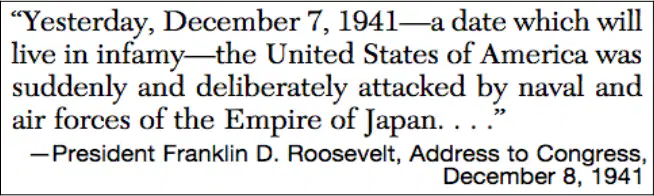
In the quote to the above which event was President Roosevelt addressing in his statement to Congress?
The sinking of merchant ships in the Atlantic Ocean
The D-Day invasion of France
The bombing of Pearl Harbor
The air raids on the Panama Canal
Based on this passage, what was the principal goal of President Truman in issuing this executive order?
…It is hereby declared to be the policy of the President that there shall be equality of treatment and opportunity for all persons in the armed services without regard to race, color, religion or national origin. This policy shall be put into effect as rapidly as possible, having due regard to the time required to effectuate any necessary changes without impairing efficiency or morale. …
— President Harry Truman, Executive Order 9981, July 26, 1948
stop the military draft
end segregation in the armed forces
increases opportunites for women to serve in combat
ensure an adequate number of troops fight in WWII
Which group of world leaders practiced fascism?
Roosevelt, Stalin, Churchill
Hitler, Roosevelt and Stalin
Mussolini, Hitler and Franco
Mussolini, Hitler, and Stalin
Which factors led to the rise of dictators before World War II? Choose 2
Imperialism’s drive for new colonies
Rise of new consumer products
Increase in nationalism due to immigration
Devastation caused by World War I
Which strategy did Europe use in attempts to keep Hitler from starting World War II?
Imperialism
Internment camps
Appeasement
Nationalism
At the outbreak of World War II, what did the United States practice in regard to their interactions with the rest of the world?
Supported the Allies monetarily & physically
Isolationism and Neutrality
Acted as the arsenal of democracy
Advisors and counselors
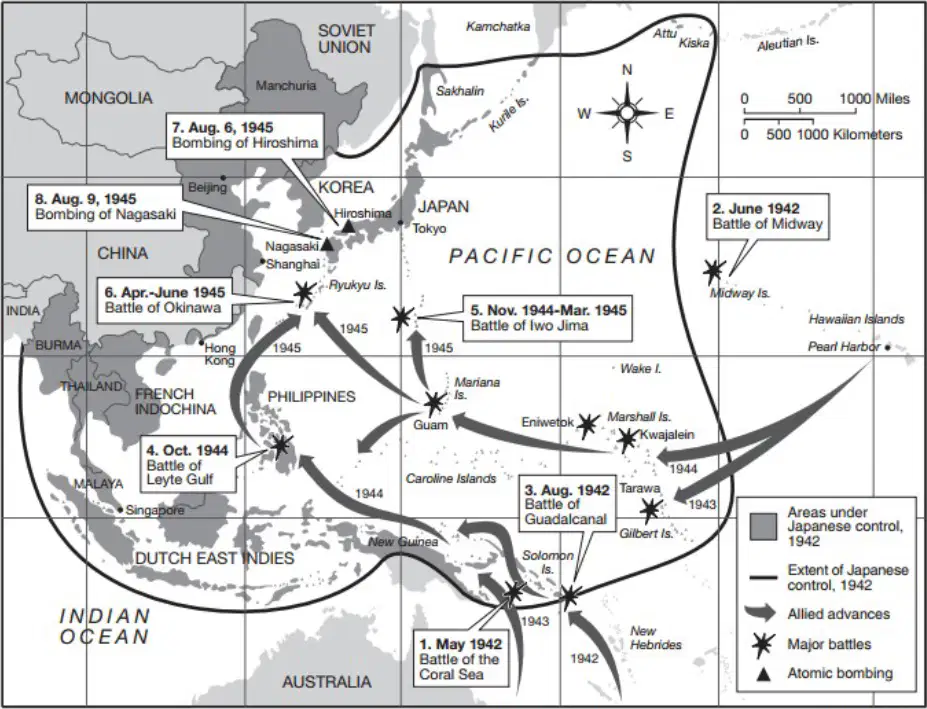
What is the most accurate title for this map?
American Imperialism in the 20th Century
Causes of World War II
World War II in the Pacific
Creation of Wartime Alliances
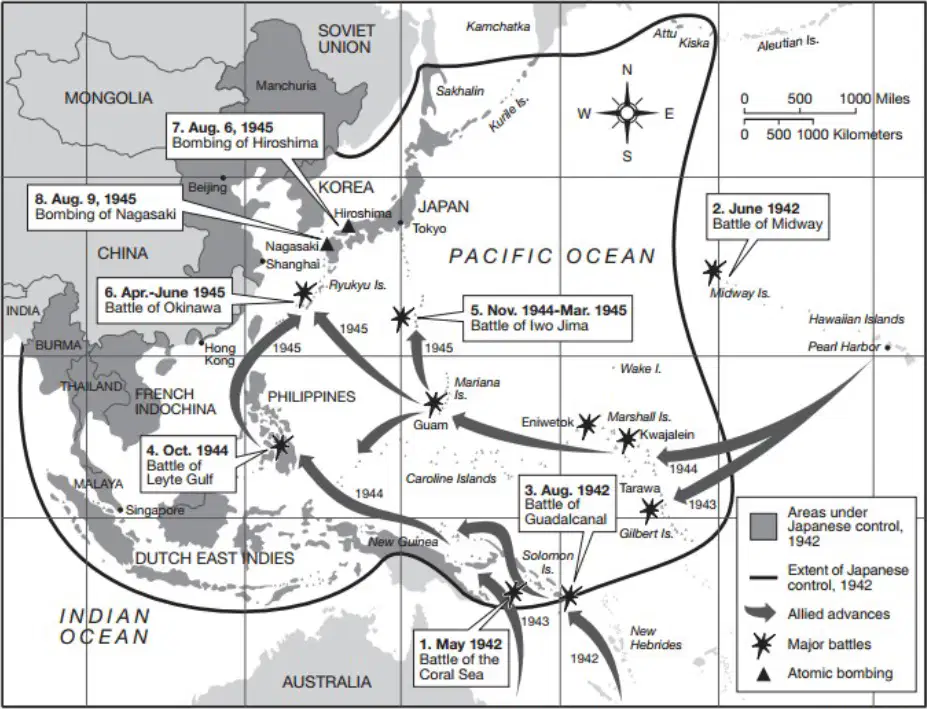
What does the map show regarding Allied forces?
Made slow but steady progress in defeating Japan.
Conducted most of the battles north of the Hawaiian Islands.
Had military support from the Soviet Union throughout the war.
Maintained control of the Philippines from the beginning of the war.
Which of the statements below concerning D-day is NOT accurate?
D-Day was the turning point of World War II for the Allies
The Axis Powers were successful in taking the French beaches at Normandy
Allied soldiers suffered heavy loses
It was the largest sea invasion in history
What strategy did the United States apply when attempting to end Japanese expansion in the Pacific Ocean?
Air raids on Japan
Intercepting of correspondences with Moscow
Island-Hoping
Island bombing
Which set of countries were all members of the Allied powers in World War II?
US, Great Britain & Soviet Union
Great Britain, US & Italy
Italy, Germany & China
US, France & Italy
Which set of countries were all members of the Axis Powers in World War II?
US, Great Britain & Soviet Union
Great Britain, US & Japan
Italy, Germany & Japan
US, France & Japan
What is the name of the group of African American pilots flew in segregated units and were the only unit not to lose a single member during WWII?
Garvey’s Gearheads
African American Acres
Tuskegee Airmen
Rough Riders

To which World War II leader is the conversation above referring?
Stalin
Roosevelt
Truman
Churchill

To what World War II practice is the conversation about referring?
Rationing
Buying War Bonds
Protesting the War
Victor Gardens
Why was Iwo Jima important to the US’s war effort?
Iwo Jima was the head quarter of the Japanese military
Iwo Jima was the secret military base shared by Hitler and Hirohito
Iwo Jima was the refueling station for the Japanese navy
Iwo Jima was close to Japan and a good place for US planes to land
Why did President Truman decide to use the atomic bomb on Japan?
Japan refused to surrender, and the US navy had lost too many ships in Pearl Harbor
Japan had plans to use an atomic bomb against the United States
Japan refused to surrender, and the US was worried too many US soldiers would die in an invasion
Japan plan to invade the US through New York City
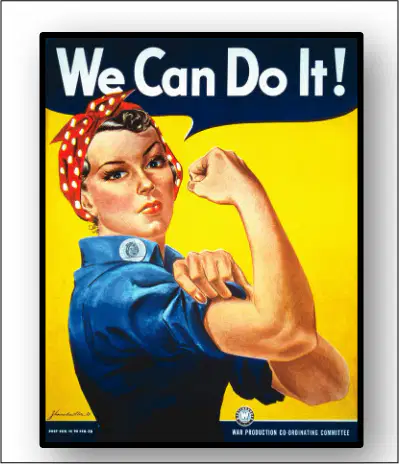
What is the nickname of the woman portrayed in the World War II poster?
Rosie The Wartime Girl
Rita the Warrior
Rosie The Riveter
Vivian Victory
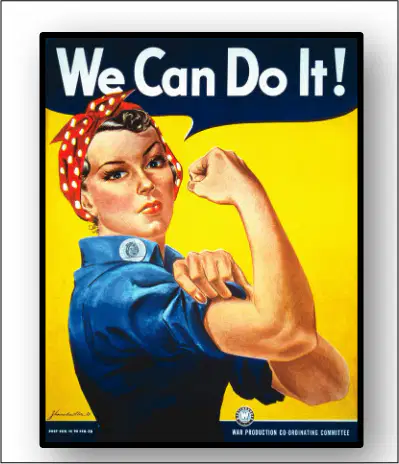
What does the woman in the poster symbolize?
Women’s desire to wear comfortable clothes
Women’s roles in factories during World War II
Women’s support of the rationing effort
Women’s commitment to living healthy lifestyles
What was the main objective of the Lend-Lease program?
To increase the US military presence in Europe
To sell outdated military equipment
To provide military aid to Allied powers
To provide military aid to Axis powers
Which event marked the official end of World War II in Europe?
The signing of the Treaty of Versailles
The fall of Berlin
V-E Day (Victory in Europe Day)
The bombing of Hiroshima
Which was a major cause of the rise dictators in Europe after WW1?
economic prosperity
Treaty of Versailles
redrawing of European borders
German win of WWI
At first many Americans were against the war and supported ________________________.
fascism
communism
isolationism
internationalism
What country was not part of the Allied powers during WW2?
France
Britain
United States
Japan

Look at the propaganda poster from the World War II era. What is the message in the advertisement?
The armed forces has fully incorporated women as soldiers
Women have no role in supporting the war effort
American women can help the army by saving and collecting items, such as food
Women are needed to work in factories to produce goods for WW2
Executive Order 9066 did which of the following?
It desegregated the armed forces
It authorized the evacuation of all Japanese-Americans to relocation camps
It placed a limit on the amount of terms a U.S. president could serve
It brought World War 2 to an end
What two cities did the U.S. drop the atomic bombs in Japan?
Tokyo & Fukushima
Hiroshima & Nagasaki
Taiwan & Beijing
Okinawa & Iwo Jima
Women and Minorities made economic gains during WWII because
there was a shortage of men that gave them jobs
more educational opportunities increased the number of skilled workers
labor unions successfully demanded equal opportunities for these groups
What was the goal of the War Production Board?
To convert factories to produce weapons
To curb inflation by limiting consumption
To prevent workers from going on strike

This form of government does not permit individual freedoms. It also gives complete control to the government.
Democracy
Communism
Fascism
Theocracy

What would be the best title for this chart?
Events During World War I
Totalitarian Regimes Between the Wars
Economic Problems Between the Wars
Causes of World War II
What did the Japanese hope to accomplish by bombing Pearl Harbor?
Take over Hawaii
Impress Hitler
Force FDR and America to surrender
To cripple the US Pacific fleet
Which statement accurately reflects the consequences of the Appeasement policy prior to World War II?
It directly led to the outbreak of World War II by emboldening aggressor nations
It successfully prevented the outbreak of a global conflict through diplomatic negotiations
It was a strategy primarily utilized by the United States to maintain its isolationism
It resulted in the immediate strengthening of the League of Nations' authority
What was the primary legal justification used by the Supreme Court in upholding the internment of Japanese Americans during World War II in Korematsu v. United States?
The internment was a necessary measure for national security.
The internment was justified as a means of preventing espionage.
The internment was based on the principle of military necessity.
The internment was deemed a reasonable action due to the state of war.
Which of the following statements about the American Home Front during World War II is TRUE?
Women were discouraged from working in factories and instead were told to focus on household duties
Rationing of food and materials was implemented to support the war effort
The government did not promote the purchase of war bonds during WWII
There was no significant change in the role of minorities and women in the workforce during the war
What was the primary goal of the Axis Powers during World War II?
To conquer capitalist countries
To expand their territories
To stop the spread of communism
To establish a new world order
What was the purpose of rationing in the United States during WWII?
To reduce the production of goods
To encourage overconsumption of products
To limit the amount of a certain product each person can get
To increase the availability of products for everyone
What was the main purpose of propaganda ads and posters in the United States during WWII?
To discourage people from supporting the war effort
To promote patriotism and self-sacrifice
To criticize the government's handling of the war
To discourage people from buying war bonds
Which of the following denied American citizens their fundamental liberties during WWII?
Chinese Exclusion Act
Hearing of the House Un-American Activities Committee
Executive order 9066/internment of Japanese Americans
Sacco and Vanzetti trial
Which country was not part of the Axis Powers during World War II?
Germany
Italy
Japan
Soviet Union
What was one major impact of World War II on the global economy?
Increased global trade and economic cooperation
Decreased industrial production worldwide
Isolation of major economies
Decline in technological advancements
Who was the Supreme Commander of the Allied Forces in Europe during World War II?
Winston Churchill
George Washington
Joseph Stalin
Dwight D. Eisenhower
Who transmitted code messages for the allies during WWII? (Text 300)
women
Navajo
African Americans
leader of the Nazi party and dictator of Germany around the time of World War II
Adolf Hitler
Joseph Stalin
Benito Mussolini
Hideki Tojo
agreement between Germany and the Soviet Union not to attack each other and a secret agreement to divide Poland between them
Appeasement
Atlantic Charter
Non-Aggression Pact
Cash-and-Carry
an agreement between FDR and Churchill about how a postwar world should look; became the basis for the United Nations
Good Neighbor Policy
Munich Agreement
Appeasement
Atlantic Charter
a government’s policy of not interfering with other countries
Non-intervention
Interventionism
Embargo
Blitzkrieg
lightning war; tactic used by Germans to quickly take territory
Holocaust
Dictatorship
Blitzkrieg
D-Day
the extermination of 6 million European Jewish people, as well as others deemed “undesirable” by the Nazis
Holocaust
Japanese Internment
Dictatorship
Axis Powers
Allied invasion of France; Normandy invasion
D-Day (Operation Overlord)
V-J Day
V-E Day
June Day
an agreement by France and England to give Hitler the German –speaking part of Czechoslovakia
Non-Aggression Pact
Munich Agreement
Atlantic Charter
Non-intervention
the United State’s agreement with Latin American nations not to interfere with their internal affairs or foreign relations with other countries
Good Neighbor Policy
Good Boy Policy
Isolationism
Dollar Diplomacy
a form of government that has only one leader and one political party; the leader has absolute power to rule the nation.
Dictatorship
Democracy
Cash-and-Carry
Churchill
The Communist dictator of the Soviet Union (USSR)
Adolf Hitler
Joseph Stalin
Benito Mussolini
Hideki Tojo
the act of giving into the demands of an aggressor to avoid war
Appeasement
Intervention
Non-intervention
Aggression
Italy, Germany, and Japan during WWII
Allied Powers
Axis Powers
United States, Great Britain, and the USSR during WWII
Allied Powers
Axis Powers
draft of young men in military service; first peacetime draft in U.S. history
Selective Training and Service Act of 1940
Neutrality Act of 1939
War Production Board
Manhatten Project
World War II government agency that coordinated the release of war information and encouraged recruitment for the war effort
CORE
Office of War Information
Cash-and-carry
Rationing
loans from CITIZENS to the GOVERNMENT to fund the war
Rationing
D-Day
War Bonds
Victory Gardens
conserving scarce resources for the war effort
Japanese Internment
Rationing
CORE
Island-hopping
the forced removal of Japanese from the West Coast to camps away from the coast
Concentration Camps
Holocaust
Japanese Internment
Rationing
U.S. commander in the Pacific
Winston Churchill
Benito Mussolini
Douglas MacArthur
Dwight Eisenhower
a secret project by U.S scientists to develop the atomic bomb
Harlem Project
Brooklyn Project
East Project
Manhatten Project
Yalta Conference, Allied leaders plan for Germany after WWII?
Germany’s unconditional surrender, divided into four post-war occupation zones, controlled by U.S., British, French and Soviet military forces
Gave self determination to the liberated peoples
iron curtain had fallen and the beginning of the Cold War
Japanese Internment Camps
What did the US decide after the attack on Pearl Harbor?
US declared war on Italy & entered WWII
US declared war on Russia & entered WWII
US declared war on Japan & Germany & entered WWII.
US declared war on the Hawaiian Kingdom & entered WWII

Hideki Tojo was the leader of what country?
Japan
Italy
France
Germany
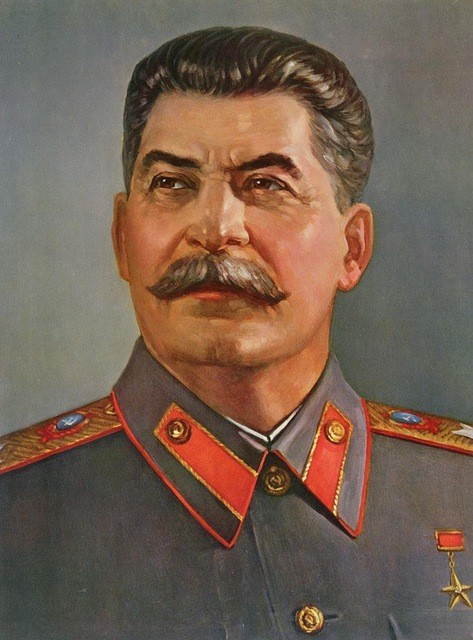
Josef Stalin was the leader of what country?
Japan
United States
Germany
USSR
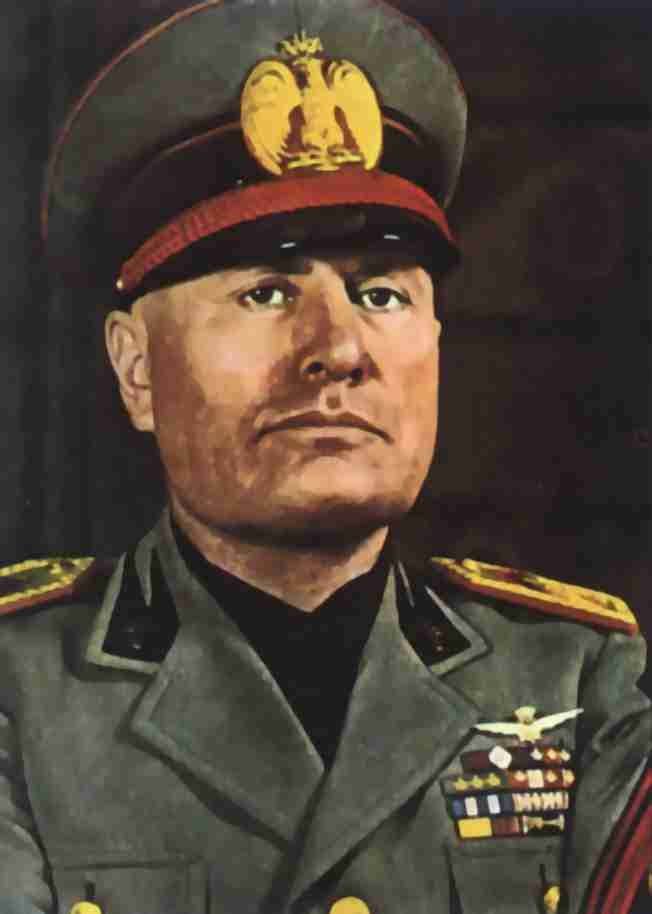
Benito Mussolini was the leader of what country during WWII?
United States
Italy
Japan
France
Tojo was general of the Imperial Army during WWII for what country?
Japan
Italy
France
Germany
Analyze the long-term effects of the Treaty of Versailles on Germany's political landscape leading up to World War II.
It had little to no effect on Germany's politics
It led to economic prosperity in Germany
It created political instability and contributed to the rise of extremism
It strengthened Germany's alliances with neighboring countries
Which of the following was a consequence of World War 2?
The establishment of the United Nations
The beginning of the Cold War
The division of Germany
All of the above
A major consequence of WWI was the disappearance of ...
The Ottoman Empire
France
Germany
Soviet Union


The deliberate destruction, in whole of an ethnic, racial, religious or national group is called
Holocaust
Genocide
Concentration Camp
Nuremberg Laws

The Nuremberg Laws
separated Jews from German society
said Jews couldn't marry non-Jews
said Jews couldn't own businesses
all of the above
"The Night of the Broken Glass", The name refers to the wave of violent anti-Jewish pogroms which took place on November 9 and 10, 1938.
Einsatzgruppen
Blitzkrieg
Kristallnacht
Reich-Stag

Why was this night known as "the night of the broken glass"
Someone broke a glass cup and forgot to clean it up
The nazi's were playing baseball and broke a window
The nazi's broke through synagogues, schools, and other jewish buildings, and broken glass was all over the streets
The jews threw glass at SS officers as a protest

What is a scapegoat?
the belief that a goat had special powers to ransom someone from their mistakes
a person who is blamed for the wrongdoings, mistakes, or faults of others
A person who fails to comply with the rules of society
the behavior of condoning someone who commits a crime

