
NEW
Font size
 Worksheets
Imperialism in Africa & American Imperialism Test
Total questions: 30
Worksheet time: 12mins

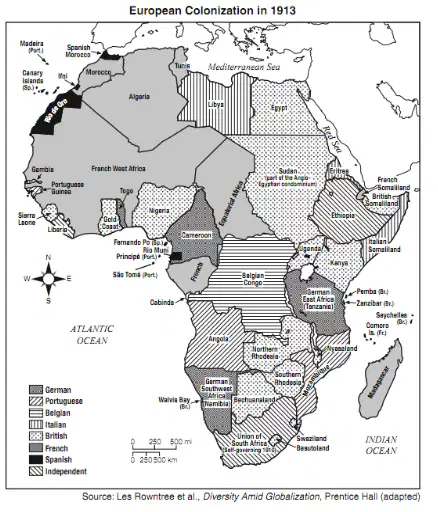
How did European borders drawn in Africa during the colonization period affect the continent?
They accurately reflected the cultural and ethnic divisions of the African peoples.
They led to economic prosperity and unity among African nations.
They caused conflicts and wars due to disregard for ethnic and cultural boundaries.
They had no significant impact on African societies.
What role did technological advancements in Europe play in the colonization of Africa?
They had little to no impact on colonization.
They were crucial for navigation and mapping of the African continent.
They enabled Europeans to establish superior educational systems in Africa.
They provided military superiority that was crucial for the conquest and control of African territories.
What was a common justification used by European powers for colonizing African territories?
Promoting global peace
The need for new technological advancements
The "civilizing mission" to spread Christianity and Western values
To establish democratic governments
What was the primary reason for European colonization in Africa during the 19th century?
To spread Christianity
To establish educational systems
To exploit natural resources and establish trade routes
To study African cultures
What was the "White Man's Burden" as it relates to imperialism?
The belief that Europeans had a moral obligation to civilize primitive cultures
The financial cost of maintaining colonies
The responsibility of white men to resist imperialism
The burden of developing new technologies for colonized lands
What did England sell to China?
Opium
Tea
Salt
Cotton
What role did technological advancements play in European imperialism?
They hindered European powers from expanding their empires
They were irrelevant to the process of colonization
They enabled European powers to easily conquer and control vast territories
They were primarily used to improve the lives of the colonized peoples
At what conference did the Europeans divide up Africa for their colonization?
Egypt Conference
London Conference
Belgium Conference
Berlin Conference
What was a primary motive for European colonization in Africa during the 19th century?
To promote democracy
To access natural resources and new markets
To establish educational institutions
To encourage cultural exchanges
What territories and acquisitions did the U.S. gain after the Spanish American War?
Hawaii, Maine, Guam, Panama
Guam; Guantanamo Bay, Cuba; The Philippines, and Puerto Rico
Panama, Puerto Rico, The Philippines, and Hawaii
Guantanamo Bay, Cuba; Puerto Rico, Panama
A type of media that focuses on sensationalism, shock value, and emotional language and appeals as a way to manipulate readers to a determined point of view?
Left-wing Media
Social Media
Yellow Journalism
Right-wing Media
Theodore Roosevelt's foreign policy that favored calm negotiation supported by a strong military is referred to as...
Big Stick Diplomacy
Naval Diplomacy
Dollar Diplomacy
Imperial Diplomacy
What condition did the U.S. impose on Panama for helping it gain independence from Columbia?
To become a U.S. territory and allow us to put naval bases there.
To allow the U.S. to harvest timber and other resources with no direct compensation.
To allow the U.S. to build, operate, and own the Panama Canal.
To aid us in the invasion of Costa Rica.

What is being built in this cartoon?
The Suez Canal
The American Canal
The Colombian Cana
The Panama Canal
Imperialism was brought on as a result of
Democratic Revolutions
World War I
Industrialization
The Renaissance

