
NEW
Font size
 Worksheets
DCP 3 Practice
Total questions: 23
Worksheet time: 20mins
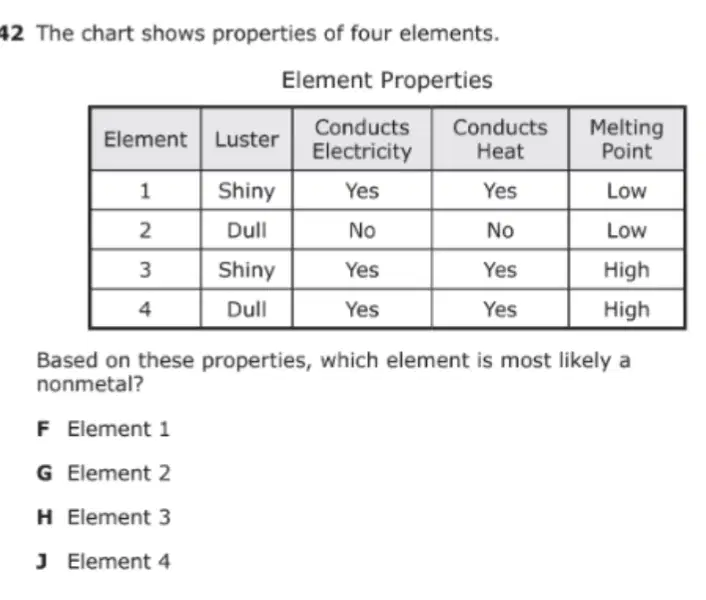
Based on these properties, which element is most likely a nonmetal?
Element 1
Element 2
Element 3
Element 4
Which statements correctly compare metals and nonmetals?
Metals tend to be good conductors of thermal energy. Nonmetals tend to be good insulators of thermal energy.
Metals are dull and brittle. Nonmetals are shiny and malleable.
Metals are good insulators of electricity. Nonmetals tend to be good conductors of electricity.
Metals cannot be stretched into thin wires. Nonmetals can be stretched into thin wires.
A student is trying to classify an unidentified, solid gray material as a metal or a nonmetal. Which question will best help the student classify the material?
Is the material malleable or ductile?
Does the material feel hard to the touch?
Will the material float in water?
Does the material feel rough or smooth?
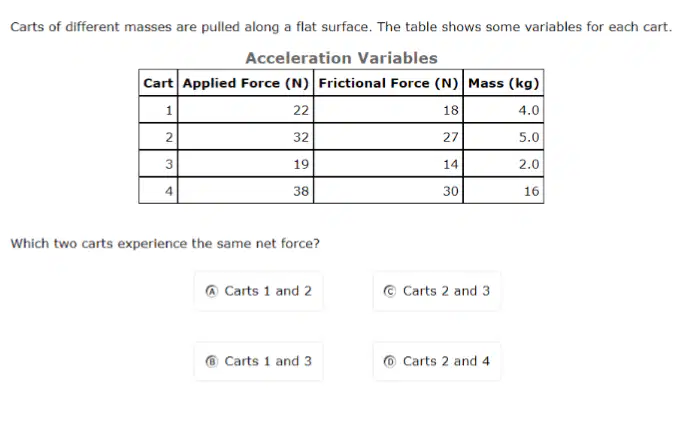
Which two carts experience the same net force?
A) Carts 1 and 2
B) Carts 2 and 3
C) Carts 1 and 3
D) Carts 2 and 4
A toy truck is at rest on the floor. Which statement describes the forces acting on the toy truck?
The forces are balanced so motion occurs.
The forces are balanced so no motion occurs.
The forces are unbalanced so motion occurs.
The forces are unbalanced so no motion occurs.
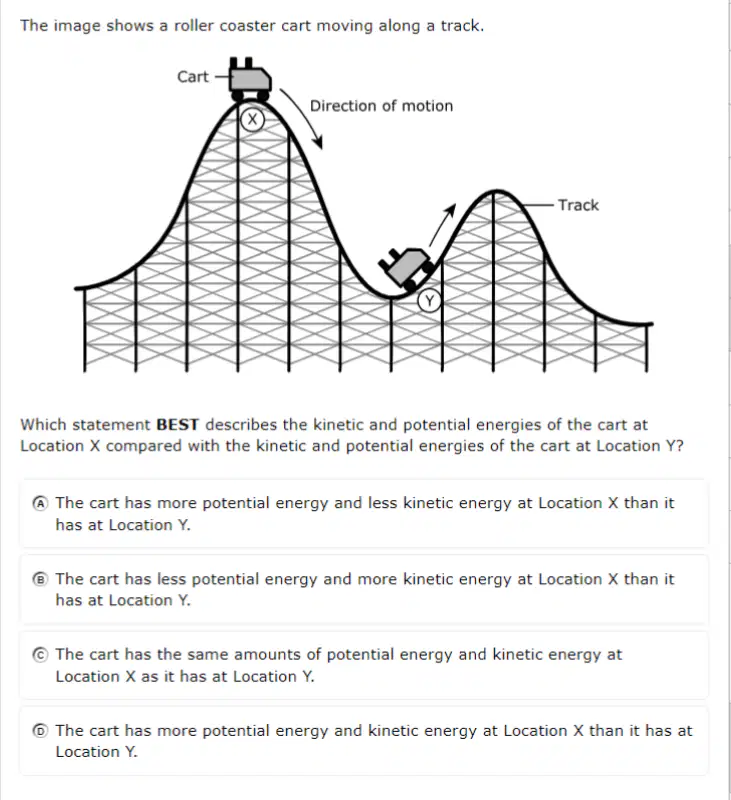
Which statement BEST describes the kinetic and potential energies of the cart at Location X compared with the kinetic and potential energies of the cart at Location Y?
The cart has more potential energy and less kinetic energy at Location X than it has at Location Y.
The cart has less potential energy and more kinetic energy at Location X than it has at Location Y.
The cart has the same amounts of potential energy and kinetic energy at Location X as it has at Location Y.
The cart has more potential energy and kinetic energy at Location X than it has at Location Y.
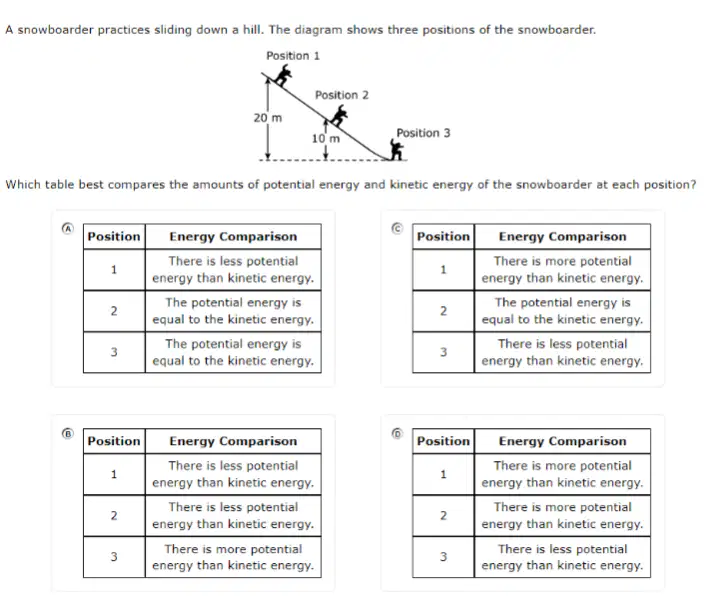
A snowboarder practices sliding down a hill. The diagram shows three positions of the snowboarder. Which table best compares the amounts of potential energy and kinetic energy of the snowboarder at each position?
Position 1: 1. There is less potential energy than kinetic energy. 2. The potential energy is equal to the kinetic energy. 3. The potential energy is more than the kinetic energy.
Position 2: 1. There is more potential energy than kinetic energy. 2. The potential energy is equal to the kinetic energy. 3. There is less potential energy than kinetic energy.
Position 3: 1. There is more potential energy than kinetic energy. 2. There is less potential energy than kinetic energy. 3. There is more potential energy than kinetic energy.
Position 4: 1. There is more potential energy than kinetic energy. 2. There is more potential energy than kinetic energy. 3. There is less potential energy than kinetic energy.
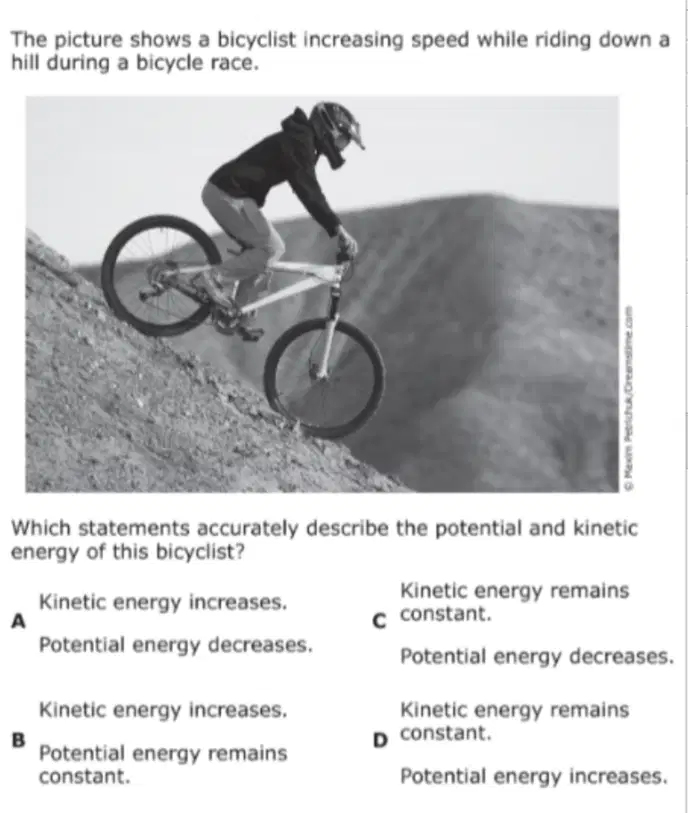
Which statements accurately describe the potential and kinetic energy of this bicyclist?
Kinetic energy increases. Potential energy decreases.
Kinetic energy increases. Potential energy remains constant.
Kinetic energy remains constant. Potential energy decreases.
Kinetic energy remains constant. Potential energy increases.
Which statement best describes the energy of the roller coaster as it slows down while traveling to the top of the coaster?
The cart gains both kinetic and potential energy.
The cart gains kinetic energy and loses potential energy.
The cart loses kinetic energy and gains potential energy.
The cart loses both kinetic and potential energy.
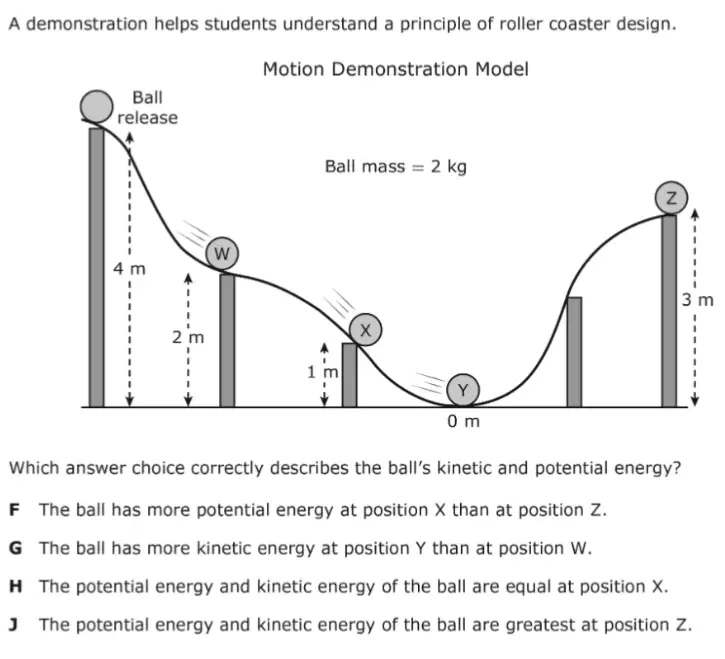
A demonstration helps students understand a principle of roller coaster design. Which answer choice correctly describes the ball’s kinetic and potential energy?
The ball has more potential energy at position X than at position Z.
The ball has more kinetic energy at position Y than at position W.
The potential energy and kinetic energy of the ball are equal at position X.
The potential energy and kinetic energy of the ball are greatest at position Z.
A group of students was conducting an investigation with plants. One group of plants was placed inside a closet. The other group of plants was placed next to a window. After two weeks, the plants next to the window were taller and healthier than the plants in the closet. Which statement BEST explains the difference in plant growth?
The plants next to the window were able to convert more light energy into chemical energy.
The plants next to the window were able to convert more thermal energy into light energy.
The plants next to the window were able to convert more thermal energy into mechanical energy.
The plants next to the window were able to convert more light energy into electrical energy.
Which action represents a conversion of chemical energy into mechanical energy?
Pancakes reheated in a microwave oven
Soup beginning to boil on a stove
A grasshopper jumping from a predator
Sunlight melting an icicle

Which statements correctly compare metals and nonmetals?
F
G
H
J

A student is trying to classify an unidentified, solid gray material as a metal or a nonmetal. Which question will best help the student classify the material?
F
G
H
J

The substances at the beginning of a chemical equation (to the left of the arrow) are called the ____
product
yield
chemical symbol
reactants


Is this an example of a physical or chemical change?
physical
chemical
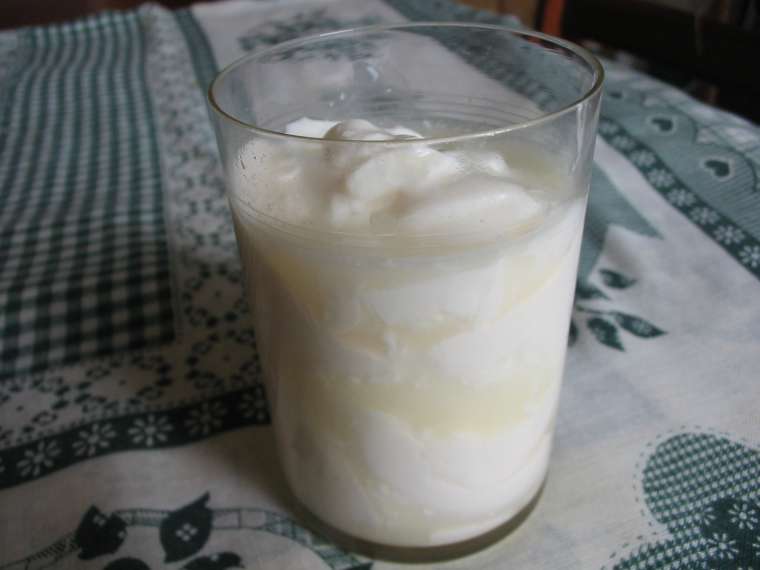
Is milk going sour a physical or chemical change?
Physical
Chemical



