
Font size
 Worksheets
Light and Sound
Total questions: 23
Worksheet time: 12mins
Which travels faster, light or sound?
Light
Sound
Fill in the blank: The speed of light is ______ km/s.
299,792 km/s
150,000 km/s
300,000 km/s
250,000 km/s
Shadows are formed when an object blocks the path of ____.
light
sound
water
air
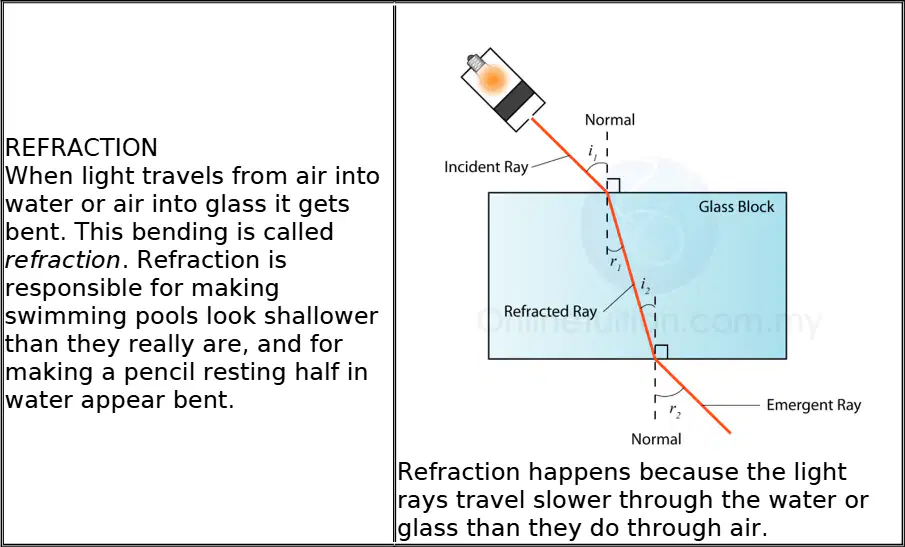
What is refraction?
The bending of light as it passes from one medium to another
The reflection of light off a surface
The scattering of light in different directions
The absorption of light by a material
Refraction is responsible for making swimming pools look ______ than they really are.
shallower
deeper
wider
narrower
When light bounces off a smooth surface, it is called:
Refraction
Diffusion
Reflection
Absorption
Absorption in terms of light is:
the process by which light is taken in by a material and not reflected or transmitted.
the bending of light as it passes through a medium.
the splitting of light into its component colors.
the reflection of light off a surface.
The process is called when light passes straight through something like a piece of transparent paper.
Reflection
Refraction
Diffusion
Transmission
The splitting of white light into a spectrum is called:
Diffraction
Reflection
Refraction
Dispersion
Optical fibers are used for ______ in communications.
transmitting data over long distances
decorative lighting
short-range wireless communication
power transmission
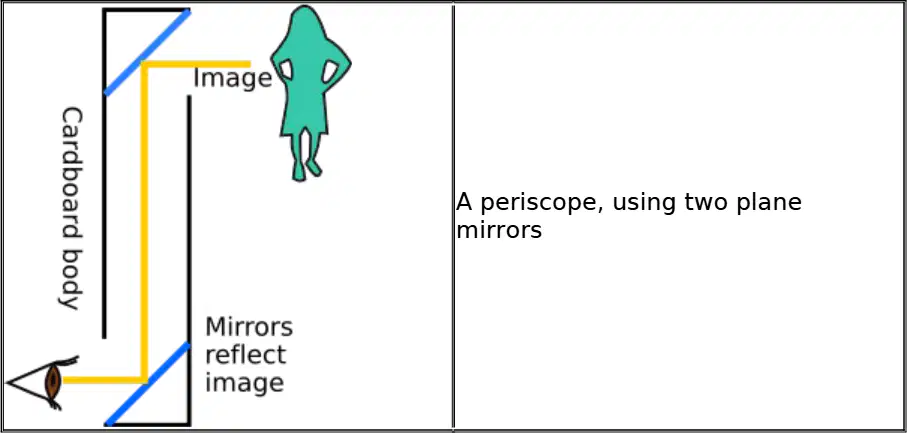
The purpose of using two plane mirrors in a periscope is to:
reflect light twice to change the direction of view
magnify the image seen through the periscope
reduce the size of the periscope
increase the field of view
A brick appears to be at a lower depth in water because of:
Refraction of light
Reflection of light
Diffraction of light
Absorption of light
To produce a sound, what must happen?
Vibration must occur
Light must be present
Temperature must change
Pressure must increase
The pitch of a note is determined by:
the amplitude of the sound wave
the frequency of the sound wave
the speed of the sound wave
the wavelength of the sound wave
The volume of the sound is determined by:
frequency
amplitude
wavelength
speed
Sound travels faster in solids and liquids than it does in air.
True
False
Sound will NOT travel through a vacuum.
True
False
Match the instrument with the part that vibrates:
Trumpet
Lips
Clarinet
Reed
Piano
Strings
Organ
Air
Guitar
Strings
An echo is:
a sound that is absorbed by surfaces
a sound that is reflected off a surface and heard again
a sound that is created by a musical instrument
a sound that is only heard once
What is its approximate frequency?
Ultrasound is too high for us to hear.
20 Hz
200 Hz
2000 Hz
Frequency is defined as the number of ______ per second.
vibrations
colors
meters
seconds
Pitch refers to how (a) a note sounds.
Amplitude is the ______ of a wave.
height
frequency
wavelength
speed

