
 Worksheets
RC 1 Review
Total questions: 45
Worksheet time: 32mins
6MgF2

Which photo shows the law of conservation of mass?
top
bottom
What is the part of the chemical equation in green called?
Fe + S → FeS
products
reactants
yield
input
What is the right part of a chemical equation called...
2H2 + O2 --> 2H2O
Reactants
Products
Yields
Output
4Ca(OH)2
Ex: 2H2 + O2 --> 2H2O

According to the law of conservation of mass, how much zinc was present in the zinc carbonate?
256 g
88 g
104 g
40 g
Which element is represented by the symbol Na in the periodic table?
Nitrogen
Sodium
Neon
Nickel
Which element is represented by the symbol K in the periodic table?
Krypton
Potassium
Phosphorus
Calcium

You notice bubbles and steam as water heats up and boils.
Physical change
Chemical change

An unusual odor is formed after combining two substances.
Physical change
Chemical change

Fizzy gas bubbles are produced as a powder is added to a clear liquid.
Physical change
Chemical change

Liquid nitrogen turns into a fog as heats up and becomes a gas.
Physical change
Chemical change
A physical change is
a change where the characteristics do not change the substance
a change where the characteristics do change the substance
a change where the chemistry changes
A chemical change is when
the chemical properties change
the chemical properties do not change
a change where the characteristics do not change the substance


Which of the following are examples of a Chemical Change?
Iron Rusting
Gas Burning
Breaking a glass
Boiling water
Burning Wood
What is a metal?
An element that is typically a gas or brittle solid
An element that is typically solid, shiny, malleable, and a good conductor of heat and electricity
An element that has properties of both metals and nonmetals
A pure substance composed of different types of atoms
Which of the following describes a nonmetal?
Shiny and malleable
Good conductor of heat and electricity
Typically not shiny, not malleable, and poor conductors of heat and electricity
Always a liquid at room temperature

A group of students were discussing their lab results after A group of students were discussing their lab results afterconducting an investigation on metals, nonmetals, metalloids, and rare earth elements. This is what they said:
Zane: “Rare earth elements are not metallic and used in many different technologies.”
Shae: “Carbon is an example of a nonmetal because it is dull and a poor conductor.”
Amy: “Nonmetals are malleable." Who was correct?
Zane
Shae
Amy

Two students tested the physical properties of an unknown element. The chart below lists their findings.Based on the chart, which of the following is true?
The students need to conduct additional investigations to determine more physical properties before the unknown element can be classified.
The students tested a metal because the physical properties describe metals.
The students tested a metalloid because the physical properties are of both a metal and nonmetal.
The students tested a nonmetal because the physical properties describe nonmetals
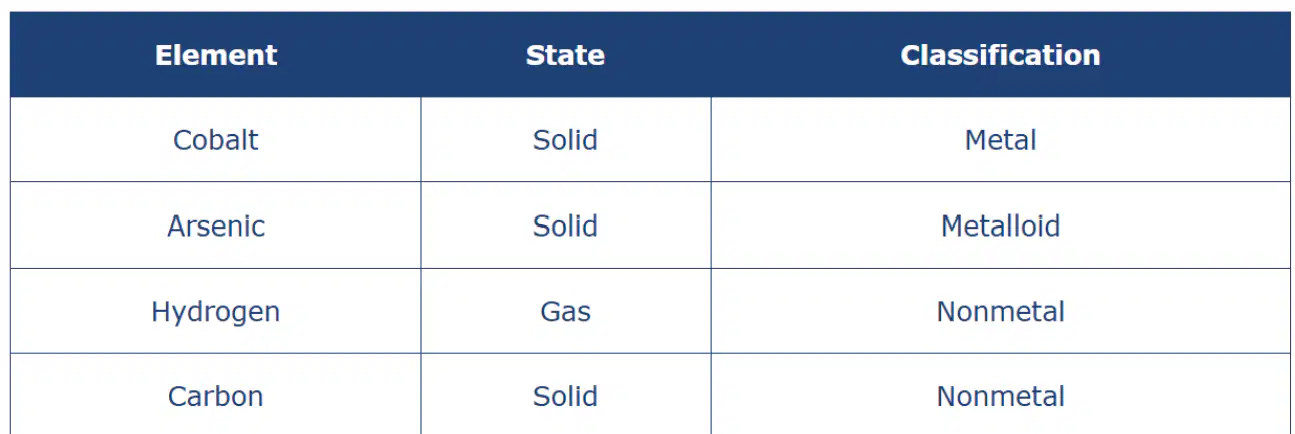
The table shows the classification and physical state of four elements. Which element most likely has a shiny luster?
Carbon
Hydrogen
Arsenic
Cobalt
Elements that have properties of both metals and nonmetals; sometimes referred to as semiconductors.
Metals
Nonmetals
Metalloids
Rare earth elements.
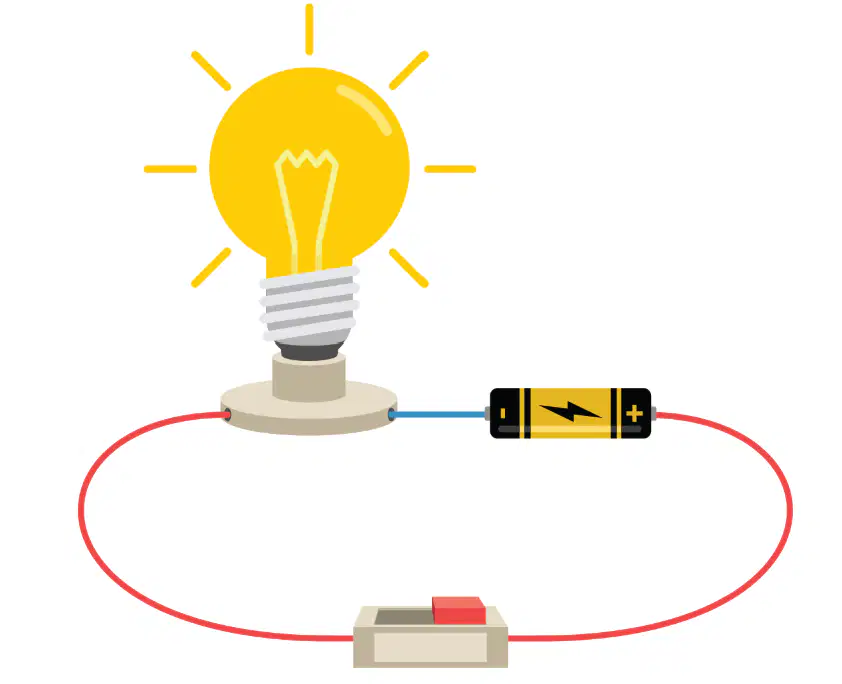
Elizabeth is making a circuit for class. She is trying to decide what type of material to use to make the wires so they can conduct electricity most efficiently. What type of material should the wires be made out of so that they best conduct electricity?
Ceramic
Metal
Nonmetal
Metalloid
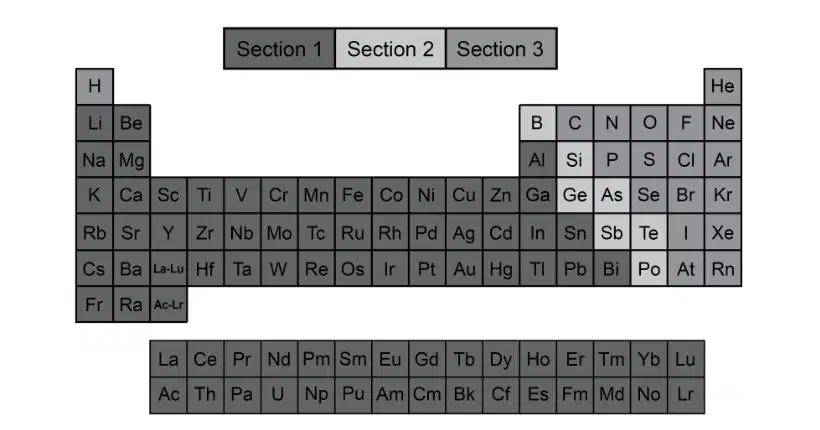
The Periodic Table can be broken into three different sections. In which section would you expect to find an element that is a gray, shiny, and malleable?
An element that is a gray, shiny, and malleable, is a metalloid; therefore, it can be found in Section 2.
An element that is a gray, shiny, and malleable, is a nonmetal; therefore, it can be found in Section 3.
An element that is a gray, shiny, and malleable, is a metal; therefore, it can be found in Section 1.
An element that is a gray, shiny, and malleable, is a rare earth element; therefore, it can be found in Section 2.
What is a rare earth element?
A. A type of rock found in the Earth's crust
B. One of 17 elements on the periodic table, including lanthanides, scandium, and yttrium
C. A common metal like copper or tin
D. A type of fossil fuel
Where are metals found on the periodic table?
Left
Right
Middle (on the zig zag)
This group of elements sit along the zig zag line on the periodic table and have properties of metals and nonmetals.
metals
nonmetals
metalloids
Oxygen
metal
nonmetal
metalloid
Where can you find nonmetals on the periodic table?
left
right
middle (on the zigzag)
Boron
metal
nonmetal
metalloid
Copper
metal
nonmetal
metalloid

