
Font size
 Worksheets
Honors Chapter 3-4 Test
Total questions: 80
Worksheet time: 1hrs 20mins
What is the hypothesis of the following statement?
If you drive an Explorer, then you drive a Ford.
Explorer
If you drive an Explorer
If
you drive an Explorer
you drive a Ford
What is the conclusion of the statement?
If you drive an Explorer, then you drive a Ford.
you drive a Ford
Ford
then you drive a Ford
then
you drive an Explorer
What is the CONVERSE of the statement given:
If the month is March, then it has 31 days.
If the month does not have 31 days, then it is not March.
If the month is not March, then it does not have 31 days.
If the month has 31 days, then it is March.
If the month is not March, then it has 31 days.
If the month has 31 days, then it is not March.
What is the INVERSE of the statement given:
If the month is March, then it has 31 days.
If the month does not have 31 days, then it is not March.
If the month is not March, then it does not have 31 days.
If the month has 31 days, then it is March.
If the month is not March, then it has 31 days.
If the month has 31 days, then it is not March.
What is the CONTRAPOSITIVE of the statement given:
If the month is March, then it has 31 days.
If the month does not have 31 days, then it is not March.
If the month is not March, then it does not have 31 days.
If the month has 31 days, then it is March.
If the month is not March, then it has 31 days.
If the month is March, then it does not have 31 days.
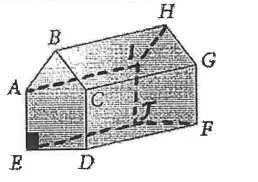
Select ALL of the segments that are SKEW to HG from the choices given.
AB
BC
AI
DF
HI
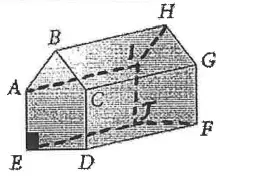
How many segments are parallel to DF?
1
2
3
4
5
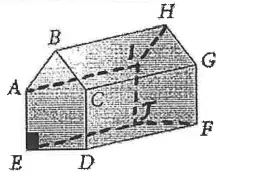
Select all segments that appears to be perpendicular to GC
AI
GF
CD
CB
ED
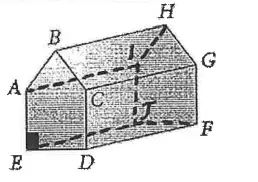
Which plane is parallel to plane HGF?
BCG
ABI
ABD
JED
CGF
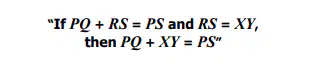
Which reason justifies the statement given?
Symmetric Property
Segment Addition Postulate
Substitution Property
Transitive Property
(Not substitution)
Simplify

Which reason justifies the statement given?
Definition of Congruence
Reflexive Property
Symmetric Property
Definition of Midpoint
Transitive Property

Which reason justifies the statement given?
Addition Property
Subtraction Property
Transitive Property
Segment Addition Postulate
Distributive Property
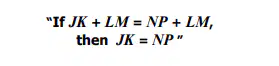
Which reason justifies the statement given?
Reflexive Property
Substitution Property
Addition Property
Subtraction Property
Simplify
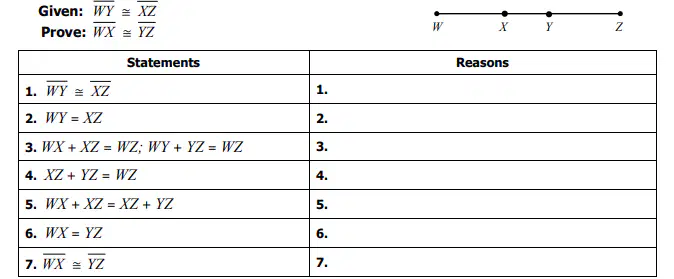
Click on the photo to enlarge if necessary. It might benefit you to copy the proof down, as the next 5 questions will be from the same proof.
What is the answer to step 2?
Subtraction Property
Definition of Congruence
Transitive Property (or Substitution)
Substitution Property (not Transitive)
Segment Addition Postulate
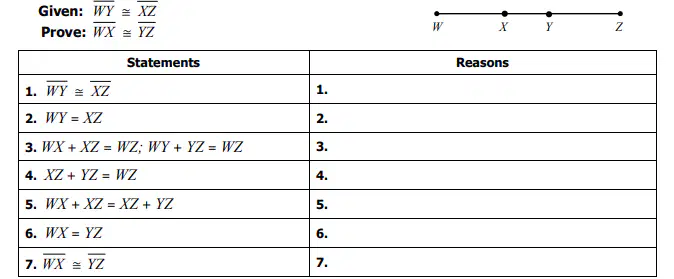
Click on the photo to enlarge if necessary.
What is the answer to step 3?
Subtraction Property
Definition of Congruence
Transitive Property (or Substitution)
Substitution Property (not Transitive)
Segment Addition Postulate
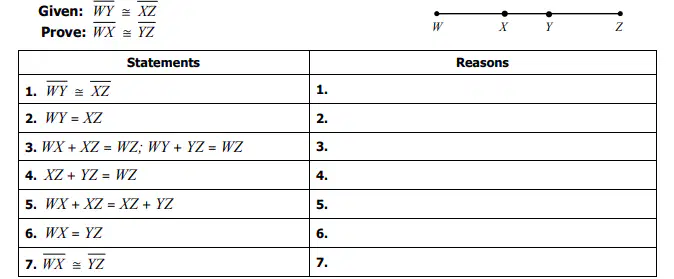
Click on the photo to enlarge if necessary.
What is the answer to step 4?
Subtraction Property
Definition of Congruence
Transitive Property (or Substitution)
Substitution Property (not Transitive)
Segment Addition Postulate
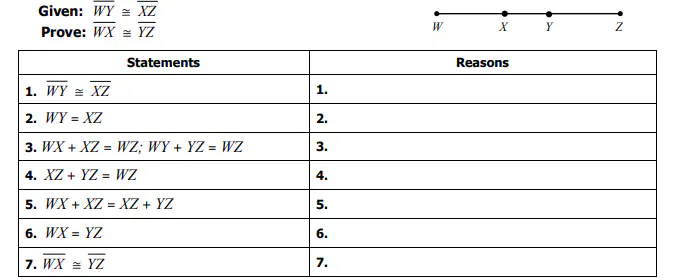
Click on the photo to enlarge if necessary.
What is the answer to step 5?
Subtraction Property
Definition of Congruence
Transitive Property (or Substitution)
Substitution Property (not Transitive)
Segment Addition Postulate
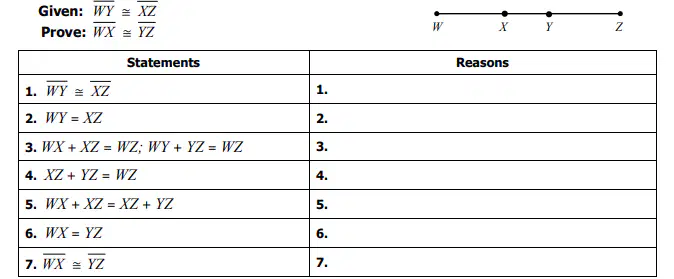
Click on the photo to enlarge if necessary.
What is the answer to step 6?
Subtraction Property
Definition of Congruence
Transitive Property (or Substitution)
Substitution Property (not Transitive)
Segment Addition Postulate
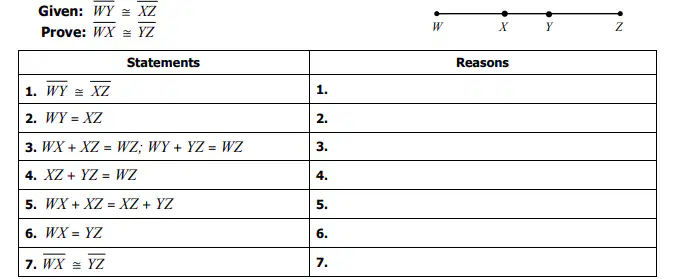
Click on the photo to enlarge if necessary.
What is the answer to step 7?
Subtraction Property
Definition of Congruence
Transitive Property (or Substitution)
Substitution Property (not Transitive)
Segment Addition Postulate
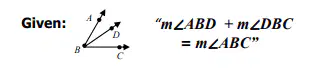
What reason justifies the statement given?
Angle Addition Postulate
Definition of Angle Bisector
Addition Property
Definition of Congruence
Segment Addition Postulate
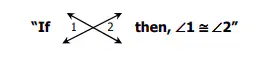
Which reason justifies the statement given?
Definition of Congruence
Angle Addition Postulate
Supplement Theorem
Vertical Angle Theorem
Linear Pair Postulate

Which reason justifies the statement given?
The Complement Theorem
Definition of a Right Angle
Congruent Complements Theorem
Definition of Complementary Angles
Angle Addition Postulate
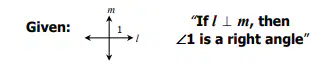
Which reason justifies the statement given?
Definition of Complementary Angles
Definition of a Right Angle
Definition of Perpendicular
The Complement Theorem
Linear Pair Postulate
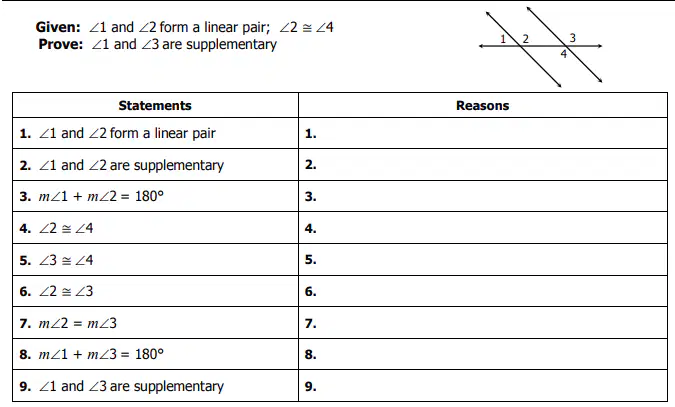
Click on the photo to enlarge if necessary. It might benefit you to copy the proof down, as the next 7 questions will be from the same proof.
What is the answer to step 2?
Definition of Supplementary
Vertical Angle Theorem
Definition of Midpoint
Definition of Congruence
Definition of LInear Pair
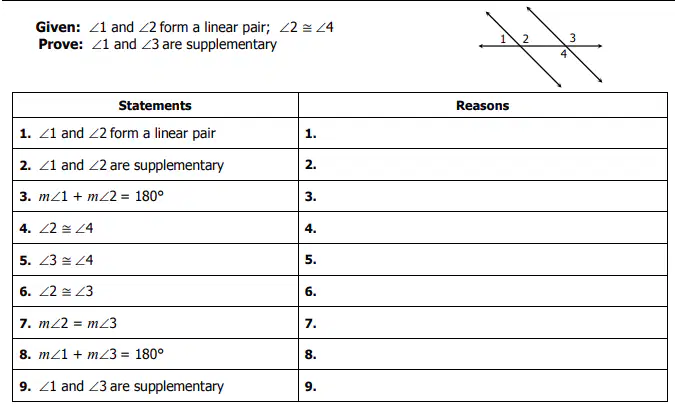
Click on the photo to enlarge if necessary.
What is the answer to step 3?
Definition of Supplementary
Vertical Angle Theorem
Definition of Linear Pair
Definition of Congruence
Simplify
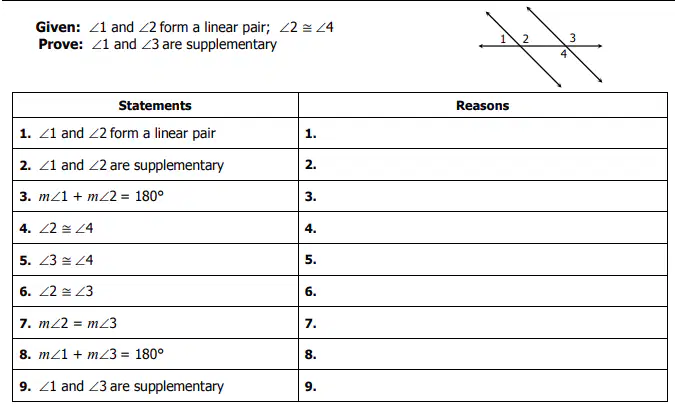
Click on the photo to enlarge if necessary.
What is the answer to step 4?
Given
Vertical Angle Theorem
Substitution
Definition of Congruence
Definition of Linear Pair
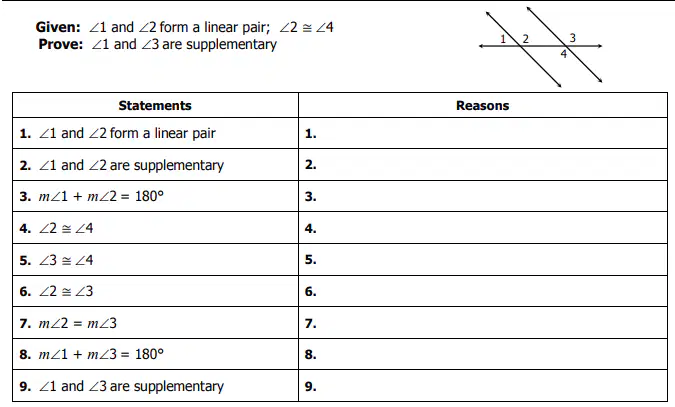
Click on the photo to enlarge if necessary.
What is the answer to step 5?
Given
Vertical Angle Theorem
Substitution
Definition of Congruence
Definition of Bisect
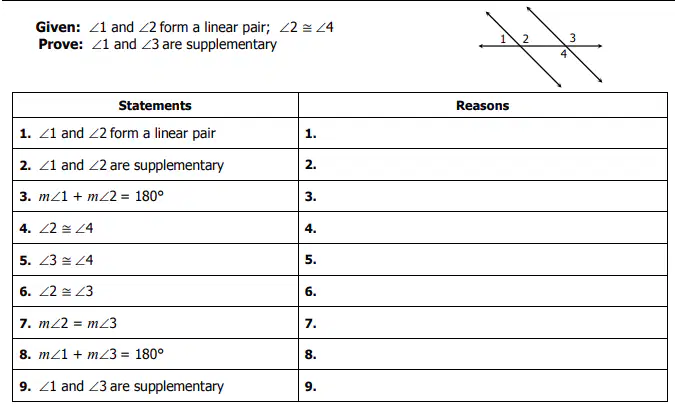
Click on the photo to enlarge if necessary.
What is the answer to step 6?
Substitution (not Transitive)
Vertical Angle Theorem
Transitive/Substitution
Definition of Congruence
Definition of Supplementary
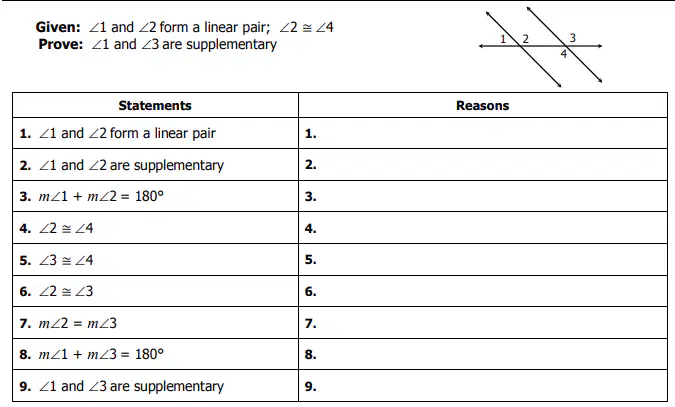
Click on the photo to enlarge if necessary.
What is the answer to step 7?
Substitution (not Transitive)
Vertical Angle Theorem
Transitive/Substitution
Definition of Congruence
Definition of Midpoint
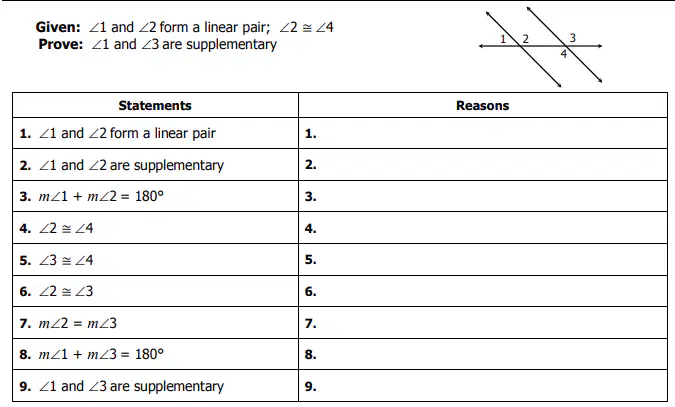
Click on the photo to enlarge if necessary.
What is the answer to step 8?
Substitution (not Transitive)
Vertical Angle Theorem
Transitive/Substitution
Definition of Congruence
Definition of LIneat Pair
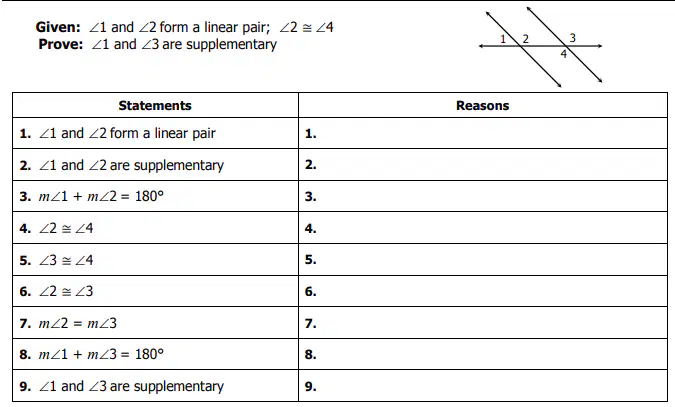
Click on the photo to enlarge if necessary.
What is the answer to step 9?
Definition of Supplementary
Vertical Angle Theorem
Definition of Linear Pair
Definition of Congruence
Substitution (no Transitive)
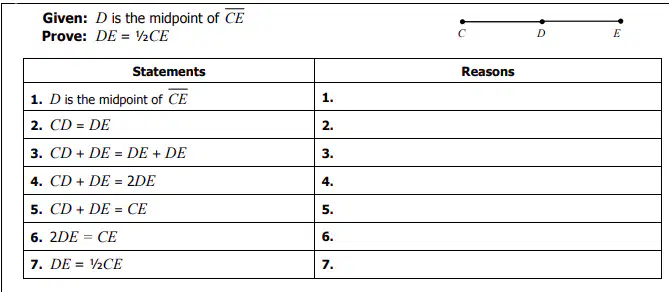
Click on the photo to enlarge if necessary. It might benefit you to copy the proof down, as the next 5 questions will be from the same proof.
What is the answer to step 2?
Addition Property
Simplify
Definition of Bisect
Definition of Midpoint
Given
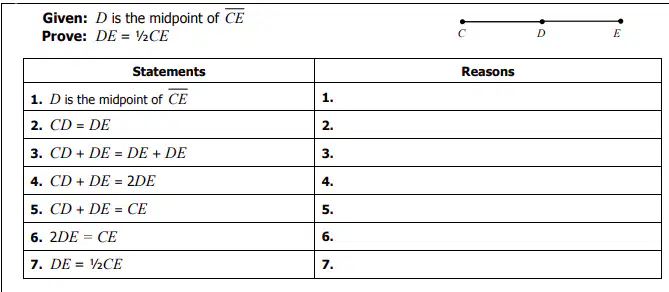
Click on the photo to enlarge if necessary.
What is the answer to step 3?
Addition Property
Simplify
Definition of Bisect
Definition of Midpoint
Segment Addition Postulate
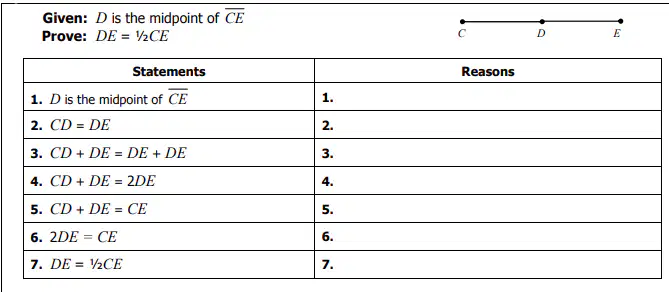
Click on the photo to enlarge if necessary.
What is the answer to step 4?
Division Property
Simplify
Segment Addition Postulate
Transitive/Substitution
Definition of Bisect
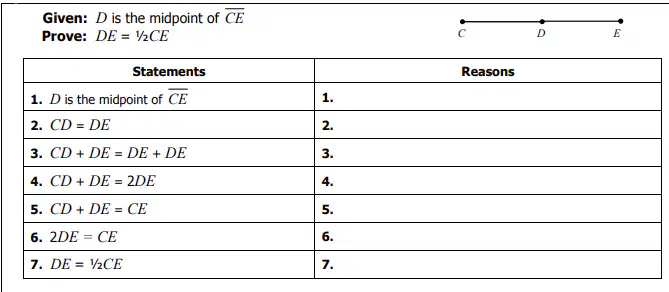
Click on the photo to enlarge if necessary.
What is the answer to step 5?
Division Property
Simplify
Segment Addition Postulate
Transitive/Substitution
Definition of Midpoint
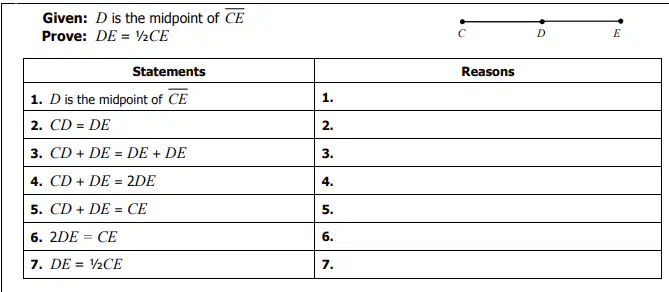
Click on the photo to enlarge if necessary.
What is the answer to step 6?
Division Property
Simplify
Segment Addition Postulate
Transitive/Substitution
Substitution (no Transitive)
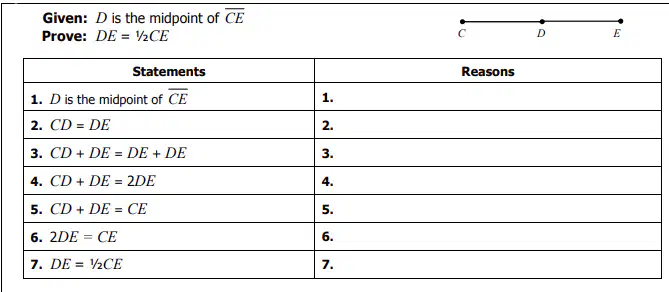
Click on the photo to enlarge if necessary.
What is the answer to step 7?
Addition Property
Simplify
Segment Addition Postulate
Transitive/Substitution
Division Property
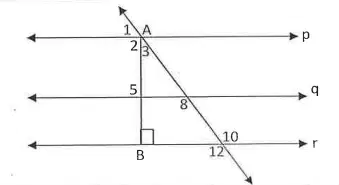
It might benefit you to draw the picture and
find all the angles to answer the next 6 questions.
p∥q, q∥r, AB ⊥ r, ∠1=50°.
What is the measure of angle 5?
50°
40°
90°
130°
140°
It might benefit you to draw the picture and
find all the angles to answer the next 6 questions.
p∥q, q∥r, AB ⊥ r, ∠1=50°.
What is the measure of angle 8?
50°
40°
90°
130°
140°
It might benefit you to draw the picture and
find all the angles to answer the next 6 questions.
p∥q, q∥r, AB ⊥ r, ∠1=50°.
What is the measure of angle 10?
50°
40°
90°
130°
140°
It might benefit you to draw the picture and
find all the angles to answer the next 6 questions.
p∥q, q∥r, AB ⊥ r, ∠1=50°.
What is the measure of angle 12?
50°
40°
90°
130°
140°
It might benefit you to draw the picture and
find all the angles to answer the next 6 questions.
p∥q, q∥r, AB ⊥ r, ∠1=50°.
What is the measure of angle 2?
50°
40°
90°
130°
140°
It might benefit you to draw the picture and
find all the angles to answer the next 6 questions.
p∥q, q∥r, AB ⊥ r, ∠1=50°.
What is the measure of angle 3?
50°
40°
90°
130°
140°
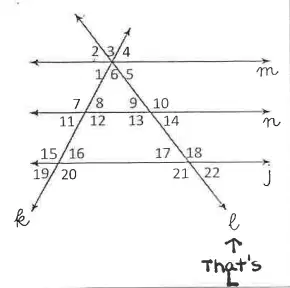
Refer to the figure. State the name of each angle pair.
∠19 and ∠4
Corresponding Angles
Alternate Interior Angles
Alternate Exterior Angles
Same Side Interior Angles
None
Refer to the figure. State the name of each angle pair.
∠13 and ∠10
Corresponding Angles
Vertical Angles
Alternate Interior Angles
Linear Pair
None
Refer to the figure. State the name of each angle pair.
∠16 and ∠8
Corresponding Angles
Alternate Interior Angles
Alternate Exterior Angles
Same Side Interior Angles
None
Refer to the figure. State the name of each angle pair.
∠12 and ∠13
Corresponding Angles
Alternate Interior Angles
Alternate Exterior Angles
Same Side Interior Angles
None
Refer to the figure. State the name of each angle pair.
∠16 and ∠10
Corresponding Angles
Alternate Interior Angles
Alternate Exterior Angles
Same Side Interior Angles
None
Refer to the figure. State the name of each angle pair.
∠17 and ∠5
Corresponding Angles
Alternate Interior Angles
Alternate Exterior Angles
Same Side Interior Angles
None
Refer to the figure. State the name of each angle pair.
∠7 and ∠8
Corresponding Angles
Vertical Angles
Alternate Interior Angles
Linear Pair
None
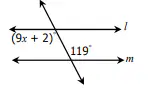
Solve the equation. The next question will ask you to write the theorem that describes the reason for finding x.
(a)
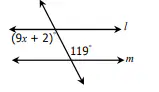
l and m are parallel
Which theorem describes why you are able to solve for x?
If lines \\, then CO angles are congruent
If lines \\, then AI angles are congruent
If lines \\, then AE angles are congruent
If lines \\, then SSI angles are congruent.
If lines \\, then AI angles are suppl.

Solve the equation. The next question will ask you to write the theorem that describes the reason for finding x.
x = 10, x = -16
x = 16
x = -10
x = 16, x = -10
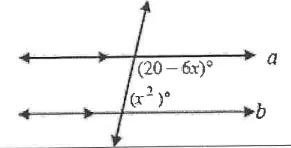
Which theorem describes why you are able to solve for x.
If lines \\, then AI angles are congruent
If lines \\, then SSE angles are supplementary
If lines \\, then SSI angles are supplementary
If lines \\, then SSI angles are congruent
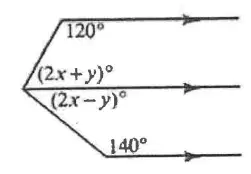
Solve the problem for x and y.
For this question, what is your x answer?
(don't erase your work! "y" answer is next)
(a)
Solve for x and y. For this question, tell your answer for y.
(a)
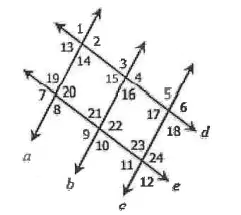
CONVERSE PROBLEM!
Determine which lines are parallel (if any) and decide if the converse statement is written correctly Only one is correct!
Given: ∠13 ≅ ∠17
a ∥ b ,
If AI ∠′s ≅, then lines ∥
a ∥ c ,
If CO ∠′s ≅, then lines ∥
a ∥ c ,
If AI ∠′s ≅, then lines ∥
No lines parallel
CONVERSE PROBLEM!
Determine which lines are parallel (if any) and decide if the converse statement is written correctly Only one is correct!
Given: ∠4 ≅ ∠9
d ∥ e ,
If AE ∠′s ≅, then lines ∥
d ∥ e ,
If CO ∠′s ≅, then lines ∥
d ∥ e ,
If AI ∠′s ≅, then lines ∥
No lines parallel
CONVERSE PROBLEM!
Determine which lines are parallel (if any) and decide if the converse statement is written correctly Only one is correct!
Given: m∠20 + m∠21 = 180°
a ∥ c ,
If SSI ∠′s SUPPL, then lines ∥
a ∥ b ,
If SSE ∠′s SUPPL, then lines ∥
a ∥ b ,
If SSI ∠′s SUPPL, then lines ∥
No lines parallel
CONVERSE PROBLEM!
Determine which lines are parallel (if any) and decide if the converse statement is written correctly Only one is correct!
Given: ∠8 ≅ ∠19
a ∥ d ,
If VAT ∠′s ≅, then lines ∥
a ∥ b ,
If VAT ∠′s ≅, then lines ∥
d ∥ e ,
If AI ∠′s ≅, then lines ∥
No lines parallel
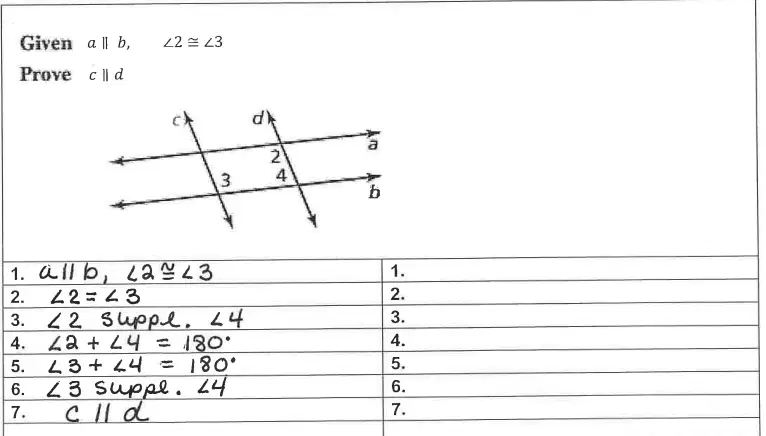
Label the given statements in the proof.
Definition of Congruence
If lines \\, then SSI angles are suppl
Answer for line 5
Substitution
Answer for line 6
Definition of Suppl
Answer for line 7
If SSI angles are suppl, then lines \\
m = 4
m = 3/4
What is the slope of a line perpendicular to -10/3
-10/3
10/3
3/10
-3/10
y = 3x – 7
y = 3x + 1


y=29x−4 and 2x+9y=18
y=−32x−1 and −3x+2y=6
y=−35x+14 and −5x+3y=−9
y=2x+5
6x + y = 2
These lines are...
y = -5x + 3 through (-5, -4)
y=−51x+5
y=−3x−51
y=51x−3
y=−51x−3
y=51x+3
Write an equation of a line that passes through the point (5, -1) and is parallel to the line y=−53x−3
y=−53x+2
y=−53x−2
y=53x+2
y=35x+2
y=35x+8
Write an equation that is parallel to y = 2x + 5 and passes through the point (2, -1)
y = 2x + 5
y = 5/2 + 5x
y = 2x - 5
y = 2x - 1
y = -1/2x - 1
Write an equation that is parallel to
3x + 3y = 12 and passes through the point (3, 4)
y = -x + 7
y = -3 - x
y = x + 1
y = -x + 3
y = x + 7
Write an equation that is perpendicular to 4x – 3y = 6 and passes through the point (8, -3)
y = -3/4x + 4
y = -2x + 13
y = -3/4x + 3
y = -2x - 3
y = -3/4x -3

