
 Worksheets
7th Grade Science Review
Total questions: 20
Worksheet time: 11mins
Which of these describes the process of how humans depend on the ocean through desalination?
Transportation and recreation - transporting goods by boat and ship and depending on the ocean for recreational activities
Food and products - humans using ocean organisms for food and other products
Air - organisms in the oceans produce oxygen
Drinking water - removing salt from ocean water to make fresh drinking water

Mesosaurus fossils have been found in Africa and South America. What does the distribution of Mesosaurus fossils suggest about the position of these continents 280 million years ago?
A. The mesosaurus could swim across vast oceans.
B. The continents were farther apart than they are today.
C. The continents were in the same position as they are today.
D. The continents were connected as part of a larger landmass.

The diagram shows fossils in rock layers across three cliff faces. Which of the following is true about the fossils found in these layers?
Trilobites are the youngest fossils.
Ammonites are younger than trilobites.
Gastropods are only found in the top layer.
Ferns are older than coral.
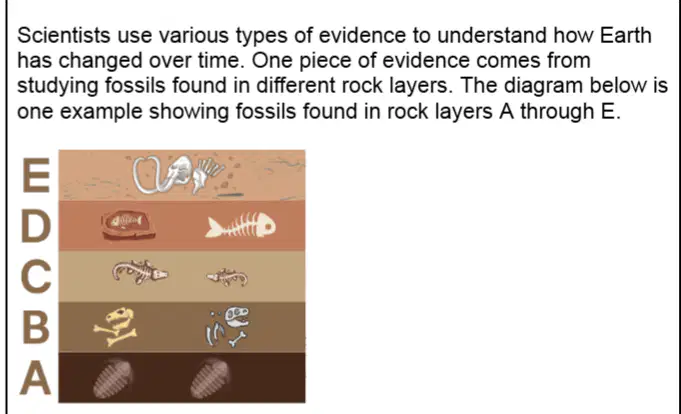
Which of these best describes the relative ages of the fossils found in these rock layers?
A. The fossils in Layer E are the oldest, and those in Layer A are the youngest.
B. All fossils are the same age regardless of their position in the layers.
C. The fossils in Layer A are the oldest, and those in Layer E are the youngest.
D. The age of fossils cannot be determined from their position in rock layers.
Which of the following best describes how fossil evidence supports the theory of continental drift?
A. Fossils are only found in metamorphic rocks.
B. Fossils of the same species are found on continents that are now separated by oceans.
C. Fossils show that plants have always been the same throughout Earth’s history.
D. Fossils indicate that all of Earth’s continents have always been in their current positions.
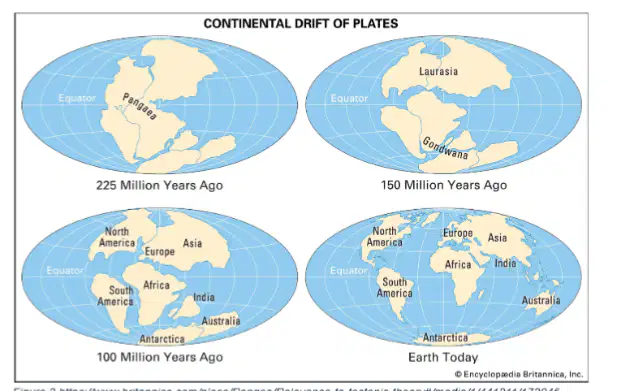
Based on the model, which of these describes how Pangaea changed over this time?
It gradually split into smaller landmasses.
It periodically merged and split repeatedly.
It slowly rotated around the Earth’s axis.
It steadily moved northward as one unit.

The diagram shows two of Earth's plates sliding past each other in opposite directions, producing earthquakes. Which type of plate boundary is indicated by this diagram?
A. Convergent
B. Divergent
C. Transform
D. Subduction

A model of plate movement is shown below. Which of these best describes the type of plate boundary shown and the result of this movement?
The boundary is a transform boundary showing ocean basin formation.
The boundary is a divergent boundary showing an earthquake.
The boundary is a transform boundary showing a mid-ocean ridge formation.
The boundary is a convergent boundary showing mountain formation.
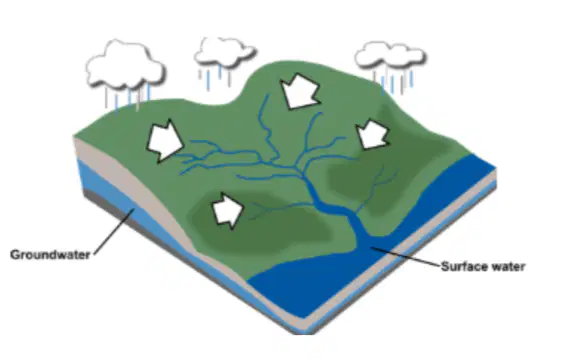
Which of the following best describes a watershed?
A body of water where groundwater collects before entering a stream
A small river that feeds into a larger river system
The area of land where all precipitation drains into a single body of water
A wetland area where surface water evaporates into the atmosphere
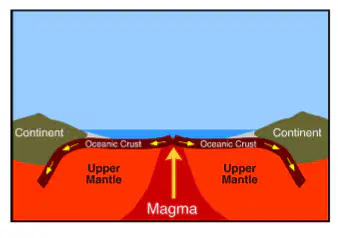
How does this type of boundary result in the formation of new ocean basins?
By sliding plates horizontally past each other
By creating new oceanic crust as plates move apart
By folding and uplifting existing crust to form mountains
By pushing old oceanic crust down into the mantle
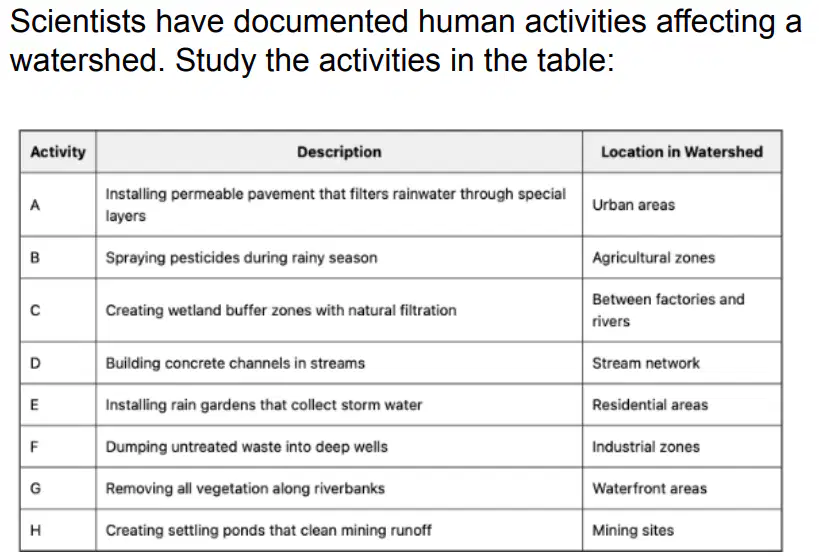
Which combination of activities should be categorized as beneficial to both groundwater and surface water?
B, D, and F
A, C, and E
G and H
A, C, E, and H
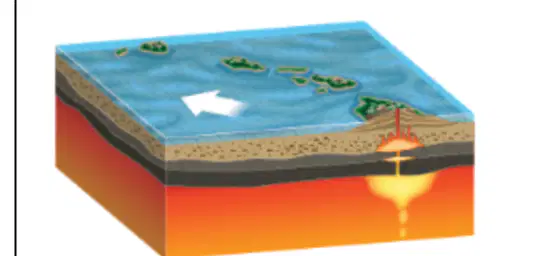
The diagram below shows the chain of Hawaiian islands. Which of the following best explains the formation of the Hawaiian Island chain?
A. A stationary hot spot beneath a moving oceanic plate
B. Diverging plates creating new oceanic crust
C. Collision of two continental plates
D. Subduction of an oceanic plate under a continental plate
Which of the following is a beneficial practice that urban developers can implement to help protect groundwater resources?
Reducing the use of permeable pavement in urban areas
Installing rainwater harvesting systems and promoting wastewater treatment and reuse
Increasing the amount of pesticides used for growing crops
Increase cloud cover to promote more precipitation from the atmosphere
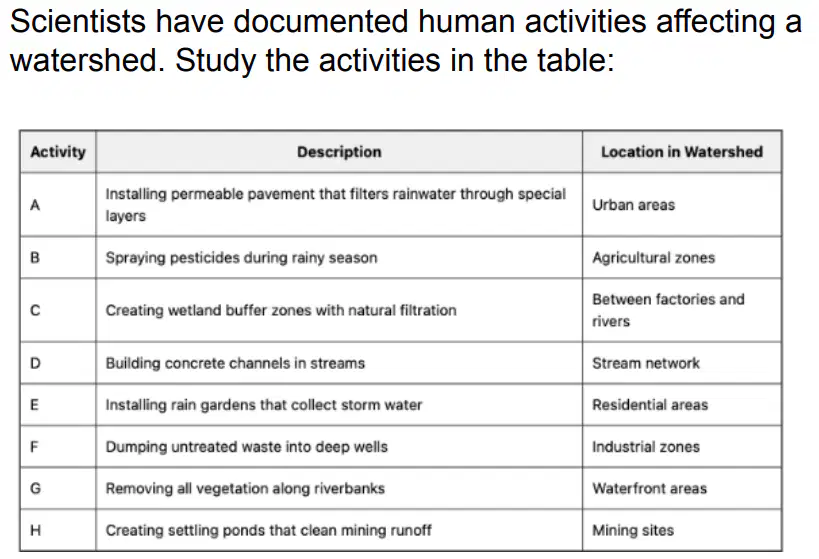
Which combination of activities would should be categorized as harmful to both groundwater and surface water?
B, D, F, and G
D and C
E and H
A, E, and H
A factory near a river discharges treated wastewater into the river, which is a primary water source for nearby communities. The factory also uses large amounts of water in its production processes. Which statement best explains how this factory's activities might impact the quality and availability of both surface water and groundwater?
The factory’s wastewater will have no impact on surface water, but the large water withdrawal will decrease groundwater recharge.
Both surface water and groundwater will be unaffected as long as the wastewater is treated before being discharged.
The discharge of treated wastewater will improve surface water quality by removing pollutants, but the factory will not affect groundwater availability.
The factory's water discharge could introduce chemicals and pollutants into the river, harming surface water quality, and excessive water use may reduce groundwater availability.
In areas where wetlands have been drained for agriculture, which solution can be most effective in restoring groundwater and surface water health in the watershed?
Expanding agricultural activities further to enhance food production
Increasing industrial activities to offset the economic losses from wetland drainage
Re-establishing wetlands to restore natural filtration processes and improve water quality
Limiting public access to affected areas and restricting water use
A group of scientists are concerned about an increase in plastic trash and debris on a local beach. Which of the following statements best describes the potential impacts of plastic pollution on ocean ecosystems? Choose TWO answers.
A. Plastic pollution increases the oxygen production of marine plants and algae.
B. Plastic debris can entangle marine animals, restricting their movement and ability to feed.
C. Large plastic items provide new habitats for coral reefs to grow and thrive.
D. Microplastics can be ingested by marine organisms, potentially entering the food chain.
E. Plastic waste is not a major concern since plastic degrades very quickly.
How does overfishing disrupt marine food webs?
By removing key species that balance the ecosystem
By reducing water temperature of the ecosystem
By increasing biodiversity in the ecosystem
By enhancing the growth of coral reefs
A city is planning on building a new wastewater treatment facility. Which of the following best describes how inadequately treated wastewater could impact the marine ecosystem, and what consequence might result?
It could increase oxygen levels, allowing marine organisms to thrive
It could raise ocean temperatures, increasing the growth rates of all marine organisms
It could introduce toxic chemicals, potentially causing harm to marine organisms
It could increase ocean salinity, leading to the growth of salt-tolerant marine organisms
A marine biologist observes changes in coral reef colors over several years. The biologist also notices an increase in average temperature in this area over this time period. Which of the following is the most likely cause of the observed changes in coral reef colors from human impact on the ocean ecosystem?
Overfishing of nearby sharks
Rising ocean temperatures linked to climate change
Increased ocean salinity due to freshwater diversion
Increased sedimentation from coastal development

