
 Worksheets
26104 power point 1 Quiz
Total questions: 40
Worksheet time: 25mins
What is one of the objectives of the session related to resistive circuits?
Calculate values in resistive circuits.
Identify voltage sources.
Measure current in capacitive circuits.
Analyze inductive reactance.
Which type of resistance identification is covered in the session objectives?
Identify resistances in series.
Identify resistances in capacitors.
Identify resistances in inductors.
Identify resistances in transformers.
What is one of the tasks you will be able to do after completing the module?
Simplify series-parallel circuits.
Design complex circuits.
Measure electromagnetic fields.
Analyze digital signals.
What is a characteristic of a series circuit?
It contains multiple paths for current flow.
It contains only one path for current flow.
The current varies at each point in the circuit.
It has no resistors.
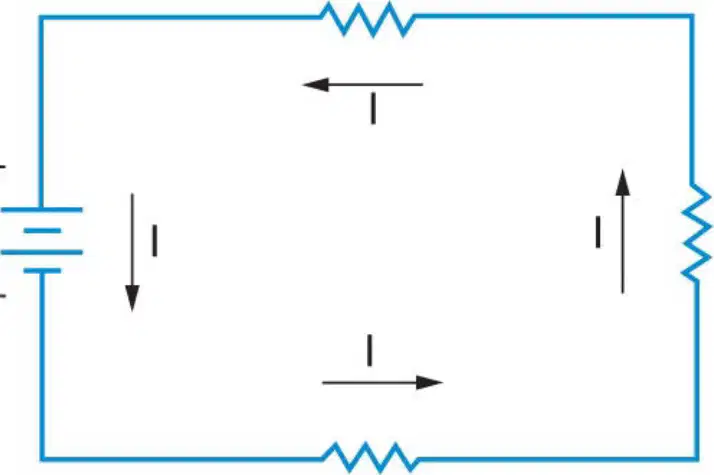
In a series circuit, how does the current behave at different points in the circuit?
The current is different at each point.
The current is zero at each point.
The current is equal at each point.
The current is maximum at the start.
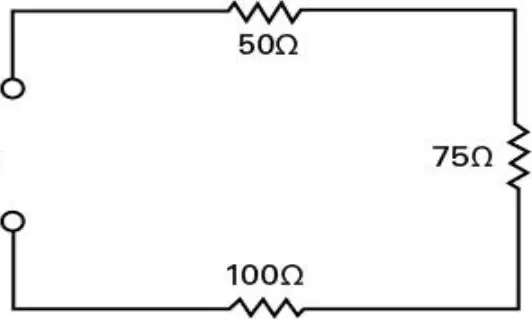
What is the total resistance in a series circuit with resistances of 50Ω, 75Ω, and 100Ω?
225Ω
150Ω
200Ω
250Ω
In a series circuit, how is the total resistance calculated?
By adding the individual resistances
By multiplying the individual resistances
By subtracting the smallest resistance from the largest
By dividing the total voltage by the total current
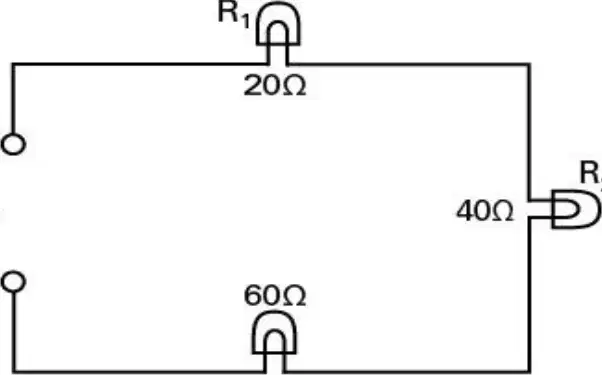
What is the total resistance in a series circuit with resistors of 20Ω, 40Ω, and 60Ω?
120Ω
100Ω
140Ω
80Ω
In a series circuit, how is the total resistance calculated?
By adding the individual resistances
By multiplying the individual resistances
By subtracting the smallest resistance from the largest
By dividing the total voltage by the total current
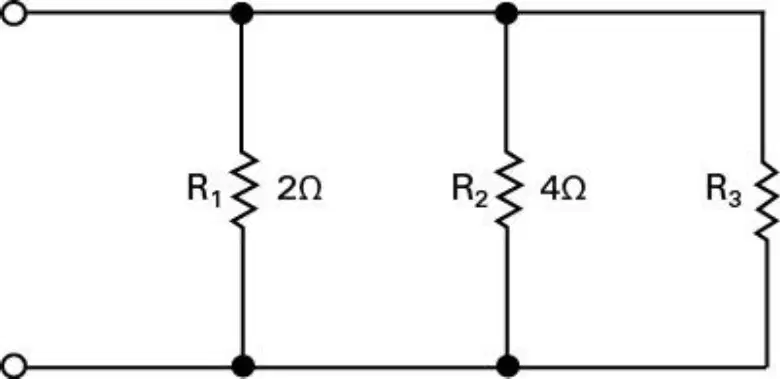
What is the total resistance $ R_T $ for resistors $ R_1 = 2\Omega $, $ R_2 = 4\Omega $, and $ R_3 = 8\Omega $ connected in parallel?
$ 1\Omega $
$ 2\Omega $
$ 4\Omega $
$ 8\Omega $
How is the total resistance calculated in a parallel circuit?
By adding the resistances directly
By multiplying the resistances
By dividing the sum of the inverse values of the individual resistances by one
By subtracting the smallest resistance from the largest
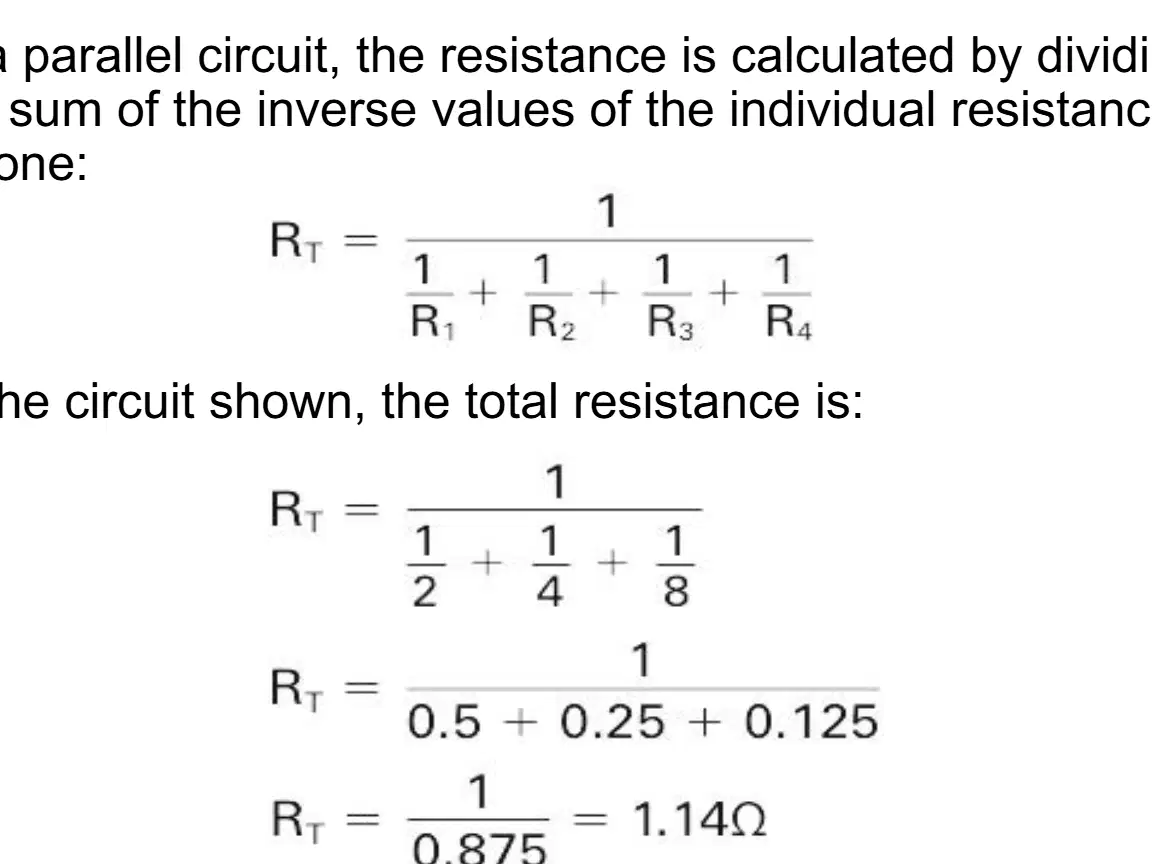
What is the total resistance in the given circuit with resistances of 2Ω, 4Ω, and 8Ω?
1.14Ω
2.5Ω
3.0Ω
4.5Ω
What is the total resistance of two 200Ω resistors in parallel?
100Ω
200Ω
400Ω
50Ω
If two 100Ω resistors are in parallel, what is their equivalent resistance?
50Ω
100Ω
200Ω
25Ω
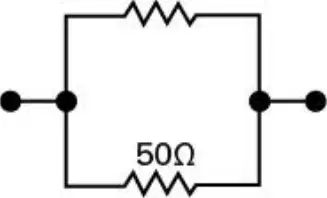
What is the equivalent resistance of two 50Ω resistors in parallel?
25Ω
50Ω
100Ω
75Ω
How is the total resistance of equal resistors in parallel calculated?
By adding the resistance of each resistor
By multiplying the resistance of each resistor
By dividing the resistance of each resistor by the number of resistors
By subtracting the resistance of each resistor
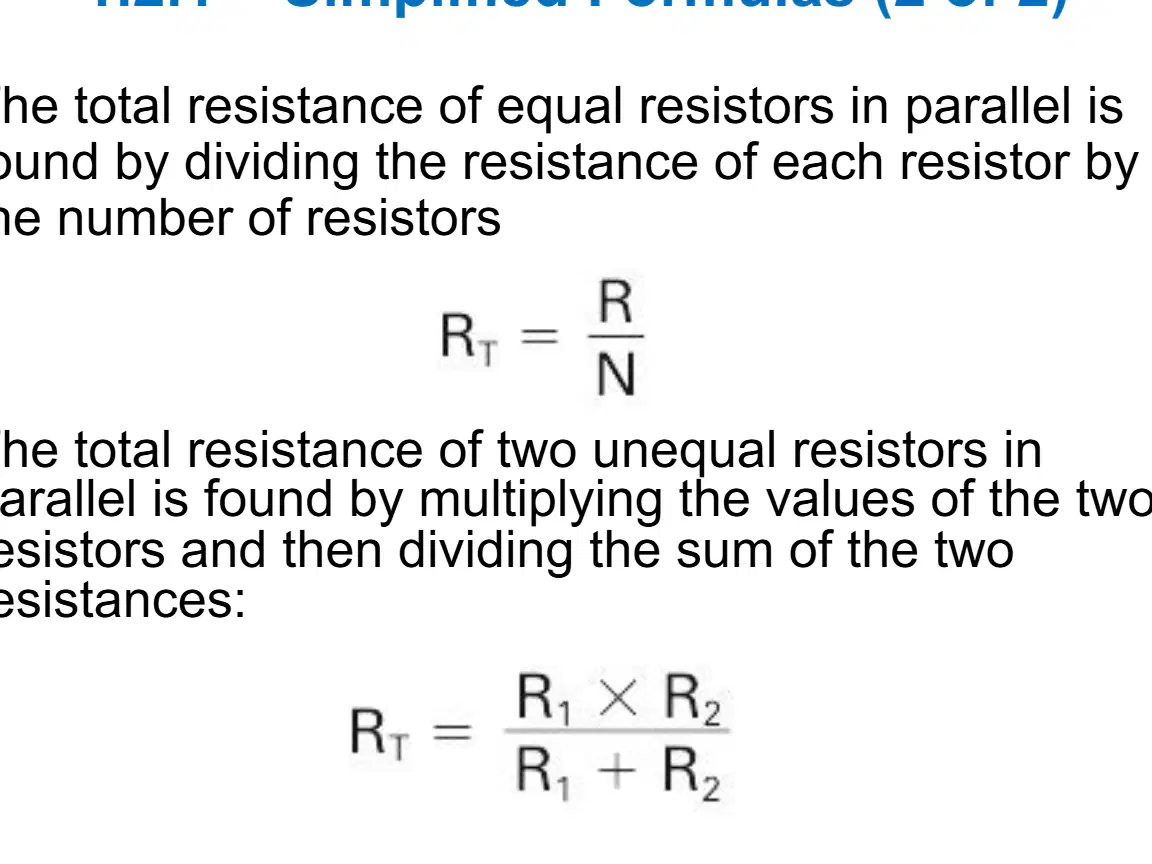
What is the formula for the total resistance of two unequal resistors in parallel?
R_T = R_1 + R_2
RT=R1+R2R1×R2
RT=R1×R2R1+R2
R_T = R_1 \times R_2
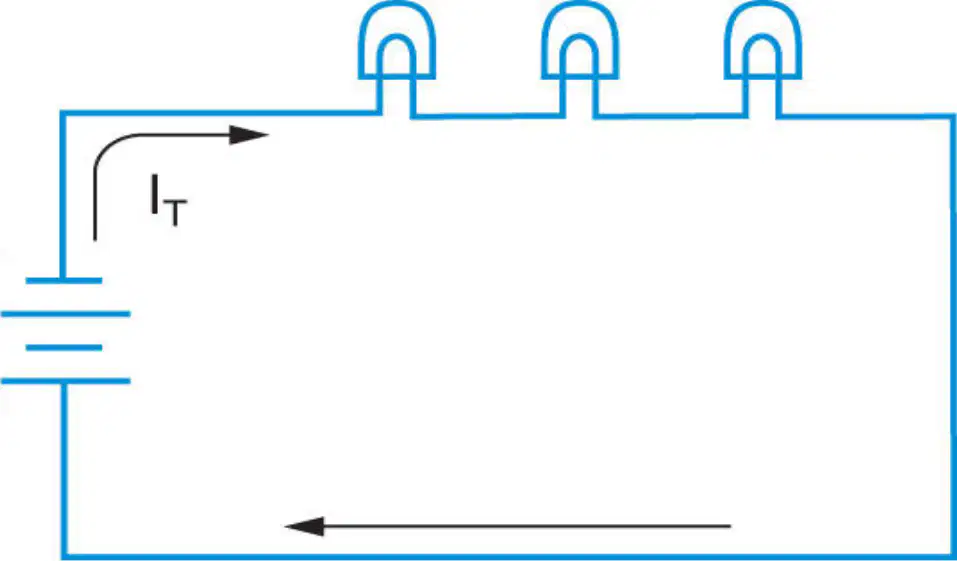
What is a series circuit?
A circuit that divides into multiple branches.
A circuit that does not divide into branches.
A circuit with only one component.
A circuit with multiple power sources.
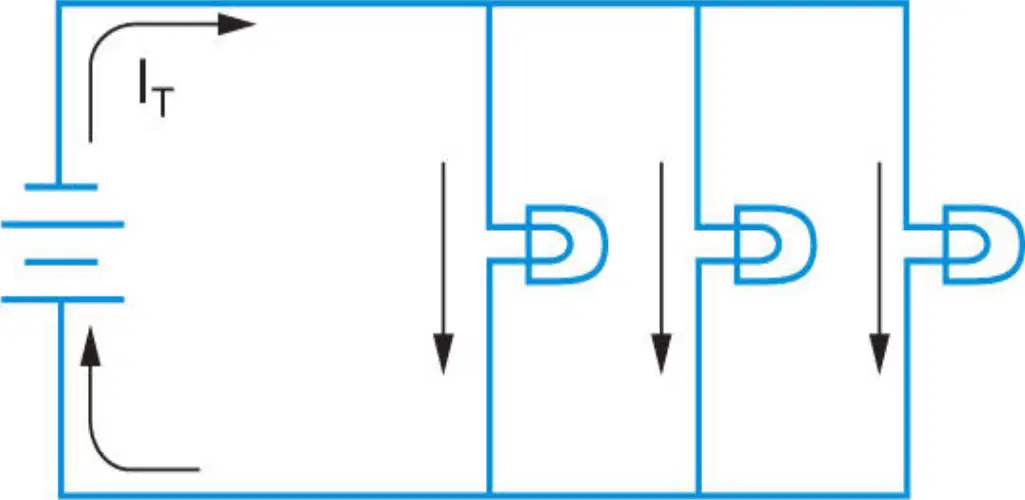
What type of circuit is formed when a circuit divides into separate branches?
Series circuit
Parallel circuit
Series-parallel circuit
Closed circuit
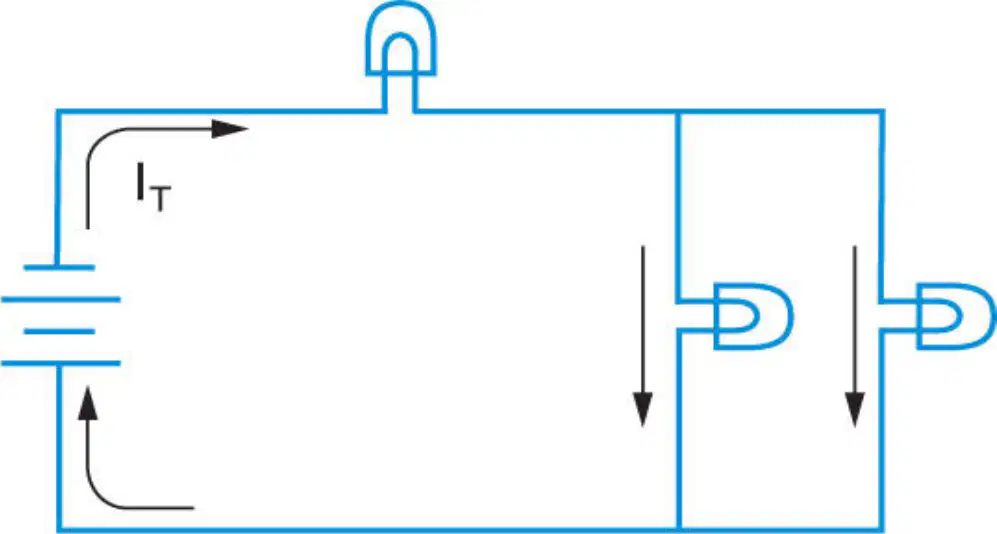
What is a series-parallel circuit?
A circuit with only series loads
A circuit with only parallel branches
A circuit that divides into separate branches and has series loads
A circuit with no branches or loads
What is the purpose of redrawing a series-parallel circuit?
To separate the series and parallel components.
To increase the voltage.
To decrease the current.
To add more resistors.
What is the first step in calculating the total resistance in a series-parallel circuit?
Calculate the effective resistance of the parallel component.
Add the resistance of the series loads.
Measure the total current.
Determine the voltage across the circuit.
After calculating the effective resistance of the parallel component, what should be done next to find the total resistance in a series-parallel circuit?
Add it to the resistance of the series loads.
Subtract it from the total voltage.
Multiply it by the total current.
Divide it by the number of resistors.
What is a characteristic of parallel circuits?
They have only one path for current flow.
They contain both series and parallel paths.
They contain two or more parallel paths for current flow.
They do not allow current to flow.
Which type of circuit has only one path for current flow?
Parallel circuit
Series circuit
Series-parallel circuit
Open circuit
What do series-parallel circuits contain?
Only series paths
Only parallel paths
Both series and parallel paths
No paths for current flow
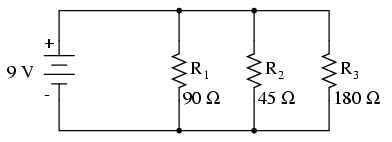
The total resistance of this circuit is (a)
If three resistors in a series circuit have values of 4Ω , 6Ω , and 10Ω , and the current flowing through the circuit is 2A , what is the total voltage across the circuit?
(a)
20V
40V
10V
30V
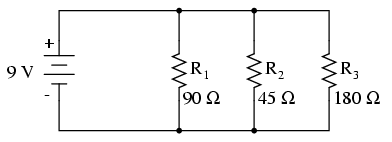
The total resistance of this circuit is (a)
Match the following scenarios with the type of circuit they represent.
Series
Connecting resistors end-to-end in a single path.
Parallel
Connecting resistors across the same two points of a battery.
Open
A circuit with a break preventing current flow.
Dihexihedral
A fictional or non-standard type of circuit.

Aarav is setting up a string of holiday lights. If one bulb goes out and all the others also go out, the circuit is a (a) circuit.


The resistance of the light bulb is 15 ohms. If the battery was replaced by one with double the voltage (with no other replacements), then the light bulb resistance must _____.
Increase to 30 ohms
Not change
Decrease to 7.5 ohms
No way to tell
A circuit has a 24V battery and the resistor is 8Ω. How many amps are running through the circuit?
3A
192A
2A
4A
The amount of current in a circuit depends on the
voltage across the circuit.
electrical resistance of the circuit.
Both of these.
None of these.
If you apply heat to a copper wire, the resistance of the wire
decreases
remains unchanged
increases
vanishes if you apply enough heat
In a series circuit, if one resistor is removed, what happens to the total resistance?
It increases.
It decreases.
It remains the same.
It becomes zero.

